AMD's Rise: Challenging Nvidia's Dominance in AI Accelerators
AMD's Flagship AI Chip
AI Market by 2030
AI Chip Supplier
The AI Chip Battle Heats Up
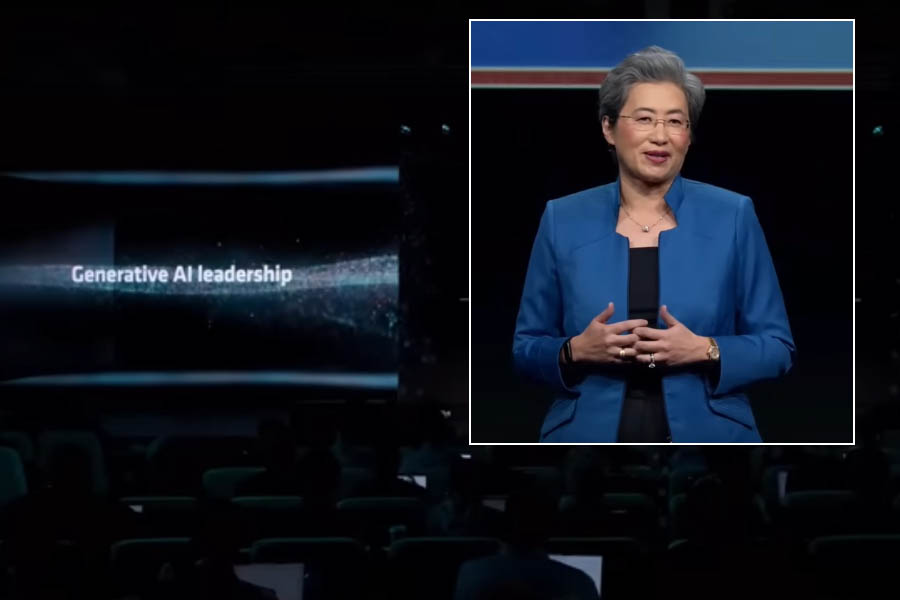
In the fast-paced realm of tech, where silicon dreams become reality, a new player has emerged from the shadows to challenge the reigning champion. Lisa Su, the visionary CEO behind Advanced Micro Devices (AMD), has thrown down the gauntlet, boasting of her company's latest creation, the MI300 chip. With mind-boggling specs and promises of unrivaled performance, AMD is gearing up for an epic showdown against Nvidia, the undisputed heavyweight of AI chipmaking.
💪 A Chip Above the Rest: MI300 Specifications
Ms. Su's confidence is palpable as she flaunts the MI300's impressive credentials:
- 153 billion transistors - surpassing Nvidia's H100
- 192 gigabytes of memory - massive capacity for large AI models
- 5.3 terabytes per second memory bandwidth - lightning-fast data transfer
- Designed specifically for AI training and inference workloads
- 3D stacking technology for improved performance
These numbers, she proudly declares, outshine Nvidia's top-of-the-line H100 chip by a significant margin. And the experts agree – AMD's MI300 is the real deal.
📊 AMD MI300 vs Nvidia H100: Spec Comparison
| Specification | AMD MI300 | Nvidia H100 |
|---|---|---|
| Transistors | 153 billion | 80 billion |
| Memory Capacity | 192 GB | 80 GB |
| Memory Bandwidth | 5.3 TB/s | 3.35 TB/s |
| Manufacturing Process | 5nm/6nm | 4nm |
| Target Workload | AI Training | AI Training + Inference |
| Software Ecosystem | ROCm (Growing) | CUDA (Mature) |
| Market Share | ~4-5% | 95% |
📈 The Rise of the Underdog: AMD's Incredible Comeback Story
AMD's journey to the top has been anything but smooth sailing. A decade ago, the company was on the brink of collapse, facing an "existential crisis" as it struggled to compete with industry giant Intel.
Lisa Su becomes CEO. AMD at $2.50/share, near bankruptcy.
Ryzen processors launch, breaking Intel's CPU monopoly.
AMD captures significant server CPU market share from Intel.
AMD stock hits $120+; MI300 announced challenging Nvidia.
However, under the visionary leadership of Ms. Su, AMD underwent a dramatic transformation, pivoting away from the sluggish PC market towards more promising ventures like data-center CPUs and gaming GPUs.
AMD's Remarkable Turnaround
• Stock price: $2.50 (2014) → $120+ (2024)
• Server CPU market share: 0% → 25%+
• Market cap: $2B → $200B+
• From near-bankruptcy to top 5 semiconductor company
• Now challenging Nvidia's AI dominance
🎯 The Battle Royale: AMD vs Nvidia for AI Supremacy
As the stage is set for an epic showdown between AMD and Nvidia, the stakes couldn't be higher. With Nvidia's dominance in AI chipmaking firmly established (95% market share, $2.8 trillion market cap), AMD faces an uphill battle to dethrone the reigning champion.
AMD's Advantages:
- Superior hardware specs - MI300 beats H100 on paper
- Competitive pricing - Typically lower cost than Nvidia
- Strategic partnerships - Microsoft, Meta, Oracle
- Open ecosystem - ROCm vs proprietary CUDA
- Integration advantage - CPU + GPU combined solutions
Nvidia's Advantages:
- CUDA software moat - 15+ years of developer ecosystem
- Market momentum - 95% share, trusted by all major AI companies
- Full stack solution - Hardware + software + networking
- AI leadership - Powers ChatGPT, Gemini, Claude
- Future roadmap - B100, X100 already announced
Key Partnerships & Adoption
• Microsoft - Deploying MI300 on Azure cloud
• Meta - Using AMD for AI infrastructure
• Oracle - Offering MI300 on OCI
• Lambda Labs - Cloud provider adopting AMD
• Growing enterprise pipeline - billions in committed deals
🔮 The Future of AI: Two-Horse Race?
While the outcome of this epic clash remains uncertain, one thing is clear – the future of AI chipmaking has never looked more exciting. As AMD and Nvidia lock horns in a battle for supremacy, the tech world holds its breath, eager to see who will emerge victorious.
The AI chip market is projected to grow from $117.5 billion in 2024 to $193.3 billion by 2027. Both companies have room to grow, and customers desperately want alternatives to Nvidia's monopoly.
What to watch:
- Software maturity - ROCm catching up to CUDA
- Customer adoption - Major AI labs switching or testing
- Production volume - Can AMD supply enough chips?
- Future roadmaps - MI400 vs B100
- Pricing competition - AI training costs decreasing
Lisa Su's Vision: "We're just getting started. The MI300 is our first step in AI. We're committed to competing vigorously in this market. Customers want choice, and we're providing a compelling alternative."
So buckle up, folks – the chip wars are about to begin!
Frequently Asked Questions About AMD vs Nvidia
The AMD MI300 features 153 billion transistors, 192GB of memory, and 5.3 terabytes per second memory bandwidth - superior specifications to Nvidia's H100 chip on paper. It's designed specifically for AI training workloads and large language models, with 3D stacking technology for improved performance. Early benchmarks show competitive real-world performance, though software optimization continues to improve.
While AMD has superior hardware specifications on paper, Nvidia maintains a massive advantage in software ecosystem (CUDA) with 15+ years of developer adoption. Currently, Nvidia holds 95% of the AI chip market. AMD is gaining traction with strategic partnerships (Microsoft, Meta, Oracle) and competitive pricing, but dethroning Nvidia will take years. The market is large enough for both, and customers desperately want alternatives.
Under CEO Lisa Su's leadership since 2014, AMD underwent a dramatic transformation: 1) Pivoted from struggling PC market to data-center CPUs and gaming GPUs, 2) Launched Ryzen processors (2017) breaking Intel's monopoly, 3) Captured significant server CPU market share (0% to 25%+), 4) Stock soared from $2.50 to $120+, 5) Market cap grew from $2B to $200B+, 6) Now applying same strategy to challenge Nvidia in AI chips.
Specs: MI300 has 153B transistors vs H100's 80B; 192GB memory vs 80GB; 5.3 TB/s bandwidth vs 3.35 TB/s.
Software: Nvidia's CUDA is mature (15+ years); AMD's ROCm is growing but behind.
Market: Nvidia has 95% share; AMD is emerging.
Price: AMD typically lower cost.
Best for: Nvidia proven for all AI workloads; AMD gaining traction with cost-conscious customers.
Key partners and customers include: Microsoft Azure (deploying MI300 instances), Meta (using AMD for AI infrastructure), Oracle Cloud (offering MI300), Lambda Labs (cloud provider adopting AMD), and numerous enterprise customers. AMD has reported billions in committed AI chip deals as customers seek Nvidia alternatives.
Lisa Su's strategy includes: 1) Delivering competitive hardware (MI300 series), 2) Building ROCm software ecosystem to rival CUDA, 3) Forming strategic partnerships (Microsoft, Meta), 4) Offering CPU+GPU integrated solutions, 5) Competitive pricing to gain market share, 6) Long-term roadmap (MI400 planned), 7) Emphasizing customer choice and open standards. "We're just getting started in AI," says Su.