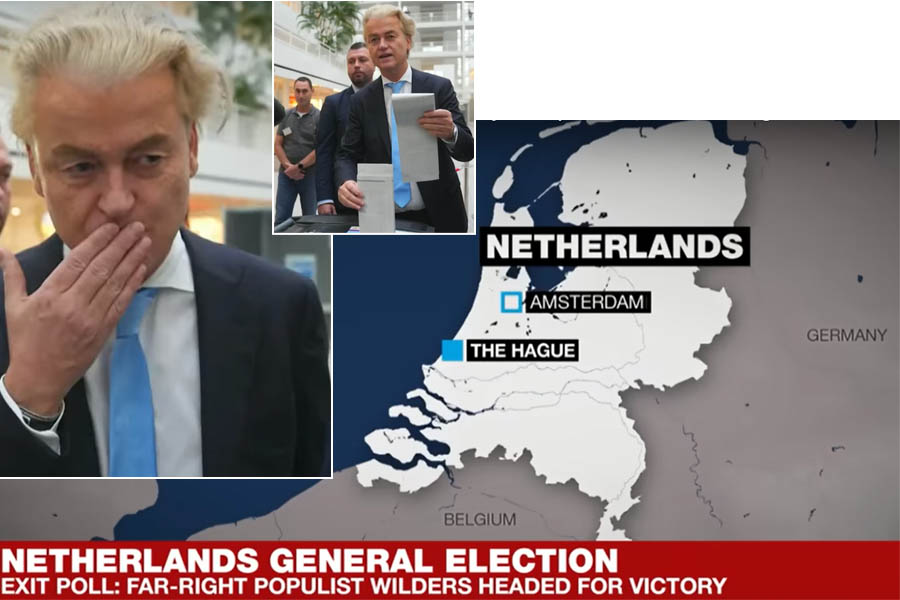
Far-Right Surge: Geert Wilders' Party for Freedom Tops Dutch Election Exit Polls — PVV Wins 35 Seats in Political Earthquake
The Hague — November 23, 2023 — In a seismic political shock that has sent reverberations across Europe, Geert Wilders' far-right Party for Freedom (PVV) is projected to become the largest party in the Dutch parliament, according to exit polls released after the November 22 general election. The PVV is predicted to win 35 seats in the 150-seat lower house — more than doubling its previous tally of 17 seats in the 2021 ballot — in what analysts are calling the most dramatic electoral upset in Dutch politics since the rise of Pim Fortuyn in 2002.
The result represents a stunning comeback for Wilders, a 60-year-old politician who has been under constant police protection since 2004 following death threats from Islamist extremists. His manifesto — which includes calls for a ban on mosques, the Qur'an, and Islamic headscarves in public buildings, as well as a "Nexit" referendum on Dutch withdrawal from the European Union — had long been considered too radical for a majority of Dutch voters. But a combination of voter frustration with immigration, housing shortages, and the cost-of-living crisis appears to have propelled PVV to unprecedented heights.
- 🥇 PVV (Geert Wilders, far-right): 35 seats (+18 from 2021)
- 🥈 GL/PvdA (Frans Timmermans, left-green): 26 seats (+9 from combined 2021)
- 🥉 VVD (Dilan Yesilgöz, liberal-conservative): 24 seats (-10 from 2021)
- 4️⃣ NSC (Pieter Omtzigt, centrist/new): 20 seats (new party)
- 5️⃣ D66 (Democrats 66, progressive liberal): 10 seats (-14 from 2021)
76 seats needed for majority. Final results expected within days.
🗳️ The Exit Poll Results: A Dramatic Shift
The exit poll, conducted by Ipsos for Dutch broadcaster NOS, shows a radically fragmented parliament with no clear governing majority. The PVV's 35 seats would make it the largest party but still far short of the 76 seats needed to govern alone. Wilders immediately claimed victory and declared his intention to form a coalition. "The PVV is the largest party, and I want to be prime minister," Wilders told cheering supporters at a post-election gathering. "The Dutch voter has spoken. They are tired of the establishment. They want their country back."
The outgoing coalition led by Mark Rutte's VVD suffered significant losses, dropping from 34 seats in 2021 to just 24 seats — a 10-seat decline. Rutte, who announced his retirement from politics in July after 13 years as prime minister, did not lead the party in this election. His successor, Dilan Yesilgöz, ran a campaign that initially promised to rule out coalition with PVV but later left the door open, a strategic ambiguity that may have cost the VVD moderate voters.
The new centrist party New Social Contract (NSC), founded by former Christian Democrat Pieter Omtzigt, won 20 seats in its first election — a strong showing but below earlier polling highs of 30+ seats. Omtzigt, who built his reputation on transparency and good governance, has categorically ruled out any coalition with PVV, citing Wilders' anti-constitutional positions on Islam and the rule of law.
🤝 Coalition Challenges: Can Wilders Form a Government?
Despite PVV's strong performance, Wilders faces an uphill battle to form a governing coalition. The heads of the three other largest parties — Frans Timmermans (GL/PvdA), Pieter Omtzigt (NSC), and Dilan Yesilgöz (VVD) — have all expressed serious reservations about governing with PVV, though with varying degrees of openness.
Frans Timmermans (GL/PvdA): The former European Commission vice president has unequivocally ruled out coalition with PVV, calling Wilders' policies "incompatible with the rule of law and fundamental rights." Timmermans' left-green alliance would be the natural alternative coalition leader if the center-left can find enough partners, but his 26 seats + possible allies (D66, PvdA, GroenLinks, SP) may not reach 76.
Pieter Omtzigt (NSC): The centrist firebrand has also ruled out coalition with PVV, stating that his party's commitment to constitutional integrity and the rule of law makes cooperation with Wilders impossible. "You cannot govern with a party that wants to ban the Qur'an," Omtzigt said during the campaign. "That's not a policy disagreement — it's a fundamental violation of religious freedom."
Dilan Yesilgöz (VVD): The liberal-conservative leader has left the door slightly ajar, stating that her party is "open to exploring all democratic options" — a shift from her earlier position ruling out PVV entirely. However, she has also ruled out supporting Wilders as prime minister. "The PVV leader cannot become prime minister," Yesilgöz said. "That is a firm position."
The most plausible PVV-led coalition would require support from VVD and NSC, but Omtzigt's firm opposition and Yesilgöz's reluctance make that unlikely. A VVD-NSC-PVV combination would have 79 seats (24+20+35=79) — exactly a majority — but Omtzigt has already said no. An alternative PVV-VVD-BBB (Farmer-Citizen Movement) combination would have 24+35+7=66 seats, falling short of 76.
Coalition negotiations in the Netherlands are traditionally lengthy; the 2021 post-election negotiations took a record 271 days (over 9 months). This time could be even longer given the fragmentation and the cordon sanitaire (firewall) that most mainstream parties have maintained against PVV since Wilders founded the party in 2006.
- 🔴🔵 PVV (35) + VVD (24) + NSC (20) = 79 seats — NSC opposes
- 🔴🟢 GL/PvdA (26) + VVD (24) + NSC (20) + D66 (10) = 80 seats — Possible center coalition
- 🔴🔵 PVV (35) + VVD (24) + BBB (7) = 66 seats — Falls short of majority
- 🟢🟡 GL/PvdA (26) + D66 (10) + PvdA (10) + SP (5) + Volt (2) = 53 seats — Left bloc too small
🌍 International Reactions: Far-Right Celebrates, Europe Watches
Far-right figures across Europe rushed to congratulate Wilders, seeing his success as validation of their own anti-immigration, anti-EU platforms.
- Viktor Orbán (Hungary): "The wind of change is blowing in Europe. Congratulations to Geert Wilders on his historic victory."
- Marine Le Pen (France): "The Dutch have rejected the arrogance of the European Union. The National Rally stands with our Dutch friends."
- Matteo Salvini (Italy): "First Italy, now the Netherlands — the people are waking up."
- Alternative für Deutschland (Germany): "A great day for Dutch sovereignty. AfD is proud of the PVV."
However, reactions from mainstream European leaders were more guarded. German Chancellor Olaf Scholz noted that "coalition negotiations will determine the direction of Dutch policy" and declined to comment further. European Commission President Ursula von der Leyen reminded that "all EU member states must uphold the rule of law and fundamental rights."
The White House issued a brief statement saying the United States looks forward to "working with whomever the Dutch people choose to form a government."
📜 Geert Wilders: The Politician Who Has Been Under Police Protection for 19 Years
Geert Wilders is no ordinary politician. Since 2004 — after the murder of filmmaker Theo van Gogh by an Islamist extremist — Wilders has lived under 24-hour police protection, moving between safe houses and bulletproof vehicles. He cannot meet constituents in public spaces, cannot campaign in open areas, and has not driven his own car or visited a supermarket in nearly two decades. His iconic silver-blond hair is a wig (to prevent identification by assassins).
Despite — or perhaps because of — this isolation, Wilders has become a folk hero to many Dutch voters who feel alienated from mainstream politics. His anti-Islam, anti-immigration, anti-EU message resonates with working-class voters who have seen their communities change rapidly in the past two decades.
In recent years, Wilders has attempted to soften his rhetoric, dropping his most inflammatory slogans (such as "fewer Moroccans") and emphasizing economic issues like housing affordability, healthcare, and purchasing power. This "moderation strategy" appears to have paid off, as PVV surged from a projected 15-20 seats in pre-election polls to 35 in the exit poll.
🏛️ Implications for Dutch Policies: What Would a PVV Government Mean?
If Wilders were to become prime minister — still a long shot given coalition obstacles — the implications would be profound.
Immigration: PVV's manifesto calls for a total freeze on asylum applications, withdrawal from the EU's Common European Asylum System, a ban on dual citizenship, and "de-Islamization" of the Netherlands (including closing mosques, banning the Qur'an, and banning Islamic headscarves in schools and government buildings).
European Union: PVV demands a "Nexit" referendum on Dutch withdrawal from the EU. While a majority of Dutch voters remain pro-EU, a PVV government would be a constant source of disruption in Brussels.
Climate: PVV is skeptical of climate change policies, opposing the government's nitrogen emissions reduction plan (which has devastated the agricultural sector) and supporting nuclear energy instead of renewables.
Economy: PVV combines left-wing economic policies (higher pensions, lower retirement age, reduced healthcare deductibles) with conservative social policies — a populist mix that has proven electorally potent.
Even if Wilders does not become prime minister, his electoral success will shift Dutch political discourse rightward. The mainstream parties, particularly VVD, will likely adopt tougher positions on immigration and EU integration to win back PVV voters in future elections.
🔮 The Road Ahead: Coalition Negotiations and Political Uncertainty
As the Netherlands awaits final results (expected within days), the political landscape remains deeply uncertain. The most likely outcome is a prolonged period of coalition negotiations, potentially lasting months, with no guarantee of a stable government emerging. The Netherlands has a tradition of technocratic "extra-parliamentary" cabinets when political negotiations fail, but even that would be challenging with such a fragmented parliament.
Analysts see three possible scenarios:
- Center-left coalition: GL/PvdA-led with VVD, NSC, D66 (80 seats) — but Timmermans and Omtzigt have policy differences on economics and Europe.
- Center-right coalition: VVD-led with NSC, D66, and perhaps others — but this would exclude PVV and require VVD to compromise with center-left on social issues.
- Right-wing minority government: PVV-led with VVD support from outside — unstable and unlikely given Wilders' controversial positions.
What is clear is that Dutch politics will never be the same. The PVV surge is not a one-off protest vote; it reflects deep structural changes in Dutch society: the erosion of traditional Christian Democratic and Social Democratic blocs, the fragmentation of the party system, and growing voter dissatisfaction with immigration and housing policies.
The surge of Geert Wilders' PVV marks a significant shift in Dutch political dynamics. As the nation awaits the formation of a new government, the uncertainties surrounding coalition-building and policy direction will likely dominate discussions. The international community will closely monitor how the Netherlands navigates this pivotal moment, as the country grapples with the challenges posed by a resurgent far-right movement.
Original Reporting: This analysis was first published on 23 November 2023. Continuous coverage at Global Post Headline Europe Desk.
Global Post Headline — independent coverage of European elections. globalpostheadline.com | Follow: Europe Desk | Politics Section


Authentic Nepali handicrafts, pashmina, singing bowls.