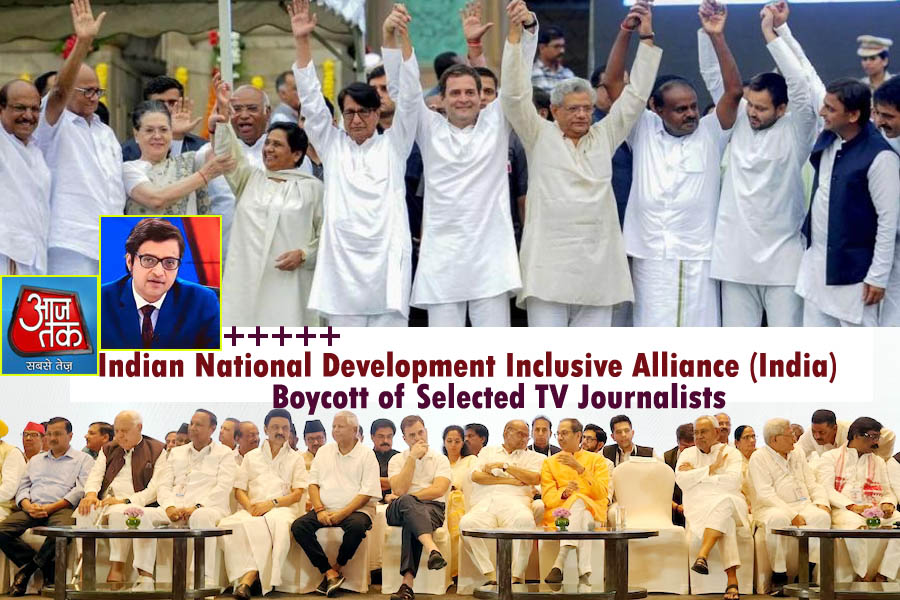
INDIA Alliance Boycotts 14 TV Journalists: 'We Will Not Be Customers of the Market of Hate' — Opposition Takes Stand Against 'Divisive Media'
New Delhi, September 15, 2023: In an unprecedented move that has reignited debates over media bias and press freedom in India, the Indian National Developmental Inclusive Alliance (INDIA) — the 28-party opposition coalition — has formally announced a boycott of 14 television journalists and their programs. The decision, announced by Congress leader and alliance communication head Pawan Khera, targets prominent news anchors including Arnab Goswami (Editor-in-Chief, Republic TV) and Sudhir Chaudhary (Editor, Aaj Tak), whom the opposition accuses of spreading "divisive, inflammatory, and hate-filled content" while exhibiting overt bias toward Prime Minister Narendra Modi and the BJP.
The boycott means that no leader or spokesperson from any INDIA constituent party will appear on programs hosted by these journalists. The decision was finalized during the alliance's coordination committee meeting in Mumbai on Wednesday. Khera took to social media platform X (formerly Twitter) to explain the rationale: "Every day from 5 pm on some channels, a store of hate is being decorated. We will not become customers of the market of hate. Our aim is 'Hate Free India.' We do not participate in the programs of some anchors because we have a heavy heart."
- 📺 Arnab Goswami (Republic TV)
- 📺 Sudhir Chaudhary (Aaj Tak)
- 📺 Aditi Tyagi
- 📺 Aman Chopra
- 📺 Amish Devgan (News18)
- 📺 Anand Narasimhan
- 📺 Ashok Srivastava
- 📺 Chitra Tripathi
- 📺 Gaurav Sawant (India Today)
- 📺 Navika Kumar (Times Now)
- 📺 Prachi Parashar
- 📺 Rubika Liaquat
- 📺 Shiv Arur
- 📺 Sushant Sinha
Alliance leaders and spokespersons will no longer appear on programs hosted by these journalists.
🎙️ 'Market of Hate': The Opposition's Justification
Pawan Khera elaborated that the decision was not taken lightly but was a response to what the alliance perceives as a systematic campaign of vilification against opposition leaders. "Despite the relentless dissemination of unrestrained comments and false news targeting our leaders, we remain committed to fighting against hatred. We will not contribute to its spread within society," Khera stated.
The Congress party specifically accused certain journalists of remaining silent when police and military personnel were killed in Jammu and Kashmir, while allegedly celebrating when army personnel were martyred — a reference to PM Modi's purported remarks. Khera used a sharp phrase: "This is not a list of journalists; this is a list of those who are 'Charan Chumbak' (feet-kissers) of Modiji." The remark drew sharp reactions from the BJP and media freedom advocates, who accused the opposition of attempting to browbeat critical journalism.
Several of the named journalists have previously been vocal critics of the Congress party and the Gandhi family, regularly airing segments on alleged corruption, dynasty politics, and national security lapses during the UPA era. The opposition's boycott is seen as a retaliatory measure to deny these anchors access to opposition voices, thereby potentially reducing their viewership and relevance.
📺 Media Reactions: Press Freedom Under Threat or Legitimate Political Strategy?
The boycott has polarized media analysts. Some argue that a political alliance is well within its rights to choose which media platforms to engage with. "No one has a fundamental right to interview a politician," said senior journalist Naresh Saxena. "If the opposition feels a particular anchor is biased, they can refuse participation. That's called media management, not censorship."
However, press freedom advocates expressed concern. The Editors Guild of India issued a statement: "While political parties have the right to decide their media strategy, boycotting journalists collectively risks creating an environment where editorial independence is punished. Healthy democracy requires robust debate across ideological lines."
Anchors named in the list responded sharply. Arnab Goswami, known for his aggressive style, said on his show: "The opposition is running away from questions because they have no answers. They want 'Hate Free India' — but the only hate is their hatred for the truth." Sudhir Chaudhary tweeted: "Facts don't care about boycotts. We will continue to ask tough questions."
🏛️ One Nation, One Election: The Other Flashpoint
The media boycott announcement coincided with another contentious political development: the government's proposal for a special parliamentary session to discuss 'One Nation, One Election' — the idea of holding simultaneous national and state elections. While the government argues it will reduce costs and governance disruptions, many opposition leaders, including those in the INDIA alliance, have raised strong objections.
Critics argue that simultaneous elections would undermine federalism, disproportionately benefit well-funded national parties like the BJP, and marginalize regional parties. The opposition contends that the proposal is a distraction from pressing issues like unemployment, inflation, and the recent media boycott controversy. Constitutional experts note that implementing 'One Nation, One Election' would require multiple constitutional amendments and extensive political consensus — making it unlikely in the near future.
📊 Strategic Implications for the 2024 Elections
The media boycott is part of a broader opposition strategy to control their own narrative ahead of the 2024 Lok Sabha elections. By refusing to engage with anchors they consider hostile, INDIA leaders hope to prevent the amplification of what they call "BJP talking points." Simultaneously, the alliance is investing heavily in its own digital media infrastructure, including social media campaigns, WhatsApp broadcasts, and friendly news outlets.
Political analysts are divided on the efficacy of this strategy. Some believe denying interviews to popular prime-time anchors will reduce the opposition's visibility among undecided voters. Others argue that the anchors' credibility has already diminished among significant sections of the audience, and the boycott could actually galvanize the opposition's base.
The BJP, meanwhile, has seized the opportunity to paint the opposition as "anti-press freedom." BJP spokesperson Sambit Patra said: "The INDIA alliance cannot tolerate any questioning. They want to create a 'yes-sir' media environment. This is dangerous for democracy." The opposition has denied this, pointing to their continued engagement with numerous other journalists and channels.
As the 2024 election campaign intensifies, the relationship between political parties and the media will remain a deeply contested arena. The INDIA alliance's boycott may set a precedent for how other political formations engage — or refuse to engage — with media they perceive as biased. Whether this move strengthens or weakens the opposition's electoral prospects remains to be seen.
Original Reporting: This analysis was first published on 15 September 2023 following the INDIA alliance's boycott announcement. Updated with reactions and 'One Nation, One Election' context. Follow ongoing coverage at Global Post Headline Politics Section.
Global Post Headline — independent media and political analysis. globalpostheadline.com | Follow: Politics Section | National News


Authentic Nepali handicrafts, pashmina, singing bowls.