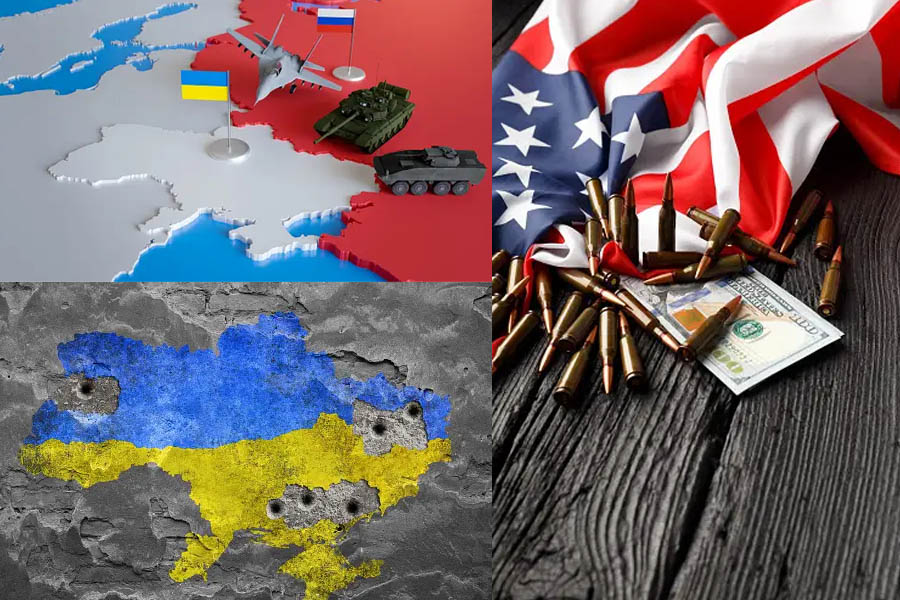
U.S. to Provide Ukraine with $250 Million in Military Aid Amidst Escalating Tensions — 54th Security Assistance Package Since August 2021
In a significant move to bolster Ukraine's defense capabilities as the war approaches its second anniversary, the United States has announced a package of military aid totaling up to $250 million. The assistance, revealed on December 27, 2023, includes a variety of arms and equipment aimed at addressing Ukraine's urgent security needs and fortifying its ability to defend its sovereignty and independence against Russian aggression.
The aid package arrives at a critical moment. Ukrainian forces are facing ammunition shortages, Russian troops have captured the strategic city of Avdiivka, and a new Russian offensive is expected in the spring. The package, while welcomed in Kyiv, is far smaller than the $60 billion supplemental request that remains stalled in Congress.
📦 What's in the Package: Air Defense, Artillery, and Anti-Armor Systems
The U.S. Department of Defense (DoD) disclosed that the aid package encompasses:
- Air Defense Munitions: Additional ammunition for NASAMS and other air defense systems to counter Russian drones and missiles.
- Artillery Ammunition: 155mm and 105mm rounds for howitzers, critical for Ukraine's counter-battery operations.
- Stinger Anti-Aircraft Missiles: Man-portable systems to intercept low-flying aircraft and drones.
- HIMARS Ammunition: Additional Guided Multiple Launch Rocket System (GMLRS) rockets for precision strikes.
- Javelin and AT-4 Anti-Armor Systems: Portable anti-tank weapons that have proven devastatingly effective against Russian armor.
- Small Arms Ammunition: Millions of rounds for rifles, machine guns, and other infantry weapons.
This marks the 54th disbursement of military equipment to Ukraine by the Biden administration since August 2021, demonstrating the United States' commitment to Ukraine's defense. The total US security assistance to Ukraine now exceeds $44 billion since the beginning of the full-scale invasion in February 2022.
The utilization of the presidential drawdown authority facilitated the swift delivery of DoD stocks to Ukraine, bypassing the lengthy procurement process that would otherwise delay assistance. The DoD emphasized the importance of U.S. leadership in sustaining the coalition efforts of around 50 allies and partners currently supporting Ukraine. The statement from the DoD asserted, "Security assistance for Ukraine is a smart investment in our national security. It degrades a major strategic competitor while strengthening our alliances and partnerships."
⚔️ The Battlefield Context: A War of Attrition
The decision to provide additional military aid to Ukraine comes against the backdrop of an ongoing 22-month war between Ukrainian and Russian forces, with both sides struggling to make substantial progress along the frontline after Ukraine's summer counteroffensive failed to achieve a breakthrough. President Joe Biden had earlier announced a $200 million military aid package in early December, expressing concerns about the conflict reaching a stalemate.
Russian forces have been on the offensive in several sectors, particularly around Avdiivka and Bakhmut, suffering heavy casualties but making incremental gains. Ukrainian forces have been forced to adopt a defensive posture, conserving ammunition and manpower while waiting for the arrival of additional Western aid. The front lines have barely moved since November, and both sides are preparing for a renewed campaign in the spring.
On the day of the announcement, Russia launched almost 50 Shahed drones at targets across Ukraine. The attacks resulted in casualties and disruptions to energy infrastructure, underscoring the volatile nature of the conflict and the critical need for continued international support for Ukraine's defense. Ukrainian air defense systems intercepted 34 of the drones, but those that got through caused damage in Odesa, Mykolaiv, and Kherson.
🏛️ Political Challenges: Congressional Gridlock and Republican Opposition
However, the provision of military aid has faced criticism on Capitol Hill, particularly from senior Republicans, including prominent figures like Matt Gaetz and Marjorie Taylor Greene. Some Republicans have insisted on linking financial support to White House concessions on border security, demanding significant changes to US immigration policy in exchange for approving the $60 billion supplemental request.
The complexities of the situation were highlighted by a CBS News/YouGov poll in September 2023, revealing a 10-point drop in Republican support for sending weapons to Ukraine compared to February 2023. Public opinion among Republicans has shifted, with a growing number arguing that the US has done enough and that European allies should bear more of the burden. The political debate reflects broader divisions in American foreign policy between internationalist and isolationist wings of the Republican Party.
Despite the internal political debates, the Biden administration remains committed to providing essential support to Ukraine, using existing drawdown authority to continue military assistance even as the larger supplemental package remains stalled. The December package was funded through previously allocated resources, but the Pentagon has warned that without new funding, US aid could run out by spring 2024.
Senate Majority Leader Chuck Schumer has vowed to bring the supplemental package to a vote in early 2024, but its fate remains uncertain. Speaker Mike Johnson has indicated he will not allow a vote on the package without significant border security provisions attached, creating a standoff that could delay aid for months.
🔧 Ukraine's Domestic Weapons Production: Building Self-Sufficiency
As the supply of foreign weapons faces uncertainty, Ukraine's Minister of Strategic Industries, Oleksandr Kamyshin, announced on Wednesday the country's efforts to enhance its own weapons manufacturing in 2024. Ukraine is reportedly producing six Bohdana self-propelled artillery units per month, a strategically important weapon using NATO-standard 155mm rounds — allowing Ukraine to integrate with Western supply chains while reducing dependence on foreign deliveries.
Kamyshin also outlined plans for the production of long-range strike drones, capable of reaching targets deep inside Russia. Ukraine has already demonstrated the ability to strike Russian airfields and logistics hubs with domestically-produced drones, and production is being scaled up. The goal is to produce thousands of drones per month by the end of 2024, rivaling Russia's drone production capacity.
"We are not waiting for anyone," Kamyshin told reporters. "We are building our own industry. In 2024, you will see a dramatic increase in Ukrainian-made weapons." The government has allocated an additional $1 billion to domestic defense production, and Western companies are being invited to establish joint ventures in Ukraine.
The development of Ukraine's own weapons industry is a long-term strategic imperative. Even after the war ends, Ukraine will need to maintain a credible deterrent against future Russian aggression. Domestic production capacity reduces reliance on foreign aid and gives Ukraine greater control over its security.
🌍 Geopolitical Implications: A Test of Western Resolve
The $250 million aid package, while significant, is a fraction of what Ukraine needs to sustain its war effort. The Biden administration continues to press Congress to approve the larger supplemental, arguing that a Russian victory in Ukraine would embolden China and other authoritarian powers. "The cost of deterring Putin is far lower than the cost of appeasing him," a senior administration official said.
European allies have stepped up to fill the gap. The European Union recently approved a €50 billion aid package for Ukraine, and individual countries have increased their bilateral contributions. But European production capacity is limited, and the US remains the only country capable of providing certain advanced weapons systems, including ATACMS missiles and F-16 fighter jets.
The geopolitical landscape in the region remains tense, with Russia's drone attacks and ongoing offensives underscoring the urgent need for continued international support. As Ukraine enters its third year of full-scale war, the battle is as much about political will in Western capitals as it is about firepower on the ground.
Related Coverage: For more on US-Ukraine relations and military aid, visit Russia-Ukraine War Hub and US-Canada News.
Global Post Headline — independent coverage of US foreign policy and the Russia-Ukraine war. globalpostheadline.com | Follow updates: War News | US News

Experience the Himalayas with expert Sherpa guides. Trekking, expeditions, and cultural tours in Nepal, Tibet & Bhutan.
Plan Your Nepal Trip →
Authentic Nepali crafts, pashmina, singing bowls — worldwide shipping.