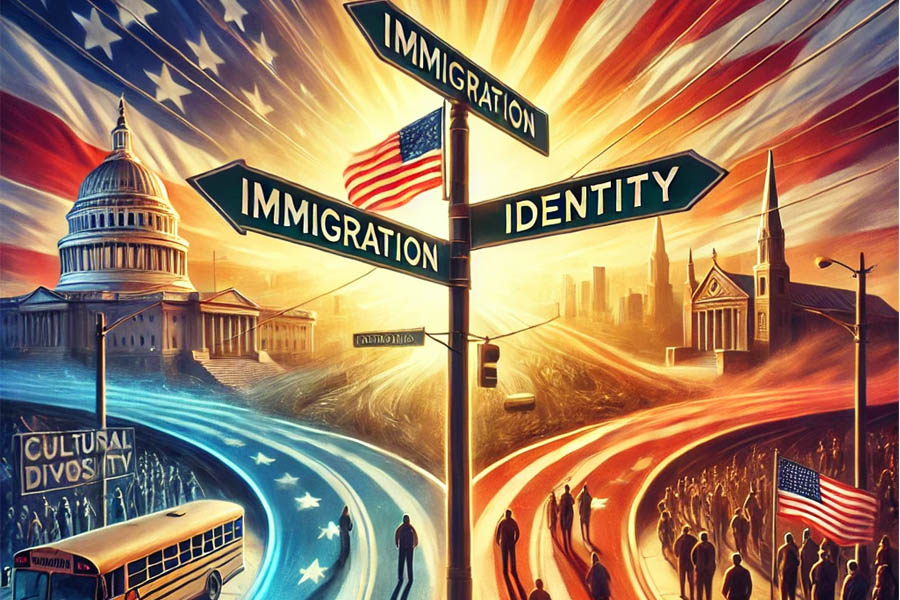
America at a Crossroads: Immigration, Identity, and Trump's Ambitious Vision — $315B Deportation Plan and the Nation's Moral Reckoning
For centuries, America has stood as a symbol of opportunity—a land where dreams are born, where the tired, poor, and huddled masses yearning to breathe free could find refuge and purpose. The Statue of Liberty's torch has illuminated the path for generations of immigrants who built the nation's railroads, staffed its factories, founded its tech giants, and enriched its culture. Yet today, this identity is being contested as never before. Immigration, the backbone of America's progress, has become the nation's most explosive political minefield.
At the center of the storm is Donald Trump, who has promised to redefine America's future with an audacious vision of immigration reform that includes the mass deportation of an estimated 13 million undocumented immigrants. The proposal, detailed in campaign speeches and policy documents, has ignited a fierce national debate about who gets to be American, what the nation owes to those who have built their lives here, and whether the country can afford—financially, morally, and practically—such a sweeping operation.
- 🚫 Mass deportation of all 13 million undocumented immigrants over 4 years
- 👮 Expansion of ICE and Border Patrol by 30,000+ new agents
- 🏛️ Construction of additional detention facilities (the largest in US history)
- 🛑 Travel ban expansion and visa restrictions on multiple countries
- 🗽 Ending birthright citizenship for children of undocumented parents (legal challenge expected)
- 📚 Visa suspensions for international students from designated countries
💰 The Mammoth Scale: Costs, Logistics, and Feasibility
The numbers are staggering. According to the American Immigration Council, deporting 13 million people would cost between $162 billion and $315 billion over four years — more than the annual budgets of the Departments of Homeland Security, Justice, and State combined. This would require the hiring of over 30,000 new ICE agents and deportation officers, the construction of massive detention facilities with capacity for hundreds of thousands, and a logistical apparatus involving military transport aircraft, chartered flights, and ground convoys.
Economists warn of additional indirect costs: the loss of tax revenue from undocumented workers who collectively pay an estimated $11.6 billion in state and local taxes annually, labor shortages in agriculture, construction, hospitality, and healthcare (sectors that depend on immigrant labor), and the inflationary shock of removing millions of workers from the economy. The American Farm Bureau Federation estimates that deporting farmworkers alone would cost the agricultural sector $30-60 billion annually.
"This is not a policy proposal; it's a fantasy," said David Bier, director of immigration studies at the Cato Institute. "The logistical, legal, and financial hurdles make it impossible to execute as described. Even if you doubled the entire DHS budget, you couldn't deport more than 500,000 per year without collapsing the system."
👨👩👧👦 The Human Cost: Families, Communities, and the American Dream
Beyond numbers and logistics lies a deeper, more profound question: what about the lives disrupted? Many undocumented immigrants have lived in the United States for over a decade, have US-born citizen children, own homes and businesses, and are deeply integrated into their communities. According to Pew Research, approximately 4.5 million US-born children have at least one undocumented parent. Mass deportation would not just uproot individuals—it would separate families, destabilize neighborhoods, and traumatize millions of American citizens.
Maria Hernandez, a 45-year-old mother of three from Los Angeles (her children are US citizens), has lived in the US for 22 years. She works as a home health aide, paying taxes and contributing to Social Security under an ITIN number. "My children don't know any other country," she told reporters. "They are American in every way except on paper. If we are deported, they would have to choose between leaving with us or staying with relatives. How is that humane?"
Proponents of the plan argue that returning skilled workers to their countries could spark local development and that the rule of law must be enforced regardless of personal circumstances. But critics warn of destabilization, economic downturns in sending countries (especially Mexico and Central American nations that rely on remittances), and irreparable damage to America's reputation as a beacon of opportunity.
🎓 International Students: Dreams in Limbo
While Trump's deportation plans dominate headlines, another group quietly faces turmoil: international students. Over one million international students study in the US, contributing approximately $40 billion annually to the economy and enriching American universities with global perspectives. In a replay of the 2017 travel ban chaos, universities across the country have issued urgent advisories urging students to return from winter break before potential travel restrictions take effect.
The memory of the 2017 ban — which stranded students, researchers, and professionals abroad for months — looms large. Nida, a biochemistry PhD student from Pakistan standing at an airport gate with a suitcase full of dreams, represents the anxiety of hundreds of thousands. Her research could lead to groundbreaking cancer treatments, but her ability to return to her lab in Boston remains uncertain. "I've spent six years building my life here," she said. "My entire professional network, my research collaborators, my future — all of it depends on a presidential executive order."
Universities including Harvard, MIT, Stanford, and the University of California system have retained immigration lawyers and are advising students to return by mid-January. Some have set up emergency funds for students who may be stranded. The uncertainty is already affecting enrollment decisions for the next academic year, with some prospective students choosing Canada, the UK, or Australia instead.
- 📚 1+ million international students currently in US
- 💰 $40 billion annual economic contribution
- 🎓 Universities on high alert for travel ban expansion
- ✈️ Urgent advisories to return before January deadlines
🇺🇸 America's Identity Crisis: What Does It Mean to Be American?
At the heart of these debates lies the most fundamental question: what does it mean to be American? Is America a civic nation defined by adherence to a constitution and set of ideals — liberty, equality, opportunity for all? Or is it an ethnic and cultural identity rooted in European heritage and English-language dominance?
Trump's vision leans heavily toward the latter. In speeches, he has spoken of preserving "American identity" against what he calls "mass migration that is changing the fabric of our country." Critics argue this vision risks erasing the diversity that has made America unique — a nation of immigrants where every wave of newcomers has faced suspicion before eventually becoming integrated and contributing to national prosperity.
"The narrative of the 'threatening immigrant' is as old as the Republic itself," said historian Dr. Mae Ngai of Columbia University. "The Irish were demonized. The Italians were demonized. The Chinese were demonized. The Jews were demonized. And yet, each group eventually became part of the American mainstream. Today's debate about Latin American immigrants follows the same tragic pattern."
Polls show a deeply divided nation. According to a December 2024 Pew Research survey, 47% of Americans support a pathway to citizenship for undocumented immigrants, while 42% support mass deportation. The divide falls largely along partisan lines, with 78% of Republicans supporting deportation and 72% of Democrats supporting a path to citizenship. Independents are split nearly evenly.
🛤️ The Path Forward: Reform, Not Retrenchment
As America approaches the 2025-2026 political cycle, immigration will remain the defining issue. Comprehensive reform — which has eluded Congress for decades — would require balancing multiple priorities: robust border security, a realistic pathway to citizenship for long-settled undocumented immigrants, streamlined legal immigration for skilled workers, and protections for farmworkers and essential laborers. The last serious attempt at comprehensive reform died in Congress in 2013, and bipartisan cooperation has only eroded since.
Policy experts offer three principles for a humane and practical approach: Reform, not retrenchment — addressing labor market needs while securing borders; Global responsibility — ensuring policies consider international impacts; and Humanity at the core — recognizing that immigration isn't just about borders, it's about people.
As the Statue of Liberty reminds us: "Give me your tired, your poor, your huddled masses yearning to breathe free." Whether America will continue to honor that promise in the face of demographic anxiety and political polarization remains the central question of our time. The answer will determine not just the nation's demographic future, but its moral character on the world stage.
Original Analysis: This report was first published on 28 December 2024. Updated with latest policy details and polling data. Continuous coverage at Global Post Headline US Desk.
Global Post Headline — independent coverage of US politics and policy. globalpostheadline.com | Follow: US Desk | Politics Section


Authentic Nepali handicrafts, pashmina, singing bowls.