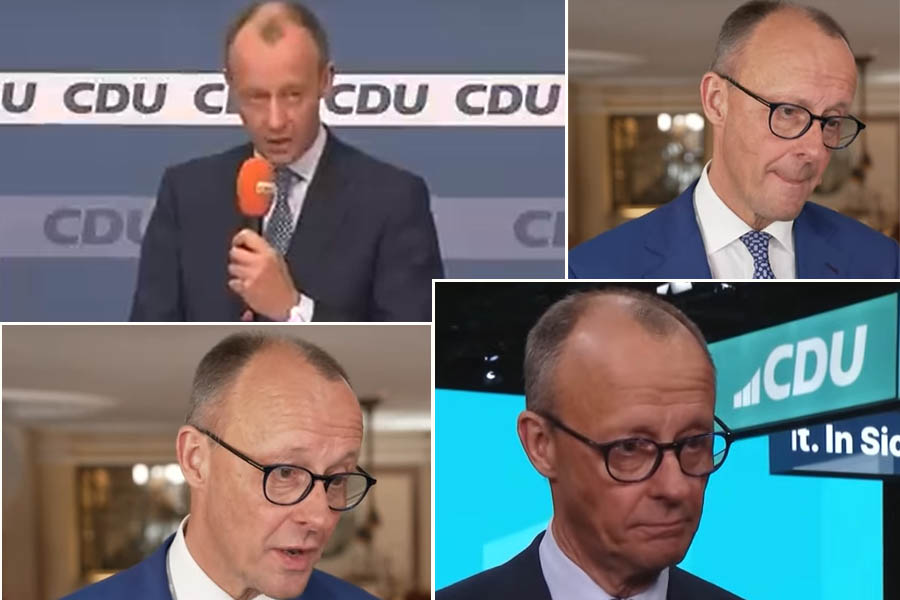
Friedrich Merz's Leadership Prospects Amid Germany's Migration Debate and AfD Rise — Can the CDU Leader Steer Germany to the Right Without Breaking the Firewall?
In recent weeks, Germany's political landscape has been shaken by a series of critical developments, particularly surrounding the contentious issue of migration. With 77% of Germans calling for a fundamental rethink on asylum and refugee policies according to a recent ARD-Deutschlandtrend poll, conservative leader Friedrich Merz of the Christian Democratic Union (CDU) has found himself at the center of the debate. His firm stance on tightening immigration controls is gaining momentum, but the shadow of potential cooperation with far-right forces — specifically the Alternative für Deutschland (AfD) — looms ominously over his chancellorship ambitions.
Merz, who narrowly lost the 2021 election to Olaf Scholz's SPD, is positioning himself as the law-and-order candidate for the 2025 federal election. With the three-party "traffic light" coalition (SPD, Greens, FDP) deeply unpopular — polling at just 32% combined — the CDU/CSU alliance leads national polls with approximately 30-32% support. But to become chancellor, Merz must navigate a treacherous political landscape defined by migration anxiety, economic stagnation, and the resurgence of the far-right.
📊 Migration Reform: A Growing Demand
A new poll highlights a clear shift in public sentiment on migration. With recent terror attacks linked to migrants or asylum-seekers — including the Solingen stabbing attack in August 2024 — a strong majority of Germans now support stricter policies. The attacks, carried out by a Syrian asylum-seeker, reignited a fierce debate about border controls and deportation procedures. Merz, sensing the political winds, has reiterated the CDU's call for immediate action at Germany's borders. He argues that it is both legally possible and long overdue to start turning away irregular migrants at entry points, a measure he believes will help restore order and public confidence.
"We've known since 2015 that this is possible," Merz stated in an interview with Bild am Sonntag. "In 2024, we need to finally make that decision. Germany cannot continue to accept unlimited migration while our cities and towns are overwhelmed." Merz has specifically called for the suspension of asylum applications from Syria and Afghanistan, citing the end of active conflict in those countries — a position that puts him at odds with the Greens and SPD, who argue such a move would violate international law.
While this tough rhetoric appeals to many conservative voters, it has sparked criticism from political opponents and human rights groups who fear the implications of such policies for Germany's international image and humanitarian obligations. Amnesty International Germany called Merz's proposals "unserious and inhumane," while Chancellor Scholz accused the CDU leader of "sowing division rather than solving problems."
📈 AfD's Surge and the Coalition Conundrum
Further complicating Merz's path to potential leadership is the rise of the far-right Alternative für Deutschland (AfD) party, which has made significant gains in recent regional elections. In Thuringia and Saxony — states in the former East Germany — the AfD emerged as a dominant force, with 33% of the vote in some districts. Nationally, the AfD polls at approximately 17-19%, making it the second or third largest party in Germany. This has left Germany's mainstream parties facing a political dilemma: How to address the growing influence of the AfD while maintaining democratic values and a "firewall" against cooperation with the far-right.
Merz has been clear on one point — the CDU will not cooperate with the AfD. "The CDU would be selling its soul if it were to cooperate with a right-wing extremist party," he declared in a party conference speech. "The firewall stands. There will be no coalition, no tolerance, no cooperation at any level." Yet, as support for the AfD climbs, there are growing calls within some conservative ranks — particularly in the more radical wing of the CSU (Bavaria's sister party) — to reconsider this strict non-cooperation policy. A recent poll showed 35% of respondents believe the CDU should at least consider working with the far-right, a significant increase from previous years.
The question now is whether Merz's hardline stance can hold, particularly as the political pressure to form stable coalitions grows in regions where the AfD is a formidable presence. In Thuringia, where the AfD is the largest party, the CDU faces a choice: support a minority government tolerated by the far-right, or force new elections. Merz has ruled out any AfD tolerance, raising the prospect of political paralysis. Some voters argue that ignoring the AfD's electoral success only further alienates its supporters, who feel their concerns — particularly on migration, inflation, and energy policy — are not being heard by the mainstream.
👤 Merz's Prospects as Germany's Next Leader
As the CDU seeks to regain national prominence after three years in opposition, Merz's prospects of becoming Germany's next chancellor hinge on his ability to unify the party while appealing to a broader electorate. Although the CDU has historically been a dominant force in German politics — producing chancellors Konrad Adenauer, Helmut Kohl, and Angela Merkel — its recent struggles have created a leadership vacuum that Merz is eager to fill.
Merz's chances of becoming Germany's next leader are bolstered by his sharp focus on immigration, a top issue for many voters. However, it remains unclear whether this single-minded focus will be enough to win over centrist voters who are concerned about the economy (Germany is facing a mild recession), climate policy (where the Greens dominate), and social welfare — issues where Merz has yet to present a comprehensive vision. His business-friendly, economically liberal positions resonate with the CDU's traditional base but may alienate working-class voters who have drifted to the AfD.
In addition, Merz faces the challenge of convincing the CDU's more moderate wing — which remembers the successes of Angela Merkel's centrist "Volkspartei" approach — that his harder line on immigration will not permanently alienate potential coalition partners. The CDU could need to form a coalition with either the SPD or the Greens after the 2025 election, both of which have starkly different positions on migration. If Merz is seen as too divisive or too closely aligned with right-wing populist rhetoric, he may struggle to attract centrist support — a vital bloc in any future national election.
Nonetheless, Merz's conservative credentials and his ability to address rising fears about migration could position him as a frontrunner in the race for chancellor, especially if public demand for stricter immigration policies continues to grow. His success in leading the CDU through upcoming regional elections in Brandenburg and Saxony — where the AfD is polling strongly — and navigating the far-right challenge will serve as critical tests of his political future.
⚔️ A Battle for the Soul of the CDU
Merz's position as leader of the CDU has also come under scrutiny from within his own party. While he has successfully positioned himself as the champion of stricter immigration controls, there is unease about how his strategy could affect the party's future. In particular, his unwillingness to engage with the AfD is seen by some as a dangerous gamble that could push conservative voters even further to the right, fragmenting the center-right vote and ensuring a left-wing government.
Moreover, Merz's challenge goes beyond migration. Germany's economy is another pressing issue, with stagnant growth (GDP contracted by 0.3% in 2023) and job losses in manufacturing compounding public dissatisfaction. The country's flagship automotive industry is struggling with the transition to electric vehicles, high energy costs, and competition from Chinese EV makers. Merz has acknowledged these challenges, but his focus on immigration may overshadow the broader reforms needed to reinvigorate Germany's industrial base. He has called for tax cuts, deregulation, and a return to nuclear energy — positions that appeal to business but are controversial in the current political climate.
There is also the shadow of Angela Merkel. Although she retired from politics in 2021, her moderate legacy still looms over the CDU. Merz has positioned himself as a clear break from the Merkel era, criticizing her open-door refugee policy in 2015 as a "mistake." But some party elders worry that a shift too far to the right could cost the CDU its reputation as a broad-based people's party. The upcoming party conference in December will be a key test of Merz's authority.
🔮 Navigating a Divided Germany
As the 2025 national elections approach — expected to take place in September 2025 — Friedrich Merz finds himself navigating treacherous waters. His tough stance on migration and refusal to cooperate with the AfD has won him support in some quarters but risks alienating others. The question is whether Merz can maintain this balancing act long enough to secure the chancellorship without compromising the core values of the CDU — or whether the rise of the far-right will force a recalibration in German politics.
Germany stands at a crossroads, and the decisions made in the coming months will not only shape its future migration policies but also determine the trajectory of its democratic institutions. For Merz, the stakes have never been higher. His ability to unite a fractured CDU, present a compelling economic vision, and appeal to a broader electorate will be key in determining whether he becomes Germany's next chancellor — or whether the CDU's decline continues, potentially opening the door to an AfD-led coalition in the future.
One thing is certain: the 2025 election will be the most unpredictable German federal election in a generation. And Friedrich Merz, for better or worse, will be at the center of it.
Related Coverage: For more on German politics and European affairs, visit Alice Weidel and the Surging Popularity of AfD and Volkswagen's EV Challenges and Factory Closures.
Global Post Headline — independent coverage of German and European politics. globalpostheadline.com | Follow updates: Europe News | Politics Section

Experience the Himalayas with expert Sherpa guides. Trekking, expeditions, and cultural tours in Nepal, Tibet & Bhutan.
Plan Your Nepal Trip →
Authentic Nepali crafts, pashmina, singing bowls — worldwide shipping.