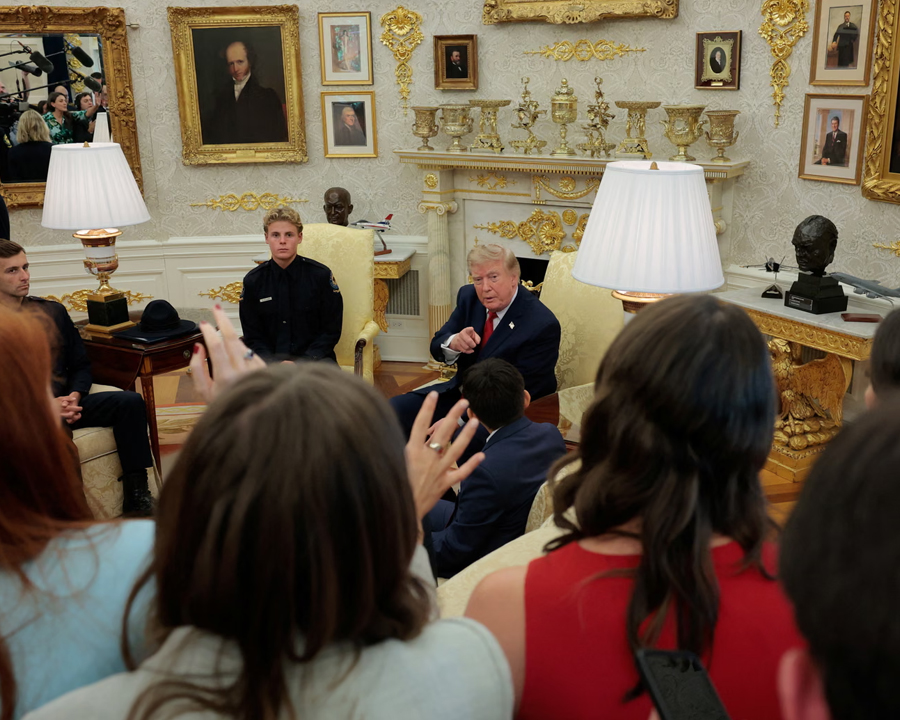
Trump with members of the press in the Oval Office on Monday.
18 August 2026 | Seoul, Washington, Pyeongtaek — Updated 23:45 GMT
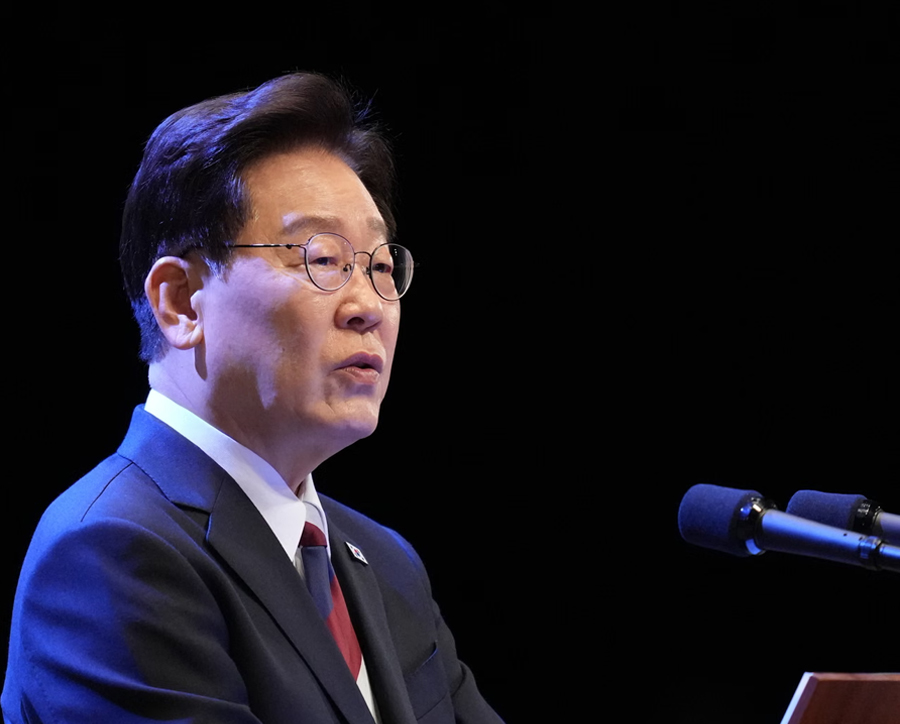
South Korea's president has renewed his push to regain independent control of the military from the US in the event of war and urged faster progress in acquiring nuclear-powered submarines after Donald Trump's order to cut joint drills.
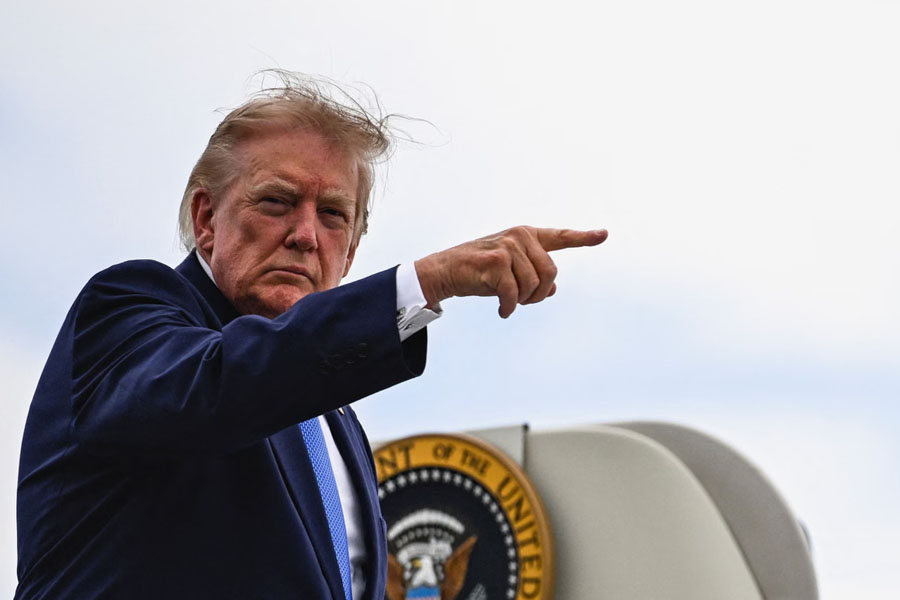
On Sunday night, Trump instructed the Pentagon to "substantially reduce" this week's joint military exercises with South Korea, saying the nuclear-armed North "has been unthreatening and respectful" and that the US president had a "very good relationship with Kim Jong-un".
Lee Jae Myung said on Tuesday that Seoul should proceed without disruption with the planned transfer, during his term, of wartime operational control, or Opcon, of South Korean forces from the US – a goal he and the government have long held.
"A strong alliance makes the foundation of security stronger, and strengthening our own capabilities increases our value and necessity as an ally," Lee said in a cabinet meeting, describing the US-South Korea alliance and independent defence as mutually reinforcing.
Welcome to the latest world headlines — where alliance politics, military readiness, and nuclear diplomacy collide on the Korean peninsula.
🌍 WORLD HEADLINES — KEY NUMBERS: Trump cuts joint drills with South Korea • 28,500 US troops in South Korea • 18,000 South Korean troops in joint exercises • 11-day exercise scaled back • 73-year-old military alliance • US-South Korea Mutual Defense Treaty (1953) • 18 UNC member states involved • North Korea ICBMs can reach US soil.
Trump Orders Pentagon to Scale Back Joint Military Exercises with South Korea
On Sunday night, Trump instructed the Pentagon to "substantially reduce" this week's joint military exercises with South Korea, saying the nuclear-armed North "has been unthreatening and respectful" and that the US president had a "very good relationship with Kim Jong-un".
Trump framed the decision as a courtesy to Kim, writing that the drills "send a signal that is totally inappropriate and hostile" to a country he described as "unthreatening and respectful", despite North Korea's continued missile testing and its expanding nuclear arsenal.
During questioning in the Oval Office on Monday, Trump claimed North Korean leader Kim had responded to his order to the Pentagon but did not provide details. When asked what stage the conversations with Kim were at, Trump said "it's very positive" but provided no further detail.
— Donald Trump, US President
Trump doubled down on his praise for Kim, saying their ties had reduced tensions. "You see, I'm actually making it much safer. Kim Jong-un has always treated me with great respect," he said. "I understand him. He understands me."
Trump has previously suspended major US-South Korean military exercises in pursuit of diplomacy with Kim. After his first summit with the North Korean leader in 2018, that year's Ulchi Freedom Guardian exercise was cancelled, while other drills were suspended or scaled back. The exercises were redesigned and resumed in modified form with changed names.
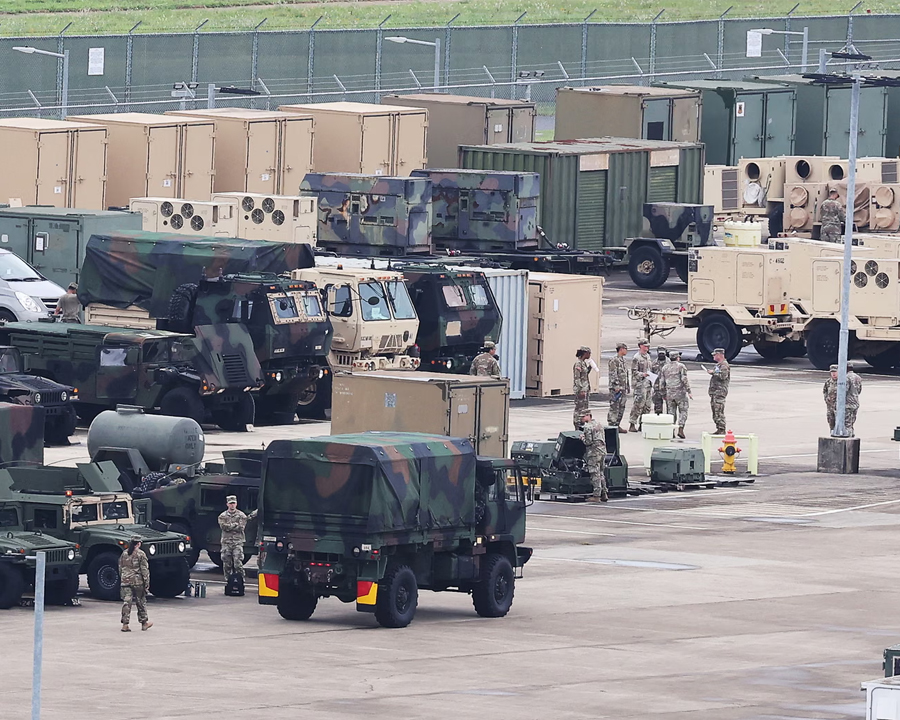
US soldiers are seen near military vehicles at Camp Humphreys in Pyeongtaek on 17 August 2026.
Lee Jae Myung Renews Push for Wartime Operational Control as Trump Cuts Drills
South Korea's president has renewed his push to regain independent control of the military from the US in the event of war and urged faster progress in acquiring nuclear-powered submarines after Donald Trump's order to cut joint drills.
Lee Jae Myung said on Tuesday that Seoul should proceed without disruption with the planned transfer, during his term, of wartime operational control, or Opcon, of South Korean forces from the US – a goal he and the government have long held.
"A strong alliance makes the foundation of security stronger, and strengthening our own capabilities increases our value and necessity as an ally," Lee said in a cabinet meeting, describing the US-South Korea alliance and independent defence as mutually reinforcing.
— Lee Jae Myung, President of South Korea
The issue dates back to the Korean war, which ended in an armistice rather than a formal peace treaty in 1953, meaning the two Koreas remain technically at war. US troops have been stationed in South Korea ever since, and the country now hosts Camp Humphreys, the largest American military base outside the US. The two militaries train and operate together closely, including through large-scale annual exercises such as this week's.
Wartime Opcon, the authority to direct South Korean forces if fighting resumes, has rested with the US since the war began, exercised through the head of the allies' Combined Forces Command, a position that has always been held by an American four-star general.
Seoul regained peacetime control of its own military in 1994, but the wartime authority has become a potent symbol of national sovereignty, and reclaiming it has been one of South Korea's foremost security goals for more than two decades, repeatedly delayed under successive governments.
This week's now-curtailed drills were meant to help certify South Korea's readiness to finally take it over, a process Lee has pushed to accelerate since taking office.
Lee also called for faster progress on South Korea's nuclear-powered submarine programme and on developing officers capable of integrated operations for future conflicts.
🇺🇸🇰🇷 US-SOUTH KOREA ALLIANCE — KEY FACTS
- US troops in South Korea: 28,500
- Camp Humphreys: Largest US military base outside the US
- Mutual Defense Treaty: Signed 1953
- Korean War: Armistice 1953 (technically still at war)
- Wartime Opcon: US-controlled since 1950
- Peacetime Opcon: Returned to South Korea in 1994
- North Korea ICBM status: Can reach US soil
- North Korea-Russia pact: Comprehensive strategic partnership (June 2024)
US Lawmakers Call Trump's Move 'Inane' and 'Shortsighted'
Donald Trump's move to gut Washington's 73-year-old military alliance with Seoul has been called "inane" and "shortsighted" as lawmakers warned it risked strengthening Russia's hand in Ukraine.
Jack Reed, the top Democrat on the Senate armed services committee, called it "another inane, haphazard decision by President Trump and his chaotic administration".
— Senator Jack Reed (D-RI), Senate Armed Services Committee
"When President Trump cuts military exercises to flatter a dictator or punishes South Korea for declining to join a war he started, all of our allies – and adversaries – think that America's commitments are negotiable," Reed said in a statement, describing the move as punishing Korea "for no reason beyond Trump's ego".
Reed's warning was echoed by Mark Kelly of Arizona, who sits on the same committee, and argued that the drills were not symbolic but the basis of the alliance's ability to function in a crisis. "North and South Korea are still technically at war," Kelly said. "Our ability to help defend our ally against the North Koreans is because our forces are well trained and able to coordinate with the South Koreans. Hollowing out these joint exercises is shortsighted and a mistake."
Andy Kim, the New Jersey senator who sits on the Senate foreign relations committee, said linking the exercises to South Korea's refusal to join the Iran war exposed a troubling attitude toward a key partner.
— Senator Andy Kim (D-NJ), Senate Foreign Relations Committee
"Our alliance with the Republic of Korea is critical for US security and prosperity – and I am concerned that President Trump's post today suggests a disregard for this relationship," Kim said. "South Korea is an essential partner in peace and security in a part of the world filled with risk; we should treat them that way instead of venting frustration on social media."
Thom Tillis, the outgoing Republican senator from North Carolina, chimed in making the point that the butterfly effect of Trump's decision would inadvertently benefit Russia.
— Senator Thom Tillis (R-NC)
"South Korea has been a solid military ally for over 70 years that possesses exquisite military capabilities," Tillis wrote on social media. "Reducing joint exercises with South Korea does nothing more than free up thousands of North Korea's troops to support Putin's systematic kidnapping, torture, rape and murder of innocent Ukrainian citizens."
Ulchi Freedom Shield Exercises Curtailed Despite North Korean Threat
The renewed push follows Trump's call to make cuts to the planned 10 days of drills that started on Monday under the name Ulchi Freedom Shield, one of two main annual exercises held by South Korea and the US.
They were expected to involve about 18,000 South Korean troops, alongside US forces and personnel from 11 of the 18 member states of the United Nations Command (UNC), the multinational body that oversees the 1953 armistice that halted hostilities of the Korean war.
Trump also tied his decision to the Iran war, saying he was unhappy that Seoul had declined to join the US military campaign against Iran, a campaign that has drained US missile stockpiles and, after Tehran shut the strait of Hormuz, helped push up prices at home. He acknowledged the two issues had little to do with one another, even as he punished Seoul over both.
"While somewhat unrelated (?), I recently asked the President of South Korea if they would like to join us in the Denuclearization of the Islamic Republic of Iran, and they said, 'No thanks'!" Trump wrote.
The US president acted despite warnings from US and South Korean military officials that Kim's regime is learning new battlefield tactics from sending North Korean troops to the Ukraine war. Last week, South Korean and US military officials said Ulchi Freedom Shield drills would incorporate aspects such as the North Koreans' experience with drones on the battlefield.
North Korea has deepened military ties with Russia since they signed a comprehensive strategic partnership pact in June 2024. Pyongyang is providing troops, artillery ammunition and ballistic missiles to support Moscow's war against Ukraine.
— Col Ryan Donald, Public Affairs Director, US-led Commands in South Korea
"They've taken those lessons they learned there and brought them back to North Korea, that changes the DPRK capability," said Col Ryan Donald, the public affairs director for the US-led commands in South Korea. "Our training accounts for that threat, that is why the exercise looks different [from previous exercises], and over the last five years it's continually evolved."
Despite Trump calling North Korea "unthreatening", his own administration's 2026 Annual Threat Assessment describes an "increasingly confident North Korean regime", warning that its weapons of mass destruction, conventional forces and cyber operations threaten the US, South Korea and Japan. His former director of national intelligence, Tulsi Gabbard, testified in March that "North Korea's ICBMs [intercontinental ballistic missiles] can already reach US soil".
🌍 WORLD HEADLINES: THE NUMBERS THAT DEFINE THE MOMENT
🇺🇸🇰🇷 ALLIANCE AT A GLANCE
Years of alliance
US troops in South Korea
South Korean troops in drills
UNC member states in drills
🗣️ KEY VOICES
Donald Trump:
"Kim Jong-un has always treated me with great respect. I understand him. He understands me."
Sen. Jack Reed (D-RI):
"Another inane, haphazard decision by President Trump and his chaotic administration."
Sen. Thom Tillis (R-NC):
"Reducing joint exercises frees up thousands of North Korea's troops to support Putin."
Col Ryan Donald:
"North Korea has taken lessons from Ukraine and brought them back."
⚠️ NORTH KOREAN THREAT ASSESSMENT
⚔️ WARTIME OPERATIONAL CONTROL (OPCON)
📋 TRUMP'S RATIONALE
🌍 THE FINAL VERDICT: ALLIANCE POLITICS, MILITARY READINESS, AND NUCLEAR DIPLOMACY
✅ WHAT'S HAPPENING:
- Trump cuts joint US-South Korea military drills
- Lee Jae Myung renews push for wartime Opcon transfer
- South Korea seeks nuclear-powered submarines
- US lawmakers condemn decision as "inane"
- Trump cites "very good relationship" with Kim
⚠️ THE CHALLENGES:
- North Korea ICBMs can reach US soil
- North Korea learning drone tactics from Ukraine
- Russia-North Korea strategic partnership
- Trump punishes Seoul for declining Iran war
- 73-year-old alliance undermined
- Critics warn move benefits Russia in Ukraine
"Kim Jong-un has always treated me with great respect. I understand him. He understands me," Trump declared, ordering the Pentagon to cut joint military exercises with South Korea. The decision has been condemned by US lawmakers as "inane" and "shortsighted," with Senator Reed warning that "all of our allies – and adversaries – think that America's commitments are negotiable." South Korea's President Lee Jae Myung renewed his push for wartime operational control, saying "strengthening our own capabilities increases our value and necessity as an ally." Critics warn the move benefits Russia in Ukraine and ignores North Korea's growing ICBM threat.
— World Headlines Analysis
Stay updated with the latest world headlines, Asia Pacific developments, and breaking news on our World News Page.