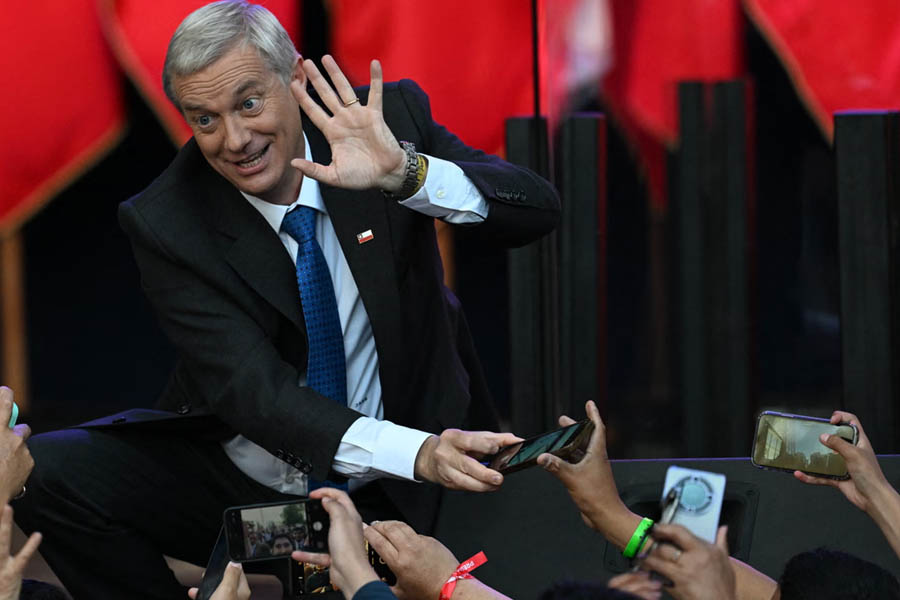
📌 The town that launched a far‑right tsunami
11-March-2026: Just south of Santiago, the tiny rural town of Paine — quiet grid of painted adobe facades — holds the key to Chile’s sharp turn. María Elena Balcázar, at her roadside cafe opposite the Parroquia Santa María Virgen de Paine, sums up the white‑knuckle fear: “We have so much crime here – robberies, guns, drugs. Past eight o’clock nobody goes out. People voted for José Antonio Kast because he promised strong, drastic changes.” The 60‑year‑old Kast, a Pinochet admirer, swept December’s runoff with 58% of the vote, on a pledge to crush violence and illegal immigration. 🗳️🔒
📊 The murder-rate paradox — fear six times higher than reality
Violent crime has ticked up with international gangs crossing porous borders. But the perception far outstrips reality. Chile’s murder rate sits at 6 homicides per 100,000 people (2023) — three times higher than 2015, yet dwarfed by regional giants: Ecuador 46, Haiti 41, Mexico 25. In fact, only Argentina and Bolivia are safer in Latin America. Still, a 2024 Gallup report ranked Chile 6th worldwide in fear of walking at night. Rolling news loops of violent assaults, plus the legacy of leftist Gabriel Boric (who beat Kast in 2021), created the perfect storm for Kast’s law‑and‑order message. 📺😨
🗡️ The Pinochet fan who never wavered
Kast studiously avoided his ultra‑conservative moral code during the campaign, but his record is stark. He has publicly supported dictator Augusto Pinochet, under whom more than 3,200 people were murdered and 1,469 forcibly disappeared. In 2021, Kast said the former dictator “would have supported” his candidacy. During three congressional terms, he fought abortion, the morning‑after pill, and championed “traditional family values.” Political scientist Claudio Fuentes (Diego Portales University) observes: “They figured out that to win, they had to move away from Boric’s agenda and focus on public safety and economic growth.” ⚖️📉
🇩🇪 Kast’s German lineage: from Wehrmacht to Chilean empire
Born in Santiago in 1966, the youngest of 10 children of Michael Kast (Nazi party member, Wehrmacht lieutenant on the eastern front) and Olga Rist — devotees of the hardline Catholic Schoenstatt movement. They built a meat processing factory in Paine and a Bavarian restaurant on the pan‑American highway, now a successful chain of 50+ restaurants. María Elena Balcázar’s father worked at the factory; she remembers Michael Kast handing out sandwiches to children. Brother Miguel Kast was a Pinochet‑era “Chicago Boy.” The family’s rightwing imprint runs deep. 🥩🍺
— Flor Lazo, whose father and two brothers were disappeared after Pinochet’s 1973 coup.
🌎 From Guzmán’s shadow to Trump’s shield
Kast studied law at the Universidad Católica under Jaime Guzmán, Pinochet’s constitution architect. He appeared in campaign adverts backing the dictatorship before the 1988 plebiscite. After a brief law stint, he joined the conservative UDI in 1996, serving three congressional terms. But in 2016 he left UDI, claiming it had drifted from its principles. He ran for president as an independent in 2017 (8% of the vote) and founded the Republican party in 2019. Recently he attended Trump’s ‘Shield of the Americas’ gala, spoke at Hungary’s CPAC, and met El Salvador’s security minister during its gang crackdown. International far‑right embrace. 🤝🇸🇻🇺🇸
⚡ What Kast’s victory means for Chile now
The night of the runoff, Kast announced an “emergency government” to wrest back public order. He has avoided discussing his social ultra‑conservatism, but allies and historians point out: “He always maintained his beliefs and never wavered,” says Felipe González Mac‑Conell, co‑author of a book on Kast. Meanwhile, Paine’s quiet squares and the capital’s upscale neighbourhoods wait to see if the Pinochet admirer will govern from the centre — or drag Chile back into its darkest chapter. Human rights groups and families of the disappeared are already on a “war footing.” 📢🇨🇱
📰 SEO snapshot: José Antonio Kast, a polarizing figure with admiration for Pinochet and a Nazi‑affiliated family, rode a wave of crime fear to the Chilean presidency. While actual homicide rates (6 per 100k) are far below regional nightmares, the perception of violence — fuelled by media and immigration concerns — handed the far right a historic win. With allies from Trump to Bukele, Kast’s Chile may redraw the Andean political map.