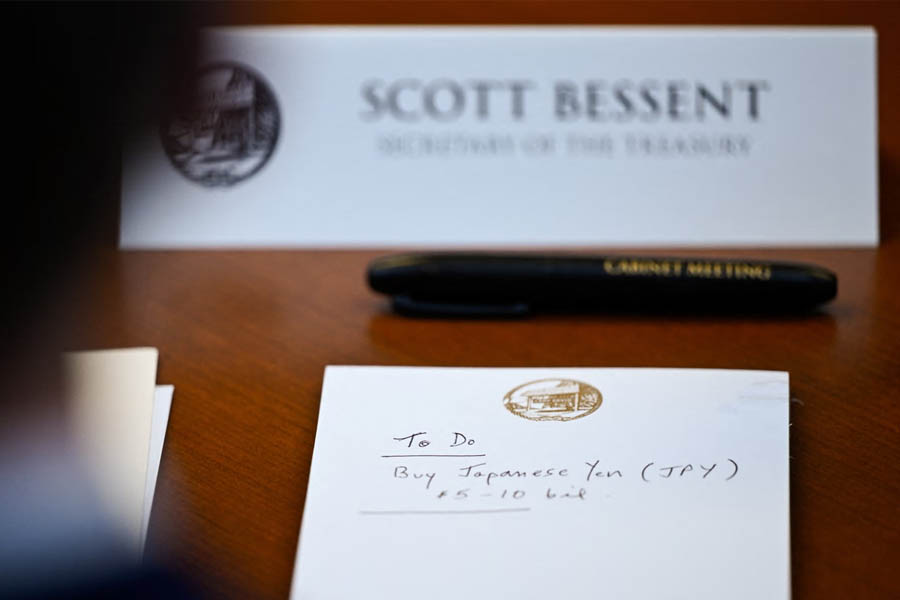
Camp David, Maryland – During a cabinet meeting at Camp David on Friday, US Treasury Secretary Scott Bessent carelessly revealed plans for the US to buy $5bn-$10bn in Japanese yen in a scribbled "to do" list left visible to a Reuters photographer.
The image, taken over Bessent's shoulder during a portion of the meeting open to journalists, showed a Camp David notepad with the underscored words "To Do" followed by "Buy Japanese Yen (JPY) $5-10 bil".
Bessent's name card on the Camp David conference table is visible and positioned immediately above the notepad.
Key developments:
- Treasury Secretary Scott Bessent's notepad reveals US plan to buy $5bn-$10bn in Japanese yen
- Photo taken over Bessent's shoulder during Camp David cabinet meeting
- Notepad visible when Bessent spoke to praise the president 30 minutes later
- Fed's New York branch sold euros to buy yen on behalf of Treasury, FT reports
- Yen hit weakest level since 1986 last week
- Japanese authorities intervened to prop up yen earlier on Friday
- Dollar dropped 0.8% against yen in late afternoon trading
- US Treasury hasn't intervened to prop up yen since 2011 earthquake/tsunami
- Latest intervention would mark first US Treasury yen intervention in 15 years
The photograph was taken at 11.33am local time, Reuters reported. Video of the televised portion of the cabinet meeting showed that the notepad was still clearly visible in front of Bessent when he spoke, to praise the president, 30 minutes later.
A Treasury spokesperson did not immediately respond to a Reuters request for comment on the contents of the notepad, "or whether the treasury had intervened to help prop up the yen's value against the dollar on Friday," the news agency said.
The Financial Times reported later that the Federal Reserve Bank of New York sold euros to buy yen on behalf of the US Treasury Department.
Yen Depreciation and Market Impact
The depreciation of the yen, which dipped last week to its weakest level since 1986, has been driven by a number of factors, including rising oil prices, according to Bloomberg News.
Earlier on Friday, about two hours before the note was seen in front of Bessent, Reuters reported that the Treasury Department had notified a number of banks that it could intervene in the yen market that day, an unnamed source said.
Japanese authorities had stepped in to prop up the yen earlier on Friday, triggering a substantial strengthening of the Japanese currency during early trading hours.
There appears to have been another sizeable strengthening of the yen against the dollar during the late afternoon on Friday.
Data from LSEG shows the dollar dropped from about 158.9 yen at around 4.14 pm ET to about 157.6 yen just before 5pm – a drop of about 0.8%.
Historical Context
The US Treasury has not intervened to prop up the yen since 2011, when it joined other G7 countries in a coordinated action after a devastating earthquake and tsunami rocked Japan.
That intervention came after the yen surged to record highs, threatening Japan's export-driven economy as companies repatriated funds following the disaster.
This proposed intervention would mark the first US Treasury yen purchase in 15 years, representing a significant shift in US currency policy.
Political Implications
The accidental revelation of the Treasury's currency plans raises questions about the administration's approach to foreign exchange policy and international monetary cooperation.
The timing of the intervention, coinciding with the Camp David cabinet meeting, suggests coordinated action between Treasury and the Federal Reserve to influence currency markets.
Analysts say the move signals US concern over the yen's weakness and its potential impact on global economic stability.
Market Reaction
The yen strengthened significantly following the revelations, with traders reacting to both the Japanese authorities' earlier intervention and the prospect of US Treasury involvement.
The 0.8% drop in the dollar-yen exchange rate in late afternoon trading suggests the market interpreted the US intervention as credible and significant.
Currency traders will be watching closely for any confirmation of the intervention and details of the execution strategy.
💰 The Big Picture
US Treasury Secretary Scott Bessent inadvertently revealed plans for the US to buy $5bn-$10bn in Japanese yen when a Reuters photographer captured his "to do" list during a Camp David cabinet meeting. The revelation comes as the yen hit its weakest level since 1986, prompting Japanese authorities to intervene earlier on Friday. The US Treasury hasn't intervened to prop up the yen since 2011, making this a significant policy shift. The Federal Reserve Bank of New York reportedly sold euros to buy yen on behalf of the Treasury, triggering a 0.8% drop in the dollar against the yen in late afternoon trading. The incident raises questions about the administration's currency strategy and its approach to international monetary cooperation.
What's Next
Key developments to watch:
- Official confirmation: Treasury Department may issue statement on the intervention
- Market reaction: Continued yen strengthening or reversal
- G7 coordination: Possible discussions with other major economies
- Political fallout: Questions over the accidental revelation
- Federal Reserve role: Further details on execution of the intervention
💰 For more breaking financial and political news: Visit NewsOrbit – World Breaking News for the latest headlines from around the globe.