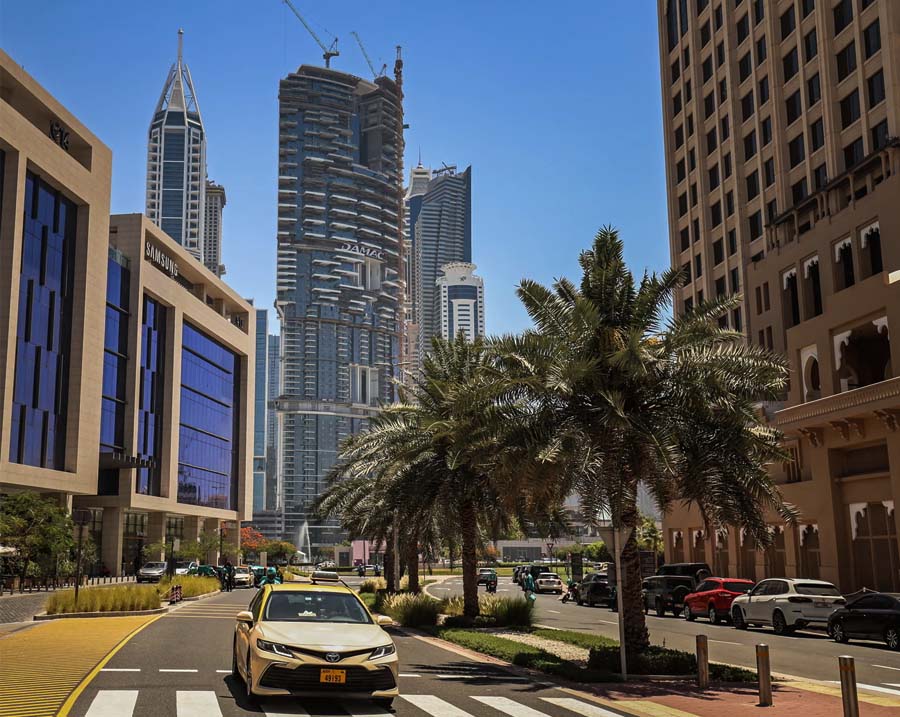
Dubai, United Arab Emirates – Property sales in Dubai have fallen "off a cliff," a leading market watcher has said, after war in the Middle East forced a dramatic slowdown in one of the world's most expensive real estate markets, sending the super-rich fleeing to other international hubs and wiping tens of millions off luxury property prices.
Sales in the city dropped 19% in May compared with the previous month, accelerating from a 4% drop in April, according to the researcher ValuStrat. Transactions are now below half their level compared with the same point last year, marking one of the sharpest corrections in the city's history.
"The ready homes market has not recorded an annual decline of this magnitude since the pandemic," said Haider Tuaima, head of real estate research at ValuStrat, a Dubai-based consultancy that has been tracking the city's property market since 2014.
Key developments:
- Dubai property sales dropped 19% in May, accelerating from 4% decline in April
- Transactions now below half their level compared to same point last year
- Property worth 22.5bn dirhams ($6.1bn) sold in May – 42% below April
- Sales about half of pre-war monthly average (46.6bn dirhams)
- Sellers wiping tens of millions off luxury villa and flat prices
- Buying agent: every 'super-high-net-worth' client he sold to in past 18 months has left Dubai
- Sales going through at 20%-25% discount to pre-conflict values
- Dubai was world's busiest luxury real estate market in 2025
- 9,050 sales in $10m+ bracket vs 6,577 in New York, 3,089 in London
- Super-rich turning to Milan, London and Singapore instead
- Broker numbers expected to fall from 10,000 to previous levels
'Every Single One Has Now Left Dubai'
Dubai, which sits on the eastern side of the Arabian peninsula, had experienced a frenzied property boom in recent years, boosted by a wave of high-earners attracted to the city's zero income tax policy, golden visa program, and status as a safe haven for global capital.
But the outbreak of war in the Middle East in late February has rocked the market. An Iranian missile hitting the five-star hotel in Dubai's famed Palm Jumeirah area in March sent shockwaves through the city's expatriate community and signaled that even Dubai was not immune to regional conflict.
Yasin Valimulla, a buying agent in Dubai who specializes in properties worth at least $10 million (£7.5 million), said that the few home sales still going through were at a 20%-25% discount to their value before the conflict.
"We have sold to super-high-net-worth guys in the last year and a half – every single one of them has now left Dubai," he said.
"There was a lot of panic in March and there is still not much clarity to this day," he added. "Western European buyers are now more reluctant to buy properties here. I think they want to wait out maybe a year, even two years. It depends on how things play out."
From Boom to Bust: The Numbers Behind the Crash
A separate study from Dubai-based research firm Reidin found that property worth 22.5 billion dirhams ($6.1 billion / £4.5 billion) was sold in May, 42% below the April figure. It was about half of the 46.6 billion dirhams in the month before the conflict began, according to figures first reported by Bloomberg.
It marks a sharp correction for Dubai, which was the busiest city in the world for luxury real estate in 2025. The international estate agent Knight Frank found that more homes worth $2.5 million to $10 million were bought in Dubai than any other city in the world at the end of 2025 – ahead of London, New York, Los Angeles, and Hong Kong.
In the $10 million-plus bracket, there were 9,050 sales in Dubai compared with 6,577 in New York and 3,089 in London. The city had become a magnet for the global super-rich, drawn by its tax advantages, safety, and luxury lifestyle.
But the market is now correcting itself, Valimulla said. "The numbers were so high to begin with, especially in the last two years. The market at that level was not sustainable anyway.
"There is going to be a correction in pricing, we just do not know the impact of that correction until we have [geopolitical] clarity."
Super-Rich Flee to Milan, London and Singapore
In the meantime, the nomadic super-rich class are turning to other international hubs. Milan has emerged as a surprise beneficiary, with its combination of fashion, culture, and relative safety attracting wealthy Europeans. London, despite its own economic challenges, remains a perennial favorite, while Singapore has become the go-to destination for wealthy Asians seeking stability.
The exodus of high-net-worth individuals from Dubai is particularly significant because they were the primary drivers of the city's luxury property boom. Their departure removes the demand that had pushed prices to record levels and leaves sellers scrambling to find buyers at any price.
Property agents report that sellers of luxury villas and flats in the city have wiped tens of millions of pounds off asking prices. One agent described the market as "frozen," with buyers and sellers unable to agree on a fair price in the current climate of uncertainty.
Brokers Face Shakeout as Market Contracts
Richard Waind, of the real estate group Cencorp, added that several brokers in Dubai's once booming property market would now be forced to close.
"The war has been a black swan event that was huge and swift," he said. "The slowdown in sales is putting pressure on those smaller agencies that set up in a frothy market. There were about 1,000 brokers in the market a decade ago – now it's about 10,000. That is going to fall."
The rapid expansion of brokerage firms during the boom years now appears to be a liability. With sales volumes plunging, many smaller agencies are struggling to cover their overheads, and consolidation is expected to accelerate in the coming months.
What Comes Next for Dubai Property?
It remains unclear how quickly the market may recover if a peace deal between the US and Iran holds firm. A lasting ceasefire would likely restore some confidence, but the damage to Dubai's reputation as a safe haven may take years to repair.
Dubai has weathered crises before. The global financial crisis of 2008 hit the city hard, leading to a property crash and a bailout from neighboring Abu Dhabi. The city recovered strongly, driven by a combination of government stimulus, infrastructure investment, and renewed foreign interest.
But the current crisis is different. The war is closer to home, the geopolitical situation is more volatile, and the global economic outlook is uncertain. The World Bank recently cut its global growth forecast to 2.5% – the lowest level since the pandemic.
For Dubai's property market, the immediate future looks bleak. Sales are expected to remain subdued until there is greater clarity on the geopolitical front. And even if a peace deal is reached, the city may struggle to regain its status as the world's premier destination for the super-rich.
As Valimulla put it: "We just do not know the impact of that correction until we have [geopolitical] clarity."
🏗️ The Big Picture
Dubai's property crash is a vivid illustration of how geopolitical shocks can upend even the most buoyant markets in an instant. Just months ago, the city was the world's busiest luxury real estate market, attracting the global super-rich with its zero income tax, golden visas, and reputation as a safe haven. The outbreak of war in the Middle East changed everything. An Iranian missile strike on a Palm Jumeirah hotel shattered the illusion of safety, and the super-rich began to flee – to Milan, London, Singapore. Sales have plunged 42% in a month, transactions are half pre-war levels, and luxury prices are being discounted by up to 25%. With 10,000 brokers now chasing a shrinking pool of buyers, a shakeout is inevitable. The question is not whether Dubai's property market will recover, but when – and what it will look like when it does.
🏗️ For more breaking news and business updates: Visit NewsOrbit - World Breaking News for the latest headlines from around the globe.