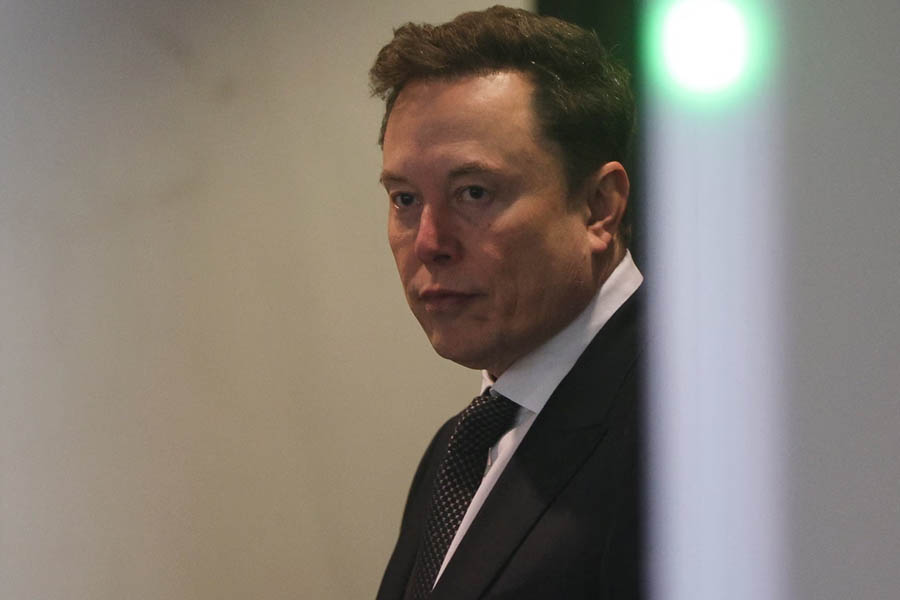
29 April 2026 | Oakland, California
OAKLAND, California – "Have you stopped beating your wife?"
The courtroom gasped. Judge Yvonne Gonzalez Rogers cut Elon Musk off mid-sentence before he could finish the analogy. But the damage – and the point – had already landed.
The world's richest man, the CEO of Tesla and SpaceX, the self-described "technoking" of Silicon Valley, was being grilled under oath. And he did not like it one bit.
"Your questions are not simple," Musk told OpenAI's lead counsel, William Savitt. "They are designed to trick me, essentially."
Thus began the second day of the trial that has captivated the tech world – a $134 billion showdown between Elon Musk and Sam Altman, two of the industry's most powerful and polarizing figures, over the soul of artificial intelligence.
⚡ THE STAKES: $134 billion in damages • OpenAI's $1 trillion IPO at risk • Control of the world's most influential AI company • The fate of "beneficial AI" hangs in the balance
"YOU'RE BEING MISLEADING": THE CROSS-EXAMINATION
The tone shifted the moment Savitt began his cross-examination. Musk's own lawyer, Steven Molo, had spent Tuesday feeding him softball questions – and getting repeatedly admonished by the judge for leading the witness. On Wednesday, there were no softballs.
Savitt fired rapid-fire questions. Musk prevaricated. The judge interjected. Again and again.
"OpenAI was formed as a nonprofit in 2015. True or false?" Savitt asked.
Musk hesitated. "In this case, yes."
But then he kept going. "The reason you can't simply answer a yes or no question, for example if you ask, 'Have you stopped beating your wife…'"
Judge Gonzalez Rogers stopped him. Several people in the courtroom audibly gasped. The reference was unmistakable – Musk had just compared the line of questioning to coercion.
At other points, Musk told Savitt: "You're being misleading with your question." He refused to answer as instructed. He accused OpenAI's lawyers of deception. The exchange was testy, tense, and made for incredible courtroom drama.
— Elon Musk, on the witness stand
THE "HAUNTED MANSION MEETING": PROOF OF A FOR-PROFIT PLAN?
Much of Savitt's questioning focused on internal emails and text messages about whether Musk wanted to create a for-profit. One email from within Musk's company Neuralink showed Musk writing that "setting it up as a nonprofit might be the wrong move."
But the most colorful evidence was a document from what Savitt called the "haunted mansion meeting" – so named because it took place in a supposedly haunted mansion that Musk had just bought in San Francisco. According to the notes, Musk suggested creating a for-profit at that meeting.
Musk's common response to these questions was: "I don't think creating a for-profit as an adjunct to a non-profit is breaking a promise."
The distinction may hinge on the interpretation of OpenAI's founding agreement – a document that Musk himself helped write.
THE POACHING CLAIM: TESLA'S "ENORMOUS AI-ENABLED ROBOT ARMY"
Savitt also pointed out that Musk was on OpenAI's board through February 2018, which entailed a legal obligation to act in the company's best interest. Simultaneously, Musk was allegedly poaching employees for Tesla – including renowned engineer Andrej Karpathy.
In one email from June 2017 with Jim Keller, the vice-president of autopilot at Tesla, Musk said: "The OpenAI guys are going to want to kill me" regarding his recruiting of Karpathy.
Savitt questioned Musk about Tesla's pursuits with artificial general intelligence, submitting several documents into evidence – including one in which Musk said he plans to build an "enormous AI-enabled robot army."
"If we build the robots, I wanted to make sure we're safe and we don't have a Terminator situation," Musk testified.
Whether the jury finds that concern genuine – or self-serving – may determine the outcome of the trial.
THE ACCUSATION: "THEY STOLE A CHARITY"
Musk's core allegation is simple, dramatic, and repeated throughout his testimony: Sam Altman and Greg Brockman "stole a charity."
He accuses his OpenAI co-founders of breaking the founding agreement of the company to build AI to benefit humanity, instead shifting the non-profit to a for-profit structure and unjustly enriching themselves along the way.
"I lost trust in Altman, and I was really concerned they were trying to steal a charity, and it turned out to be true," Musk said – one of the many times he repeated the accusation.
Musk called himself a "fool" for providing OpenAI funding to create a billion-dollar company. He testified that he cautiously continued funding OpenAI, paying its rent and sending $5 million quarterly payments, because he received assurances from Altman that the company would remain a non-profit.
OpenAI rejects Musk's claims as "motivated by jealousy." The company says Musk was always aware of plans for the business and that he left OpenAI in 2018 only after a failed bid to take it over. OpenAI also emphasizes that it is still overseen by the original non-profit – a structure Musk calls a "sham."
THE JACKASS EMAIL: "I DON'T YELL AT PEOPLE, BASICALLY"
Musk's own lawyers tried to paint him as a humanitarian and tech pioneer. Molo showed Musk emails from OpenAI engineers praising his technical knowledge. But he also showed him a document where Musk called OpenAI's safety team "jackasses."
Musk said the "jackass" statement was a joke. "I don't yell at people, basically," Musk said. "You occasionally have to use strong language to get people to change their course."
The courtroom – filled with tech enthusiasts who had lined up before dawn – seemed unsure whether to laugh or cringe.
THE SPECTACLE: MUSKFANS, PHOTOGRAPHERS, AND THE JUDGE'S PATIENCE
The federal courthouse in Oakland was packed with a mix of media and eager young men who lined up before dawn to get a glimpse – and a picture – of Musk. At one point, Judge Gonzalez Rogers threatened that if observers did not stop taking photos and videos, a violation of the court's rules, she would shut down an overflow room for watching the proceedings.
The trial is being watched intensely in Silicon Valley. It pits two of the tech industry's most powerful men against each other and promises to intensify their feud. Altman and Musk have openly sniped at each other on social media in the lead-up to the trial, causing the judge to request that both parties keep their posts to a minimum.
Investors and other AI companies are also keeping an eye on the trial because it threatens severe consequences for OpenAI. The company is seeking to go public on the US stock market later this year at about a $1 trillion valuation – one of the largest IPOs in history. Any changes to its leadership or corporate structure would threaten that offering.
WHAT COMES NEXT?
The trial is expected to last around three weeks. A nine-person jury will decide on Musk's claims. But if OpenAI is found liable, the judge will be the one to decide on any remedy – including whether to undo the for-profit conversion, remove Altman and Brockman, or award Musk's requested $134 billion in damages.
Musk is seeking to have that money redistributed to OpenAI's non-profit arm – a remedy that would reshape the company's future.
This much is clear: whatever the outcome, the trial has already exposed the raw nerves, broken friendships, and philosophical divides at the heart of the AI revolution.
Two men who once shared a mission to save humanity from rogue AI are now fighting each other in federal court. And the world is watching.
Stay updated with the latest tech trends headlines on our Tech Trends Page.