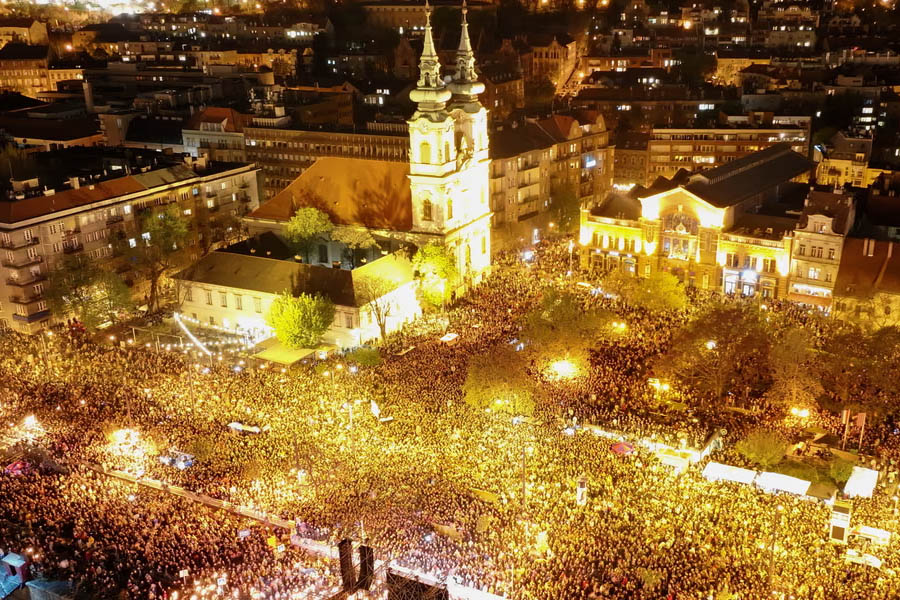
12 April 2026 | Budapest, Hungary
Budapest, Hungary – The unthinkable has happened. After 16 years, Viktor Orbán is no longer Hungary's prime minister. The opposition Tisza party, led by the charismatic Péter Magyar, has secured a decisive election victory – ending one of the longest-serving premierships in modern European history.
Orbán conceded defeat shortly after polls closed, his voice heavy but his words unambiguous. "The outcome is painful but unambiguous," he said. "The people have spoken." He confirmed that Fidesz would continue its role from the opposition benches – a position the party has not occupied since 2010.
In Budapest, thousands poured into the streets. The crowd celebrated not just a victory, but a new beginning. After 16 years, Hungary had chosen change.
Election Results:
- Tisza Party (Péter Magyar): 138 seats – Super-majority
- Fidesz (Viktor Orbán): 55 seats
- Mi Hazánk: 6 seats
- Total seats: 199
- Turnout: Historically high
A Super-Majority for Change
Tisza's commanding majority – 138 seats in the 199-seat parliament – gives the party the power to amend the constitution and reshape key legislation without any opposition support. It is a mandate for transformation, delivered with unmistakable clarity.
Péter Magyar, speaking to jubilant supporters in Budapest, described the election result as a turning point in Hungary's political landscape. "Today, the Hungarian people chose Europe. They chose democracy. They chose a future free from corruption and isolation," he said.
Magyar confirmed that his government would move swiftly to strengthen cooperation with the European Union, unlock frozen EU funds, and redirect national resources toward public services – healthcare, education, and infrastructure.
International Implications: A New Era for EU Relations
The election outcome is expected to fundamentally reshape Hungary's position within the European Union and NATO. For years, Orbán's government clashed with Brussels over justice, migration, LGBTQ+ rights, and aid for Ukraine – leading to the suspension of billions in EU funding.
That era is now over. Leaders across Europe have already signaled their readiness to work with the incoming government. European Commission President Ursula von der Leyen congratulated Magyar, saying the EU looked forward to "constructive and cooperative relations" with Hungary once again.
The shift is also expected to affect Hungary's broader geopolitical stance, including its position on sanctions against Russia and military aid to Ukraine – areas where Orbán consistently broke with EU consensus.
End of a Long Political Era
Viktor Orbán first came to power in 2010, sweeping into office on a wave of populist anger. Over the next 16 years, his government implemented wide-ranging political and institutional changes: a new constitution, reforms to electoral laws, the judiciary, and the media landscape. Critics called it democratic backsliding. Supporters called it the "illiberal state."
But on Sunday, the Hungarian people delivered their verdict. High turnout reflected the significance of the contest – voters were not merely choosing a government, but deciding the soul of their nation.
Orbán's concession was graceful but grim. For a man who once declared that "the future belongs to illiberal democracy," the future has now arrived in a different form entirely.
Challenges Ahead: Dismantling the Orbán System
Despite the super-majority, the incoming administration faces complex challenges. Institutional structures built over the past 16 years remain deeply embedded across governance, media, and economic sectors. Orbán's allies control countless boards, foundations, and regulatory bodies.
"You cannot dismantle a system like this overnight," said one Budapest-based analyst. "Magyar has the mandate. Now he needs the strategy – and the patience."
Analysts suggest that while reforms may begin swiftly, structural changes could take years. The Tisza government will need to navigate a delicate transition, balancing the public's hunger for immediate change with the reality of entrenched power.
What Comes Next?
Péter Magyar will be formally appointed prime minister in the coming days. His first acts are expected to include:
- Reopening dialogue with the European Commission to unlock frozen EU funds
- Initiating judicial and media reforms
- Addressing corruption investigations
- Clarifying Hungary's position on Ukraine aid and Russia sanctions
For Orbán, the future is uncertain. He has promised to remain in politics, leading Fidesz from opposition – a role he has not held since becoming prime minister. But history suggests that for populist strongmen, the opposition benches can be a cruel place.
For Hungary, the celebrations will continue through the night. But come morning, the real work begins. After 16 years, the Orbán era is over. The Magyar era has just begun.
Stay updated with the latest world headlines on our World Headlines Page.