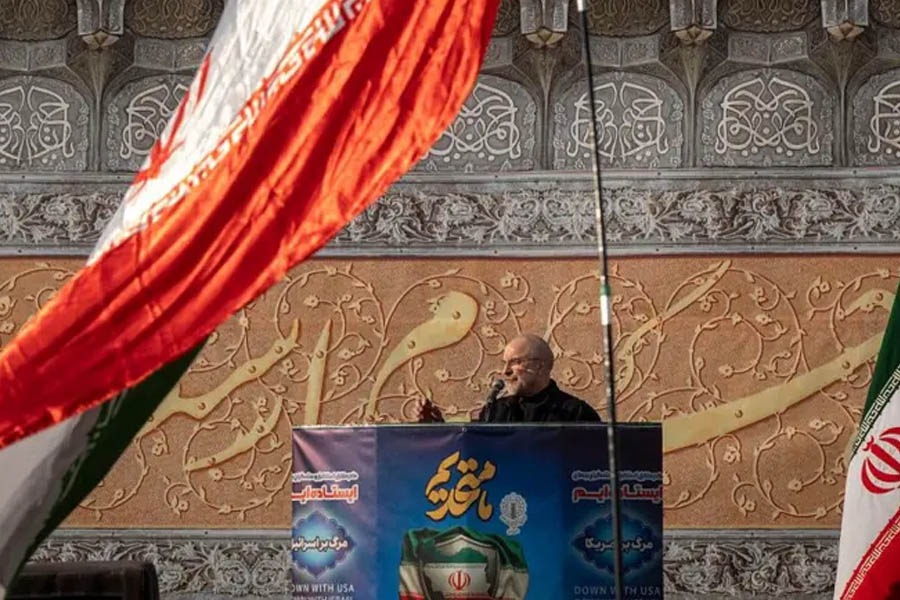
Tehran: Iran's Parliament Speaker Mohammad Bagher Ghalibaf has issued a strong warning, accusing adversaries of signaling openness to negotiation publicly while secretly preparing for a ground offensive. The warning comes as the conflict in the Gulf region enters its second month with no signs of de-escalation.
Key developments:
- Iran parliament speaker warns of hidden US ground attack plans
- UAE aluminium facility sustains significant damage from missile strikes
- Kuwait airport radar system heavily damaged in attacks
- USS Tripoli arrives in region with thousands of Marines
- 701 strikes recorded across Iran in 24 hours, 1,551 civilians killed since war began
- Egypt orders early closure of shops to conserve energy
Iran Parliament Speaker Issues Warning
In a message released by Iranian state media to mark 30 days since the outbreak of the war, Ghalibaf stated that "the enemy signals negotiation in public, while in secret it plots a ground attack." The statement reflects growing Iranian concerns about potential US military escalation despite ongoing diplomatic back-channel communications.
He further claimed that the United States is attempting to impose its strategic objectives through a detailed set of demands, describing it as a "15 point list" aimed at achieving goals that could not be secured through military confrontation. Iranian officials have previously rejected similar proposals, insisting on their own five-point plan for regional peace.
Ghalibaf emphasized that Iranian forces are prepared for escalation, warning that they are "waiting for American soldiers to enter on the ground so they can rain fire upon them." The threat signals that any US ground operation would face significant resistance from Iranian military forces deployed across strategic locations in the Gulf region.
Addressing speculation about Iran's possible surrender, he firmly rejected the notion, stating that Iran will not accept humiliation under any circumstances. The statement appeared aimed at countering rumors that Tehran might be seeking to negotiate an end to the conflict on unfavorable terms.
Rising Attacks on Gulf Infrastructure
The conflict has intensified significantly across the Gulf region over the past 24 hours, with major infrastructure coming under repeated attacks. Industrial facilities, airports, and energy infrastructure have all been targeted, causing significant damage and disrupting economic activity across multiple Gulf states.
The United Arab Emirates reported one of the highest levels of ballistic missile strikes in recent weeks. Emirates Global Aluminium confirmed that its major facility in Abu Dhabi sustained significant damage, with several workers injured. The facility is a critical component of the UAE's industrial diversification strategy, and its damage could have long-term economic implications.
In Bahrain, Aluminium Bahrain reported that two employees suffered minor injuries after its smelter, one of the largest in the world, was targeted. The company is still assessing the full extent of the damage to its operations, which are a cornerstone of Bahrain's economy.
Kuwait also experienced serious disruptions, as the radar system at its international airport was heavily damaged in the attacks. The damage has forced the airport to reduce flight operations, with officials working to restore full capacity as quickly as possible.
Iran's Revolutionary Guards stated that these strikes were carried out in response to earlier attacks on Iranian steel plants, highlighting the escalating cycle of retaliation that has characterized the conflict. Each attack appears to prompt a counterattack, with industrial infrastructure becoming a primary target for both sides.
Military Build Up and Strategic Uncertainty
Reports indicate a significant increase in United States military presence in the region. The Pentagon is believed to be preparing for potential ground operations, though final approval remains uncertain as administration officials debate the risks and benefits of such an escalation.
United States Central Command confirmed the arrival of the warship USS Tripoli, while thousands of Marines are reportedly positioned aboard vessels heading toward the Gulf. The Tripoli is a large amphibious assault ship capable of carrying helicopters, vertical takeoff jets, and landing craft for potential beach assaults.
Additional airborne forces remain on standby, with discussions ongoing about further reinforcements. The 82nd Airborne Division has been placed on heightened alert, and additional units from the 101st Airborne are reportedly preparing for potential deployment.
Military analysts note that the US force posture now includes significant amphibious and airborne capabilities, suggesting that planners are preparing for a range of contingencies including potential ground operations to secure strategic locations such as Kharg Island or to reopen the Strait of Hormuz.
Regional Impact and Energy Measures
The war is also affecting neighboring countries, prompting emergency measures. Egypt has ordered shops, restaurants, and commercial centers to close early in an effort to conserve energy as the conflict disrupts natural gas supplies that the country depends on for electricity generation.
Authorities have also introduced power saving measures, including dimming street lighting and reducing outdoor advertising illumination. The measures are designed to reduce electricity consumption and extend the life of available fuel supplies.
Other regional countries are considering similar measures as energy prices remain elevated and supply disruptions continue. The economic impact of the conflict is being felt across the Middle East, with tourism, transportation, and industrial sectors all experiencing significant disruptions.
Heavy Civilian Toll in Iran
According to the Human Rights Activists News Agency, the past day has seen one of the highest levels of attacks since the war began. At least 701 strikes were recorded across Iran within a 24 hour period, representing a significant intensification of the air campaign.
The majority of these attacks were concentrated in Tehran, accounting for nearly three quarters of the total. Residential areas near military and industrial targets have been particularly affected, with residents reporting that explosions have become a regular part of daily life.
The agency reports that the conflict has resulted in the deaths of at least 1,551 civilians, including 236 children, underscoring the severe humanitarian consequences of the ongoing war. The civilian casualty count has been rising steadily as the conflict continues, with medical facilities struggling to treat the wounded.
International humanitarian organizations have called for ceasefires to allow aid to reach affected populations, but the intensity of the fighting has made such efforts extremely dangerous. Hospitals in affected areas report shortages of medical supplies, and many healthcare workers have been forced to work around the clock.
Divisions Over Future Peace Talks
As tensions escalate, Gulf countries are increasingly concerned about their security and economic stability. Many regional governments insist on having a direct role in any future peace negotiations, recognizing that their interests are directly affected by the conflict's outcome.
However, divisions remain over how to approach relations with both Iran and the United States, reflecting the complex geopolitical landscape shaping the conflict. Some Gulf states advocate for a more conciliatory approach toward Tehran, while others support continued military pressure.
Pakistan continues to play a mediatory role, hosting talks between regional powers and conveying messages between Tehran and Washington. The effectiveness of these diplomatic efforts remains uncertain as military operations continue to escalate on multiple fronts.
The situation remains highly volatile, with continued military escalation raising fears of a broader regional confrontation. Diplomats warn that the window for a negotiated settlement may be closing as both sides become more entrenched in their positions and the human and economic costs continue to mount.