22 April 2026 | Tehran / Washington / Dubai
Tehran, Iran – The guns are not yet silent. The ceasefire is hanging by a thread. And in the narrow waters of the Strait of Hormuz, Iran just fired a warning shot heard around the world.
Iran's Islamic Revolutionary Guard Corps (IRGC) navy has seized two ships in the strait, according to the semi-official Tasnim news agency. The vessels – identified as MSC Francesca and Epaminondas – were reportedly directed to Iranian shores after "operating without the required authorisation and for manipulating navigation systems."
"Disrupting order and safety in the Strait of Hormuz is our red line," the IRGC was quoted as saying.
Earlier, the UK Maritime Trade Operations (UKMTO) reported that two ships were fired at near the strait. The BBC later reported a third vessel was attacked near the Iranian coast – a ship that sustained "damage to the hull and accommodation."
Key developments:
- Ships seized: MSC Francesca and Epaminondas
- Third ship attacked: Damage to hull and accommodation
- IRGC warning: "Crushing and unimaginable blows" if fighting resumes
- Iran job losses: 2 million+ confirmed; up to 12 million at risk
- Seafarers stranded: 20,000+ on 2,000 ships in the Gulf
- US dollar shipments to Iraq: Halted by Trump administration
- Israel-Lebanon: IDF kills two "terrorists" violating ceasefire
"Crushing Blows": The IRGC's Warning
The ship seizures came as the IRGC issued a stark warning: if fighting resumes, Iran will inflict "crushing blows" against "the enemy's remaining assets" in the Middle East.
In a statement carried by Tasnim, the IRGC said it is "prepared to confront any threat or renewed aggression from the enemy decisively, conclusively, and immediately, and in the next phase of a potential military conflict, will inflict crushing and unimaginable blows on the enemy's remaining assets in the region."
The language was deliberate. The threat was unmistakable. Iran is not backing down.
The warning came after Donald Trump unilaterally announced an extension of the US-Iran ceasefire that was set to expire today. Trump said he would "extend the ceasefire until such time as [Iran's] proposal is submitted, and discussions are concluded, one way or the other."
But Iran has yet to decide whether to join negotiations in Pakistan. A foreign ministry spokesman said Tehran will only take part if it believes the discussions would yield results.
Two Million Jobs Lost: Iran's Economic Collapse
Behind the military brinkmanship, Iran's economy is crumbling. More than two million people have lost their jobs as a result of the war, according to an Iranian minister – pushing a fragile economy already battered by sanctions and an internet blackout deeper into crisis.
The war has inflicted severe damage on Iran's critical infrastructure, including its oil and gas facilities, petrochemical industries, steel plants, and aluminium factories. Internet disruptions during January protests, and the blackout since the war began on 28 February, have also paralysed the digital economy.
Widespread redundancies have followed. Hadi Kahalzadeh, a former economist at Iran's Social Security Organisation, estimates that 10 to 12 million jobs – roughly 50% of Iran's workforce – are at risk.
Gholamhossein Mohammadi, Iran's deputy labour minister, said initial estimates show the war has led to the loss of more than one million jobs and direct and indirect unemployment of two million people. The government has launched initiatives to train and recruit people for the reconstruction of damaged homes and industries.
"Our approach this year has shifted from quantity to quality, with a focus on the training required for reconstruction, renewable energy and the digital economy," he said.
But for the two million already out of work – and the millions more who fear they are next – the future is bleak.
Trump on UAE: "We Would Be There for Them"
In a CNBC appearance, Trump discussed the state of the United Arab Emirates' wartime economy, suggesting the US was considering helping the UAE financially and spoke about a potential currency swap.
"They're really led by incredible people ... I mean, I'm surprised, because they are really rich," Trump said. "If I could help them, I would, I mean, we're helping them much more with what we're doing with the war."
The Wall Street Journal reported that the UAE's central bank governor had raised the idea of a currency swap line with US Treasury Secretary Scott Bessent and Federal Reserve officials in meetings in Washington last week, in case the war plunges the oil-rich country into a deeper crisis.
But Yousef Al Otaiba, the UAE's ambassador to the US, was quick to deny any financial distress. "Any suggestion that the UAE requires external financial backing misreads the facts," he said. "The UAE is one of the world's most financially resilient economies, underpinned by more than $2 trillion in sovereign investment assets."
Yet the war has taken a toll. While able to export some oil through a pipeline to the Gulf of Oman, the continued chaos around the Strait of Hormuz has cut off much of its oil from reaching the market. Businesses in Dubai and the country's long-haul carriers Emirates and Etihad have also been affected.
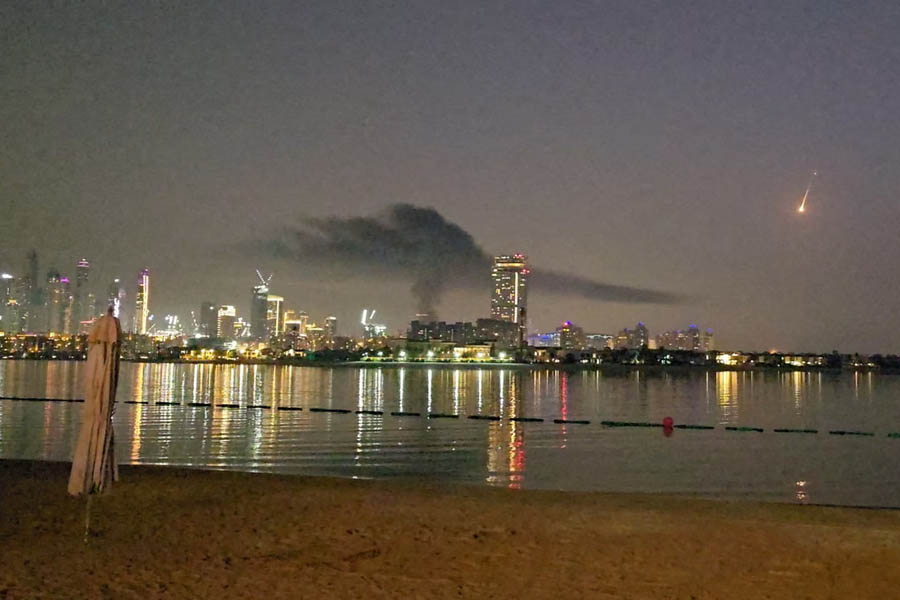
The image of smoke rising over a damaged hotel on Dubai's famed Palm Jumeirah – captured on 28 February – remains a haunting reminder that even the region's wealthiest nations are not immune.
Seafarers Stranded: 20,000 Workers Trapped at Sea
The head of the UN maritime agency has appealed for help for thousands of seafarers stranded in the Gulf by the effective closure of the Strait of Hormuz. About 20,000 seafarers and 2,000 ships have been stranded since US-Israeli strikes on Iran on 28 February, according to the International Maritime Organization (IMO).
At least 10 seafarers have been killed and several more severely injured in attacks on commercial vessels since the start of the war. The IMO's secretary general, Arsenio Dominguez, said the agency is working on an evacuation plan for the stranded ships – but that it can only be put into action when there are clear signs of de-escalation.
For the 20,000 men and women trapped on the water, the wait is agonising. Supplies are running low. Morale is collapsing. And the fighting shows no sign of stopping.
Israel-Lebanon: Ceasefire Violations Mount
On Israel's northern front, the Israeli military said it killed "two terrorists who had violated the ceasefire agreement" in southern Lebanon, saying they crossed what it described as the front defence line that separates an area occupied by the Israel Defense Forces (IDF) from the rest of the country.
After identification and a quick closing of the circle, the air force attacked and eliminated the terrorists in order to remove the threat," the IDF said in a report.
Since the 10-day Israel-Lebanon ceasefire took effect on Friday, the Israeli military has carried out demolitions in the territory it occupies on Lebanon's southern border. Hezbollah has launched rockets toward northern Israel in retaliation for what it said were Israeli violations of the truce.
Meanwhile, Israel's Foreign Minister Gideon Saar urged Lebanon to make joint efforts with his country to counter Hezbollah. Speaking ahead of talks between the countries set to resume in Washington, Saar said: "I call on the government of Lebanon – let's work together against the terror state that Hezbollah built in your territory."
Whether Lebanon will heed that call remains an open question.
US Halts Dollar Shipments to Iraq
The Trump administration has halted US dollar shipments to Iraq and frozen security cooperation programs with its military, as it presses Baghdad to dismantle Iranian-backed militias operating in the country, the Wall Street Journal reported.
US Treasury officials recently blocked a delivery of nearly $500 million in US banknotes – the proceeds of Iraqi oil sales – from accounts at the Federal Reserve Bank of New York. Washington has also informed Baghdad it is suspending funding for some counter-terrorism and military training programs until militia attacks end.
The move is a dramatic escalation of pressure on Iraq, which has struggled to balance its alliances with both Washington and Tehran.
Europe Readies Energy Crisis Response
The European Commission is set to unveil plans today to cut electricity taxes and coordinate the summer refill of countries' gas storage, as it seeks to cushion the energy fallout from the Iran war.
Europe's heavy reliance on oil and gas imports has left it exposed to spiralling prices since the Strait of Hormuz was effectively closed. Europe's benchmark gas price on Tuesday was roughly a third higher than before the war began on 28 February.
Airlines have warned that jet fuel shortages could emerge in weeks – a crisis that would disrupt summer travel across the continent.
What Comes Next?
The ceasefire has been extended – but not the hope that came with it. Iran has seized ships. The IRGC has threatened "crushing blows." Two million Iranians have lost their jobs. Twenty thousand seafarers are stranded at sea.
Trump says he is waiting for a "unified proposal" from Tehran. But Iran has yet to decide whether to even attend talks. And in the Strait of Hormuz, the red line has been drawn – and crossed.
The next few days will determine whether the region plunges back into full-scale war – or whether diplomacy can somehow reassert itself before it is too late.
Stay updated with the latest world headlines on our World Headlines Page.