21 April 2026 | Vatican City
Vatican City – One year ago, the world lost a pope who spoke not from a throne, but from the margins. Today, the world's greatest living filmmaker returns the favor – with a camera, a vision, and a final conversation.
A new documentary by acclaimed filmmaker Martin Scorsese about the late Pope Francis will receive its world premiere at the Vatican today, as part of commemorative events marking the first anniversary of the pontiff's death.
The film, titled Aldeas, The Final Dream of Pope Francis, explores the life, philosophy, and cultural vision of Pope Francis, featuring what is described as his final in-depth on-camera interview. For Scorsese, a director whose films have long grappled with faith, sin, and redemption, the project represents a deeply personal tribute.
Key details:
- Film title: "Aldeas, The Final Dream of Pope Francis"
- Director: Martin Scorsese (co-directed with Johnny Shipley and Clare Tavernor)
- Premiere date: 21 April 2026 (first anniversary of Pope Francis's death)
- Venue: Vatican City
- Key feature: Pope Francis's final in-depth on-camera interview
- Organizer: Scholas Occurrentes (educational foundation founded by Pope Francis in 2001)
- Scorsese quote: "Cinema is the best medium to encourage people across the world to exchange ideas with respect while preserving cultural identity"
A Film Rooted in Dialogue and Cultural Exchange
The screening is being organized by Scholas Occurrentes, an international educational initiative founded by Pope Francis in Argentina in 2001, long before he became the Bishop of Rome. The organization promotes social integration through sports, arts, and technology, and was later formalized as a global foundation during his papacy.
The documentary highlights the "Aldeas" community cinema movement, which Pope Francis described as an effort to explore the "essence of human life, sociability, conflict, and shared journeys through culture and storytelling."
"Cinema is the best medium to encourage people across the world to exchange ideas with respect while preserving cultural identity," Scorsese said when announcing the project. For a filmmaker who has spent decades exploring the darkest corners of the human soul – from Travis Bickle to Jake LaMotta to Frank Sheeran – the chance to illuminate a vision of hope was a departure. But it was also a homecoming.
Scorsese's Collaboration with the Papacy
The film was co-directed by Martin Scorsese alongside Johnny Shipley and Clare Tavernor. It was first announced shortly after Pope Francis's death in April 2025, generating global interest among both film and religious communities.
Scorsese, known for his deep interest in spiritual and religious themes, has previously collaborated on faith-inspired works including Silence (2016) – a harrowing meditation on faith and persecution set in 17th-century Japan – and the documentary series The Saints (2024).
But Aldeas is different. It is not a drama. It is not a historical reconstruction. It is a conversation – between two men who, despite their vastly different worlds, share a belief in the power of storytelling to bridge divides.
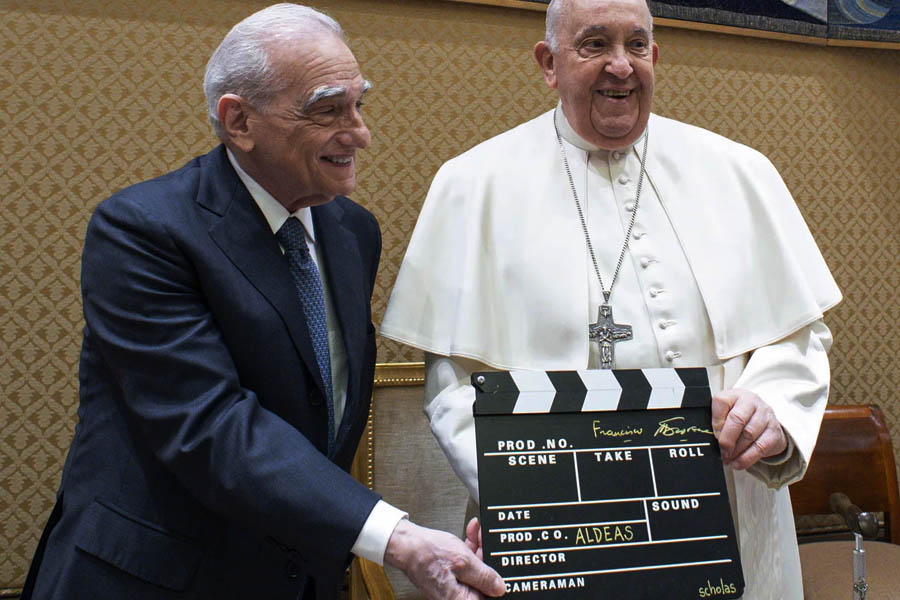
The photograph of Scorsese and Pope Francis together on the set, taken on 31 January 2024, captures something rare: a filmmaker and a spiritual leader, both in their eighties, both at the height of their powers, both aware that time is short and the work matters.
Global and Political Context: The Shadow of Pope Leo
The Vatican premiere also takes place amid rising political tensions involving the United States and the Catholic Church. Recent remarks by Pope Leo – Pope Francis's successor – criticizing international military actions have sparked diplomatic reactions, including public statements from US political figures.
Pope Leo has been far more outspoken than his predecessor on matters of war and peace. His denunciation of the "delusion of omnipotence" fueling the US-Israel war in Iran drew a sharp rebuke from Donald Trump. The episode has reignited debate over the role of religious leadership in global political discourse, particularly in relation to conflicts involving the Middle East.
In that context, Aldeas offers a counterpoint. Pope Francis rarely waded directly into geopolitical controversies. His power was subtler – a power of presence, of parable, of patient persuasion. The film captures that approach, preserving it for a world that often seems to have lost its capacity for patience.
Pope Francis's Vision Through Film: The Aldeas Movement
Central to the documentary is Pope Francis's belief in cultural storytelling as a bridge between communities. Through Scholas Occurrentes, he promoted creative expression as a way to foster empathy, dialogue, and global understanding.
The "Aldeas" (Spanish for "villages") movement encourages communities to tell their own stories – not through professional filmmakers, but through the eyes of ordinary people. The result is a mosaic of human experience, unfiltered and raw.
Scorsese, who has spent his career telling stories about outsiders, recognized a kindred spirit. "The Pope understands that every person has a story worth hearing," Scorsese said. "That is not a political statement. It is a human one."
The Final Interview: A Pope's Last Words on Film
The documentary's centerpiece is Pope Francis's final in-depth on-camera interview. Conducted just months before his death, the conversation ranges from his childhood in Buenos Aires to his vision for the Church's future.
He speaks about the environment, about migration, about the sin of indifference. He speaks about joy, about doubt, about the importance of laughter. He speaks as a man who knows his time is short – and who wants to make every word count.
"I am not afraid of death," he says in the film. "I am afraid of not having loved enough."
Those words, captured on camera, may prove to be his epitaph.
Legacy of a Cultural and Spiritual Collaboration
The Vatican premiere underscores the unique relationship between Pope Francis and Martin Scorsese, who met on multiple occasions to discuss faith, art, and humanity.
Organizers say the event is not only a film screening but also a symbolic tribute to Pope Francis's enduring legacy as a spiritual leader who embraced modern storytelling as a tool for global connection.
"He was not afraid of the modern world," Scorsese has said. "He wanted the Church to speak the language of the people. And the people, today, speak in images."
What Comes Next?
Aldeas, The Final Dream of Pope Francis will screen at the Vatican today before a select audience of religious leaders, filmmakers, and dignitaries. A wider release is expected in the coming months, though no formal distribution plan has been announced.
For Scorsese, now in his eighties, the film is part of a late-career turn toward faith and spirituality – a reflection, perhaps, of his own mortality. For the Catholic Church, it is a chance to preserve the vision of a pope who redefined the papacy.
And for the rest of us, it is a reminder: cinema is not just entertainment. It is a record of who we were, who we are, and who we hoped to become.
Stay updated with the latest showbiz headlines on our Entertainment Headlines Page.