16 April 2026 | Berlin / Kyiv / The Hague
Berlin, Germany – While the world watches the Middle East, Europe is sending a message: we have not forgotten Ukraine. And we are arming them for the next phase of the war.
The Netherlands will spend €248 million ($293 million) on producing drones for Ukraine, Dutch Defence Minister Dilan Yesilgoz-Zegerius announced Wednesday. The drones will be manufactured in both the Netherlands and Ukraine – a partnership designed to accelerate production and integrate battlefield lessons in real time.
"Drones play a crucial role on the modern battlefield," Yesilgoz-Zegerius said after meeting her counterparts from NATO countries and alliance Secretary General Mark Rutte in Berlin. "Ukrainians deploy them with incredible skill to repel the incessant Russian attacks."
She added: "Thanks to the good cooperation with Ukraine, we are learning directly from this. This also offers opportunities for our business community."
Key developments:
- Netherlands drone funding: €248 million ($293 million) for joint production with Ukraine
- Kyiv strike: 12-year-old child killed, 10 injured in Russian missile attack
- Odesa strike: 1 killed, 6 injured after apartment building hit
- Russia warning: European drone supplies "dragging countries deeper into war"
- Ukraine ground robots: Over 100 attacks using unmanned systems
- Territory regained: Nearly 50 sq km (19 sq miles) retaken in March
NATO's Promise: "We Will Not Lose Sight"
Mark Rutte and Kyiv's top allies vowed Wednesday that they would not lose sight of Ukraine's conflict with Russia – a pointed message to those who fear the Middle East war is draining attention and resources from Europe's deadliest conflict since 1945.
With the outbreak of the US-Israel war against Iran, fears have grown that international support for Kyiv is waning, more than four years since Moscow's full-scale invasion. American-led talks to end the war have stalled since the start of the Middle East conflict, at a time when US support for Ukraine was already weakening under President Donald Trump.
"Ukraine cannot wait," Rutte said. "The battlefield does not pause because the world's attention shifts. We must continue to deliver – and we will."
Russia's Warning: "Deeper into War"
Moscow responded swiftly and sharply to the Dutch announcement. Russia's defence ministry warned Wednesday that European plans to step up drone supplies to Ukraine are dragging those countries deeper into a war with Russia.
The ministry said it believes governments in a number of EU countries have decided to increase the production and supply of drones to Ukraine – a move Moscow views as a step that is escalating the conflict.
In an unprecedented move, the ministry published a list of factories and enterprises in several European countries it alleges manufacture drones or drone components, complete with addresses. The list included sites in Britain, Germany, Spain, Italy, Israel, and Poland, among others.
The message was clear: Russia is watching. And Russia is warning.
Kyiv Under Fire: A Child Killed
Even as diplomats met in Berlin, Russian missiles struck the Ukrainian capital. A 12-year-old child was killed in Kyiv early Thursday, Mayor Vitali Klitschko said. Ten others were injured, including several emergency crew members who rushed toward danger only to become victims themselves.
"As a result of the enemy attack, a 12-year-old child has been killed," Klitschko wrote on Telegram. "At the moment, 10 people are injured. That includes several medics."
A large fire broke out in a building in the Obolon district in the north of the capital, while debris fell in several locations. Tymur Tkachenko, head of the city's military administration, said at least four people had been injured.
The attack was a brutal reminder that Russia's war against Ukraine is not frozen. It is not forgotten. It is not paused. It continues, day after day, night after night, killing children and destroying homes.
Odesa: Another Strike, Another Death
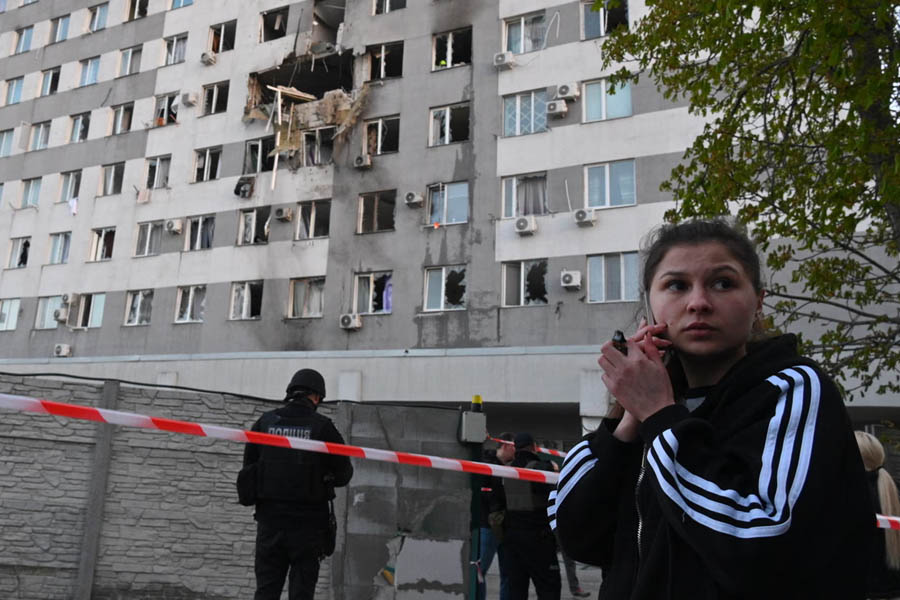
Meanwhile, in Ukraine's Black Sea port of Odesa, a Russian strike on an apartment building killed one person and injured six on Wednesday, the head of the local military administration said.
Serhiy Lysak, writing on Telegram, said apartments from the fifth to the seventh floor of the building were damaged. He posted photos showing at least one apartment badly damaged and debris strewn throughout the building's interior.
The woman in the photograph – standing before the wreckage, phone in hand – became the face of yet another Russian attack on civilian infrastructure. Her building. Her home. Her life, shattered by a drone she never saw coming.
Ukraine's Drone Revolution: From Sky to Ground
But Ukraine is not merely absorbing blows. It is innovating.
Ukraine's defence ministry announced Wednesday that it was introducing a new model of operations integrating drone warfare with infantry activity. Top commander Oleksandr Syrskyi said Kyiv's forces had regained control of nearly 50 square kilometers (19 square miles) of territory from Russia in March, building on gains since the start of the year.
Drones have assumed a prominent role in the four-year-old war. Both sides have devoted resources to developing ways to intercept drones and upgrade air defenses. But Ukraine is now pushing the boundaries further.
Ground Robots: Over 100 Attacks
A Ukrainian unit told AFP on Wednesday that it has carried out more than 100 attacks on the front using ground robots – a development President Volodymyr Zelenskyy recently hailed after the capture of a Russian position using this new method.
"In total, there have already been over 100 such operations," said a source within the NC-13 company, which specializes in the use of these combat machines and is part of Ukraine's 3rd Assault Brigade.
"These operations include the elimination of enemy personnel, the destruction of shelters, command posts, and other enemy infrastructure objects. These are no longer isolated incidents, but systematic combat operations," the source said.
The systems allow the replacement of infantry assaults – which can result in soldier deaths – while also detecting and engaging targets and preventing enemy infiltrations. In other words: Ukraine is saving lives while taking territory.
The Dutch-Ukrainian Partnership: Learning from the Battlefield
The Netherlands' €248 million investment is not a donation. It is a partnership. Drones will be manufactured in both countries, allowing Ukrainian engineers to work alongside Dutch manufacturers, incorporating real-time battlefield feedback into production.
"We are learning directly from this," Yesilgoz-Zegerius said. "This also offers opportunities for our business community."
For Ukraine, the deal means a steady supply of drones tailored to the specific demands of the front line. For the Netherlands, it means technological expertise and a foothold in the rapidly expanding defense drone market.
For Russia, it is a provocation – and a threat.
What Comes Next?
The war in Ukraine is entering a new phase. Drones – both aerial and ground-based – are reshaping the battlefield. European funding is flowing. Russian warnings are escalating. And on the ground, children are still dying.
NATO has promised not to lose sight of Ukraine. The Netherlands has put nearly $300 million behind that promise. Ukraine has retaken territory and innovated its way into a new era of warfare.
But Russia has not relented. The missiles keep coming. The drones keep falling. And the world, distracted by the Middle East, must decide whether it has the attention span – and the will – to see this through.
"Ukraine cannot wait," Rutte said. The question is whether the world is still listening.
Stay updated with the latest world headlines on our World Headlines Page.