24 April 2026 | Kyiv / Washington / Brussels
Kyiv, Ukraine – A prince stood in a war-torn capital and appealed to the most powerful nation on Earth. His words were passionate. His message was simple: honour your promises.
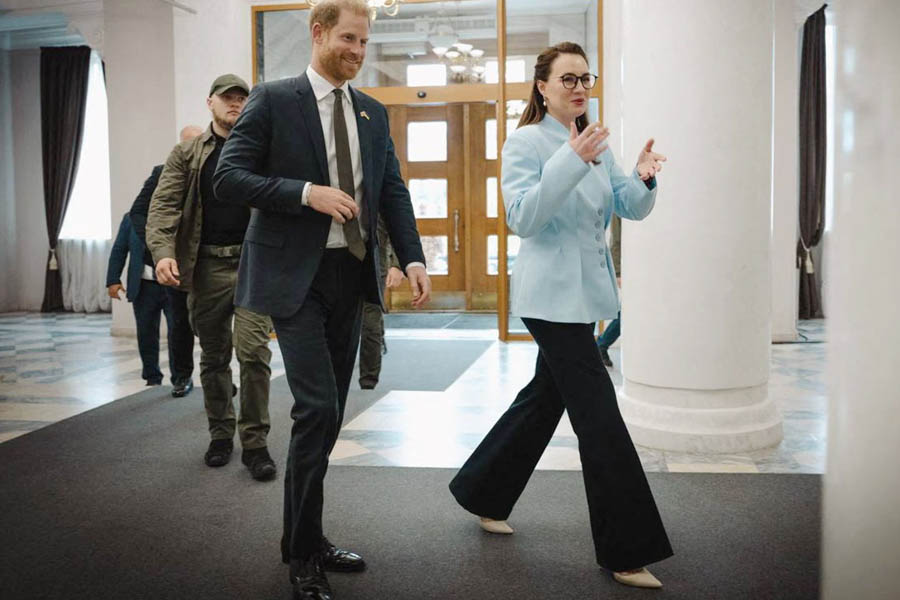
Prince Harry, the Duke of Sussex, delivered an impassioned speech at the Kyiv Security Forum on Thursday, urging the United States to "honour its international treaty obligations" after persuading Ukraine to give up its nuclear weapons in the 1990s.
"The United States has a singular role in this story," Harry told the audience. "Not only because of its power, but because when Ukraine gave up nuclear weapons, America was part of the assurance that Ukraine's sovereignty and borders would be respected."
He added: "This is a moment for American leadership, a moment for America, to show that it can honour its international treaty obligations – not out of charity but out of its own enduring role in global security and strategic stability."
Key developments:
- Prince Harry's speech: Urged US to honour Budapest Memorandum obligations
- Trump's response: "I think I am speaking for the UK more than Prince Harry"
- Drone breakthrough: Ukraine flew interceptors from 2,000km away – "historic experiment"
- EU loan: €90bn finalized + 20th sanctions package against Russia
- Tuapse fire: Oil refinery still burning after 4 days – 4 storage tanks ablaze
- Russian casualties: 3 killed in Dnipropetrovsk; girls aged 9 and 14 wounded
- Battlefield shift: Russia made almost zero territorial gains in March (first time in 2.5 years)
- Turkey mediation: Erdogan working to revive Russia-Ukraine negotiations
"I Am Speaking for the UK More Than Prince Harry": Trump Bristles
Donald Trump, never one to let a perceived challenge pass, responded swiftly. The US president bristled at the duke's comments, saying: "I think I am speaking for the UK more than Prince Harry. But I appreciate his advice very much."
The response was dismissive, almost condescending. "I appreciate his advice very much" – words that suggested Trump was humoring Harry rather than engaging with his argument.
Harry, an ex-serviceman who served two tours in Afghanistan, did not claim to be speaking for the UK. He said he was "not here as a politician" but as "a soldier who understands service" and a "humanitarian." The distinction seemed lost on the president.
The exchange laid bare a fundamental tension: the US, under Trump, has grown weary of underwriting European security. Ukraine, under Zelenskyy, sees American support as existential. And now, a member of the British royal family has stepped into the fray, urging Washington to remember its promises.
The Budapest Memorandum: A Promise Unkept
Harry's reference to Ukraine's nuclear disarmament was not incidental. In 1994, Ukraine possessed the world's third-largest nuclear arsenal – inherited from the collapsed Soviet Union. Under the Budapest Memorandum, Ukraine agreed to give up its nuclear weapons in exchange for security assurances from the United States, the United Kingdom, and Russia.
Russia, one of the guarantors, invaded. The US and UK, the other guarantors, have provided aid – but not the direct military intervention that some in Kyiv believe the memorandum implied.
"This is a moment for American leadership," Harry said. The subtext was unmistakable: America promised. America must deliver.
Drone Breakthrough: Flying from Thousands of Kilometres Away
While diplomats argued and princes pleaded, Ukraine's technologists achieved something remarkable.
Ukrainian MP Marian Zablotskiy described a "historic experiment" in which he piloted an FPV interceptor drone from thousands of kilometres away. "I piloted an FPV interceptor drone first from my office, then from right in front of the state border, and then from somewhere about 2,000km away from the drone itself – from abroad," he said. "I consider this breakthrough a decisive factor in finally stopping the Russian offensive."
Ukrainian drone manufacturer Wild Hornets confirmed Zablotskiy's involvement and said it wanted the remote control system to "become the primary method of drone control."
Defence Minister Mykhailo Fedorov added: "Ukraine is the first in the world to systematically scale up remote control of interceptor drones. Today, we have confirmed results – the downing of targets at distances of hundreds and thousands of kilometres."
The implications are staggering. Ukrainian operators no longer need to be near the front line. They can sit in offices, in bunkers, in other countries entirely – and still hunt Russian targets.
Battlefield Shift: Russia's Advance Halted
The drone breakthrough is already having an impact. Agence France-Presse's analysis of data from the Institute for the Study of War (ISW) showed that Russian troops made almost no territorial gains across the frontline in March – the first time this had occurred in two and a half years.
"We have minimised the Russians' advantage in manpower through the use of drones," Foreign Minister Andriy Sybiha said. "For us, the situation on the battlefield is about strengthening our negotiating position. We can shoot down up to 90% of the targets that strike our cities."
He added: "Ukraine's position on the battlefield is indeed the strongest, or the most solid, it has been over the past year."
EU Finalizes €90bn Loan and 20th Sanctions Package
European leaders welcomed the end of diplomatic deadlock over a long-awaited €90 billion loan for Ukraine. The bloc completed the agreement along with a 20th sanctions package against Russia – a signal that European resolve remains firm despite the distractions of the Middle East war.
European Commission President Ursula von der Leyen said she thought it would be possible to disburse the first tranche of the €45 billion funding planned for 2026 in this quarter, meaning by the end of June. The first payment, she indicated, would fund Ukraine's domestic drone production – "drones from Ukraine for Ukraine."
The symbolism was deliberate. Europe is betting on Ukrainian technology as much as Ukrainian courage.
Tuapse Burns: Oil Refinery Still Ablaze After Four Days
On the other side of the battlefield, Russia is still counting its losses. Ukraine struck oil facilities in the southern town of Tuapse on Monday, targeting Russian oil exports that fund the war. The attack triggered a huge blaze and sent plumes of thick black smoke into the sky.
Four days later, the fire is still burning. "Four storage tanks are ablaze," the regional emergency headquarters told AFP. Contaminated rainfall on Wednesday left "a black coating on surfaces," authorities said.
The environmental damage is severe. The economic damage is worse. And the fire continues to burn – a metaphor, perhaps, for Russia's broader war effort.
Civilian Casualties: Girls Aged 9 and 14 Among the Wounded
While the world focused on princes and drones, the human cost of the war continued to mount. Russian attacks on residential areas killed three people and wounded at least 10, including girls aged nine and 14, the head of Ukraine's central Dnipropetrovsk region said on Thursday.
In Russia's Samara region, one person was killed in a drone strike. Another attack killed a person in the Russian border region of Belgorod.
The numbers are small, relative to the scale of the war. But each number is a person. Each person is a tragedy.
Turkey Mediation: Erdogan Works to Revive Talks
Turkey is trying to revive negotiations between Russia and Ukraine and bring together their leaders at the request of Kyiv, the office of Turkish President Recep Tayyip Erdoğan said on Wednesday.
Erdogan told NATO head Mark Rutte in a meeting in Ankara that "we are working to revive negotiations and start talks at leaders' level."
Foreign Minister Sybiha confirmed that Ukraine is pushing for face-to-face talks between Volodymyr Zelenskyy and Vladimir Putin. While Turkey was asked to facilitate, Ukraine would consider any venue outside Russia and Belarus.
"We are advocating for a meeting now to bring new momentum to diplomacy," Sybiha said.
But Kremlin spokesperson Dmitry Peskov said that Putin would only meet Zelenskyy "for the purpose of finalising agreements." The Kremlin instead appealed for the US to again send Donald Trump's delegates Steve Witkoff and Jared Kushner to Moscow – a suggestion that suggests Russia still believes it can negotiate directly with Washington, over Kyiv's head.
What Comes Next?
Prince Harry has returned to the UK. Trump has moved on to other controversies. The EU's loan will take months to disburse. Ukraine's drones are flying, and Russia's refinery is burning.
But the fundamental questions remain unanswered. Will the US honour its obligations? Can Ukraine's drone advantage translate into a decisive battlefield breakthrough? Will Russia ever agree to meaningful negotiations?
"This is a moment for American leadership," Harry said. The moment is still here. The question is whether anyone is listening.
Stay updated with the latest world headlines on our World Headlines Page.