29 April 2026 | Tuapse / Washington / London / Kyiv
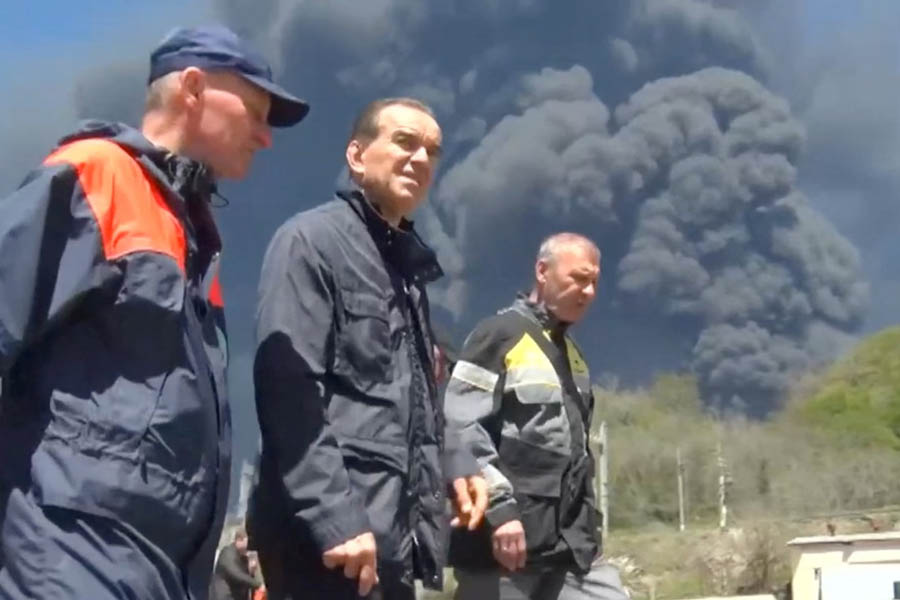
TUAPSE, Russia – For the third time in less than two weeks, thick black smoke billowed over this Russian port city on the Black Sea. The sky turned dark. Black rain fell. And Vladimir Putin's war machine took another hit.
A Ukrainian drone attack has caused another major fire at the Russian oil refinery in Tuapse – a facility with annual production capacity of about 12 million tonnes of crude. Dense black smoke again rose from the direction of the refinery. Local residents were ordered to evacuate by bus to a nearby school.
"A strike against civilian infrastructure," Putin called it. Kyiv calls it something else: a legitimate military target in a campaign designed to disrupt Russia's oil industry and slash the revenues that fund Moscow's war.
⚡ THE NUMBERS: 3rd attack in 12 days • 12M tonnes annual capacity • Refinery halted production April 16 • Black rain fell on beach resort after previous strike
BLACK RAIN AND BURNING SKIES: TUAPSE UNDER FIRE
The refinery halted production on 16 April because of drone damage to the port that made it impossible to ship its output, industry sources told Reuters. Then came another attack. And another.
On Tuesday, the head of the Tuapse district, Sergei Boyko, ordered people living near the refinery to evacuate. The scene was apocalyptic: residents boarding buses against a backdrop of towering flames and acrid smoke.
After an attack on 20 April, black rain fell on the town and a popular beach resort, leaving an oily residue on everything it touched. Cars. Buildings. Children's playgrounds. The beaches where Russian families once vacationed are now covered in the remnants of war.
Putin has sent an emergencies minister to Tuapse. But no minister can undo the damage – or stop the drones.
KING CHARLES TO US CONGRESS: "THE SAME, UNYIELDING RESOLVE IS NEEDED"
While the fires burned in Tuapse, a different kind of address was taking place in Washington. King Charles spoke to the US Congress, and his words carried a pointed message about Ukraine.
"In the immediate aftermath of 9/11, when NATO invoked Article Five for the first time, and the UN Security Council was united in the face of terror, we answered the call together," the King said. "Shoulder to shoulder, through two world wars, the Cold War, Afghanistan, and moments that have defined our shared security."
He paused. Then came the barb.
"Today, Mr. Speaker, that same, unyielding resolve is needed for the defence of Ukraine and her most courageous people. It is needed in order to secure a truly just and lasting peace."
— King Charles III, addressing the US Congress
The King's remarks come just days after his son, Prince Harry, visited Kyiv and urged "American leadership" to honour its security commitments to Ukraine. Donald Trump rebuffed Harry's comments, saying the Duke "is not speaking for the UK." But the King is a different matter. Trump is known to be an avid fan of the monarchy. Dismissing Charles will be far more difficult.
ACTING US AMBASSADOR STEPS DOWN: FRUSTRATION IN KYIV
The acting US ambassador to Ukraine will step down from her post after less than a year in the job, the State Department has said. The departure comes amid a lull in US-brokered efforts to achieve a ceasefire and end Russia's invasion.
The Financial Times, quoting unnamed sources, said Julie Davis had grown frustrated with Donald Trump over his lack of support for Ukraine. Her predecessor left for the same reason. The State Department said she was simply retiring from the department – but the pattern is impossible to ignore.
Two ambassadors. Two departures. Same frustration.
HUNGARY'S NEW LEADER: A SHIFT IN TONE, IF NOT POLICY
In a development that could reshape European unity on Ukraine, Hungarian election winner Péter Magyar has proposed a meeting with President Volodymyr Zelenskyy to discuss minority rights of ethnic Hungarians in western Ukraine.
Magyar does not share defeated rival Viktor Orbán's overt hostility towards Ukraine and support for Russia. But he still opposes fast-track Ukrainian membership of the EU. And he says Kyiv's treatment of ethnic Hungarians will be key to rebuilding ties.
Orbán was accused of exaggerating and distorting the extent of grievances between Ukraine's ethnic Hungarian population and the Kyiv government. The truth is more complicated: ethnic Hungarians are among those fighting for Ukraine against Russia. They include the head of Ukraine's drone force – the very same forces that are striking refineries like Tuapse.
A meeting between Magyar and Zelenskyy could signal a thaw. But on the ground, the war continues.
WHAT COMES NEXT?
Tuapse is burning. King Charles has spoken. The US ambassador is leaving. And Hungary is recalibrating.
But the fundamental question remains unanswered: will the West – and particularly the United States – continue to support Ukraine as the war drags into its fifth year? The King's 9/11 analogy was deliberate. He was asking America to remember what it felt like to be attacked. To remember the unity. To remember the resolve.
Whether Congress was listening is another matter.
Stay updated with the latest Russia-Ukraine war headlines on our Russia-Ukraine War Page.