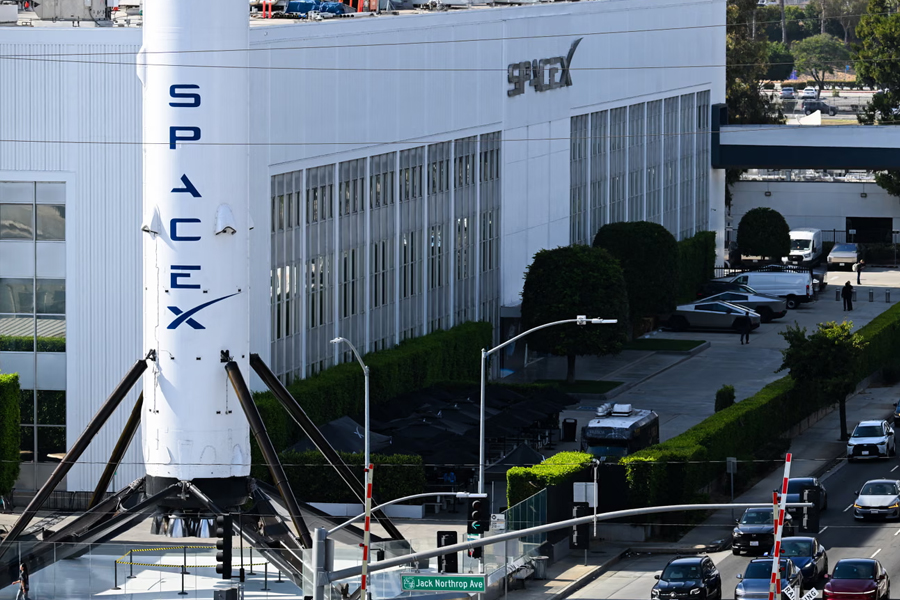
Hawthorne, California – Elon Musk's SpaceX is set to launch the biggest stock market float in history on Friday, with a valuation of $1.78 trillion that could make Musk the world's first trillionaire – but analysts are warning of a "major disconnect" between the company's price and its underlying fundamentals.
The space exploration, satellite broadband, and artificial intelligence company will join the US stock market at a valuation of $1.78 trillion after offering at least $75 billion of shares to investors through an initial public offering. The offering is oversubscribed by three or four times, according to Reuters, with more than $250 billion of bids from investors keen to participate.
The $75 billion share offer is nearly three times the previous record – Saudi Aramco's $29.4 billion offering when it floated in 2019. If the float goes as planned, Musk could make history as the world's first trillionaire, adding to his already massive fortune amassed through Tesla, X (formerly Twitter), and his other ventures.
Key developments:
- SpaceX set for record $1.78tn IPO, largest in stock market history
- Company offering $75bn shares – nearly 3x Saudi Aramco's $29.4bn record
- IPO oversubscribed 3-4 times with over $250bn in investor bids
- Elon Musk could become world's first trillionaire if float succeeds
- Morningstar warns of "major disconnect" between price and fundamentals
- SpaceX valued at 92x trailing sales – "extremely speculative" says analyst
- Company made net loss of $4.9bn in 2025
- Senator Elizabeth Warren calls for SEC to delay IPO over governance concerns
- Morningstar estimates SpaceX worth only $63/share vs anticipated $135 IPO price
- MSCI confirms SpaceX likely eligible for early index inclusion
- S&P Dow Jones refuses to relax rules – SpaceX may wait months for S&P 500 entry
'Major Disconnect': Analysts Warn of Overvaluation
Despite the frenzy surrounding the IPO, investment research group Morningstar has calculated that SpaceX is worth only $63 a share – well below the anticipated IPO price of $135 – and warns there is "a major disconnect between market expectations and underlying fundamentals."
Michael Field, chief equity strategist at Morningstar, suggests investors should sit out the IPO and wait for "a more attractive entry point down the line."
"We believe the business has real strengths, particularly in Starlink, but with so many unknown and untested technologies underpinning much of the valuation price, particularly within the AI business, we think the valuation is extremely speculative," Field said.
At $1.78 trillion, the IPO values SpaceX at roughly 92 times its trailing sales – a very hefty valuation that means investors are wagering that Musk can achieve his ambitious goals for the company.
SpaceX's Three Business Divisions
SpaceX, which made a net loss of $4.9 billion in 2025, is composed of three distinct businesses:
- Space Exploration: Including its Falcon and Starship rockets, satellite launches for government and commercial customers, and NASA partnerships for crew and cargo missions to the International Space Station
- Connectivity (Starlink): A satellite constellation providing high-speed internet access to remote and underserved areas worldwide, with over 5,000 satellites already in orbit
- Artificial Intelligence (xAI): Musk's AI division, competing with OpenAI, Google, and Anthropic in the rapidly growing generative AI market
SpaceX has claimed that Starlink has a total addressable market of $1.6 trillion. However, Morningstar estimates the segment's realistic global opportunity at about $129 billion – a dramatic difference that highlights the valuation debate.
Musk's Vision: From Orbital Datacentres to Cities on Mars
Investors buying into the IPO are betting on Musk's ambitious, long-term goals for the company, which include:
- Orbital datacentres in space for AI computing and data processing
- Building a permanent base on the moon
- Establishing cities on Mars and other planets
- Expanding Starlink to serve billions of unconnected users globally
- Developing Starship into a fully reusable interplanetary transport system
- Extending "the light of consciousness to the stars" – a phrase Musk often uses to describe his philosophical motivation
These goals remain unproven and years, if not decades, away from realization. The gap between current revenue and the valuation reflects investor faith in Musk's ability to execute on this vision – a faith that has paid off handsomely for Tesla investors but has also led to significant volatility.
Elizabeth Warren Calls for SEC Delay
Earlier this week, US Senator Elizabeth Warren called for the Securities and Exchange Commission to delay SpaceX's IPO, citing concerns about the company's valuation and corporate governance.
"Given the unprecedented threats to investor protection and market integrity posed by the biggest IPO in history, you must delay any eventual acceleration of the registration statement's effectiveness accordingly," Warren wrote to the market regulator on Tuesday.
Warren has been a long-time critic of Musk and what she describes as inadequate oversight of major corporations. Her request adds political pressure to an already closely watched IPO.
The SEC has not publicly responded to Warren's letter, and the IPO is proceeding as scheduled for Friday.
Index Inclusion: MSCI Says Yes, S&P Says No
Investors who do not participate in the IPO may still find themselves with a stake in SpaceX once the company is added to stock market indices.
Earlier this week, index provider MSCI confirmed it would apply existing rules for early inclusion of large IPOs in its Global Standard Indexes, which likely clears the way for SpaceX to join. That would create demand from passively managed investment funds that track those indices.
The Nasdaq index has also made changes that will make it easier for new listings such as SpaceX to join its indices, potentially accelerating the company's inclusion in technology-focused funds.
However, S&P Dow Jones Indices has declined to relax its strict entry rules, blocking fast-track inclusion. This means it could take months before SpaceX is added to the tech-heavy S&P 500 stock index – a potential disappointment for investors hoping for immediate passive buying pressure.
What This Means for Musk: The First Trillionaire?
Musk currently holds approximately 42% of SpaceX, according to securities filings. At the $1.78 trillion IPO valuation, his stake would be worth approximately $747 billion – enough to push his total net worth past the $1 trillion mark when combined with his Tesla holdings and other assets.
Forbes currently estimates Musk's net worth at approximately $380 billion, primarily from his stake in Tesla. A successful SpaceX IPO would more than double that figure, making him the world's first trillionaire by a significant margin.
However, that calculation depends entirely on SpaceX maintaining its $1.78 trillion valuation after the IPO – something analysts warn is far from guaranteed.
Largest IPOs in History (By Share Offering)
| Company | Year | Offering Size | Valuation at IPO |
|---|---|---|---|
| SpaceX | 2026 | $75bn | $1.78tn |
| Saudi Aramco | 2019 | $29.4bn | $1.7tn |
| Alibaba | 2014 | $25bn | $168bn |
| Meta (Facebook) | 2012 | $16bn | $104bn |
| Uber | 2019 | $8.1bn | $75bn |
Should You Invest? Analysts Are Divided
The investment community is sharply divided on SpaceX's IPO. Bulls point to Musk's track record of defying skeptics at Tesla, the strategic importance of Starlink for global connectivity, and the potential of xAI in the burgeoning AI market.
Bears counter that the valuation is detached from reality, that Starlink faces competition from Amazon's Project Kuiper and OneWeb, and that the space exploration business remains heavily dependent on government contracts.
Morningstar's Michael Field offers a cautious perspective: "We believe the business has real strengths, particularly in Starlink, but with so many unknown and untested technologies underpinning much of the valuation price, particularly within the AI business, we think the valuation is extremely speculative."
Other analysts are more bullish. "Musk has a track record of achieving what others said was impossible," said tech analyst Dan Ives of Wedbush Securities. "Tesla was supposed to fail. Now it's a $500 billion company. Betting against Musk has historically been a losing trade."
Investors will have to decide for themselves whether SpaceX represents the investment opportunity of a generation or a bubble waiting to burst.
🚀 The Big Picture
The SpaceX IPO represents a watershed moment for financial markets – the largest stock market float in history, with a valuation that surpasses the GDP of most countries. Whether it's justified or a bubble depends entirely on whether Elon Musk can deliver on his ambitious promises. The company has real achievements: Starlink is already generating billions in revenue, and Falcon rockets have transformed space access. But the valuation assumes much more – orbital datacentres, cities on Mars, and AI dominance. Morningstar's warning of a "major disconnect" may prove prescient, or it may be another example of analysts underestimating Musk. One thing is certain: the SpaceX IPO will be the most closely watched market event of the year, and its performance will shape perceptions of tech valuations for years to come.
🚀 For more breaking news and market updates: Visit NewsOrbit - World Breaking News for the latest headlines from around the globe.