7 May 2026 | Washington / Brussels
WASHINGTON, D.C. – The clock is ticking. The deadline is symbolic. And Donald Trump is done waiting.
The US president has given the European Union until 4 July – America's 250th birthday – to ratify its trade deal with Washington, or face "much higher" tariffs. The ultimatum, delivered on his Truth Social platform, raises the stakes in a transatlantic trade war that has simmered for months.
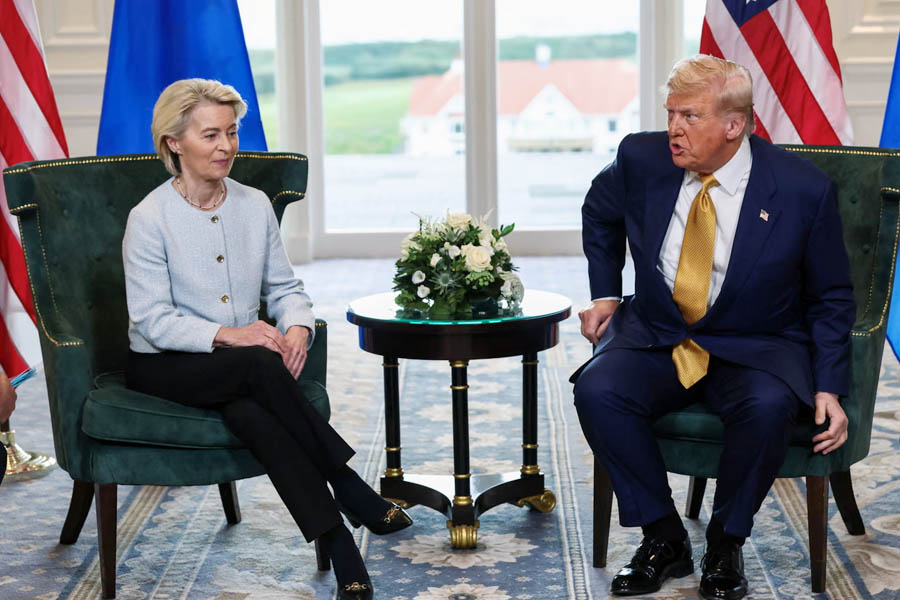
"I spoke to the EU Chief, Ursula von der Leyen, and agreed to give her until our Country's 250th Birthday or, unfortunately, their Tariffs would immediately jump to much higher levels," Trump posted.
The Fourth of July holiday this year marks 250 years since the American colonies declared independence from British rule. Trump framed the deadline as a birthday gift – but the wrapping paper is made of threats.
⚡ THE NUMBERS: July 4 deadline (America's 250th birthday) • 15% current tariff rate • 25% threatened rate on EU cars • Deal struck July 2025 at Turnberry • Supreme Court ruled tariffs unlawful in February • Temporary 10% duty in place
"Cut Their Tariffs to ZERO": Trump's Frustration Boils Over
Von der Leyen said Thursday that the bloc had made "good progress" toward ratifying the deal by early July. "We remain fully committed, on both sides, to its implementation," she added on X.
But Trump's patience has worn thin. The 27-member EU bloc and the US struck a deal last July at Trump's Turnberry golf course in Scotland, setting tariffs on most European goods at 15%. The agreement was hailed as a breakthrough – a truce in a trade war that had threatened to spiral.
Yet ratification has dragged. The European parliament gave its conditional green light in late March, but the deal must still be negotiated with EU member states before it can be implemented. Cyprus, which holds the rotating presidency of the Council of the European Union, said it wanted to maintain "positive momentum" at talks with MEPs on 19 May.
Trump is not satisfied.
— Donald Trump, Truth Social
The Supreme Court Complication: Trump's Authority Curtailed
The situation became more complicated after the US Supreme Court ruled in February that Trump had exceeded his authority in imposing a wide swathe of his tariffs, including on the EU. The ruling was a legal setback for an administration that had built its trade policy on executive action.
Since then, the Trump administration has imposed a temporary 10% duty while pursuing more lasting ways to rebuild his trade agenda. But the court ruling did not affect sector-specific tariffs like those on cars, which under the EU agreement had been lowered to 15%.
Last week, Trump vowed to raise duties on EU cars and trucks to 25%, accusing the bloc of failing to hold up its side of the bargain. The threat sent shivers through European automakers, who had counted on the Turnberry deal to stabilize transatlantic trade.
A Symbolic Deadline: America's 250th Birthday
Trump's choice of 4 July is no accident. The deadline is steeped in symbolism – a reminder of American independence and, implicitly, a warning that the US will not be bound by European拖延.
"I've been waiting patiently for the EU to fulfill their side of the Historic Trade Deal we agreed in Turnberry, Scotland, the largest Trade Deal, ever!" Trump posted. "A promise was made that the EU would deliver their side of the Deal and, as per Agreement, cut their Tariffs to ZERO!"
The reference to "ZERO" tariffs is likely an exaggeration – the Turnberry deal set a baseline of 15%, not zero. But Trump's rhetorical escalation suggests he is preparing to walk away from the agreement entirely if the EU does not move faster.
What the EU Wants: Safeguards and Speed
In late March, EU lawmakers gave their green light to the tariff deal with Trump, but they also sought additional safeguards. The safeguards are designed to protect European industries in case the US reneges on its commitments – a concern that has grown as Trump has threatened new tariffs.
Cyprus, holding the EU presidency, has attempted to steer a middle course – maintaining "positive momentum" while addressing member state concerns. But the clock is ticking. The 19 May talks with MEPs are seen as a crucial test. If they fail, the deal could unravel.
Von der Leyen struck an optimistic tone on Thursday, but her words may not be enough to satisfy Trump.
📊 TRADE DEAL AT A GLANCE
- Signed: July 2025 at Trump's Turnberry golf course, Scotland
- Current tariff rate (most goods): 15%
- Threatened rate (cars/trucks): 25%
- Temporary US duty: 10% (post-Supreme Court ruling)
- Supreme Court ruling: February 2026 – Trump exceeded authority on tariffs
- EU parliament approval: Conditional green light (late March)
- Next talks: May 19 (Cyprus presidency with MEPs)
- Deadline: July 4, 2026 (America's 250th birthday)
The Stakes: A Transatlantic Trade War Reborn
If the EU fails to ratify the deal by 4 July, Trump has promised "much higher" tariffs. The immediate impact would be felt by European automakers, who would face a 25% duty on cars and trucks exported to the US – a market they cannot afford to lose.
German manufacturers, already struggling with high energy costs and competition from Chinese electric vehicles, would be hit hardest. French wine producers, Italian luxury goods makers, and Spanish agricultural exporters would also suffer.
But the damage would not be one-sided. US farmers, who rely on European markets for agricultural exports, could face retaliation. The global economy, already strained by the Iran war and rising energy prices, would absorb another shock.
Trump's ultimatum is a gamble. He is betting that European leaders will blink – that they will ratify the deal on his terms rather than face higher tariffs. Von der Leyen is betting that patience and diplomacy can keep the deal alive.
Only one of them will be right.
What Comes Next?
The 19 May talks will determine whether the deal survives. If EU member states and MEPs can agree on safeguards, ratification could proceed. If not, the clock will keep ticking toward 4 July.
Trump has made his position clear. Von der Leyen has expressed optimism. But history suggests that transatlantic trade disputes rarely end neatly – and that deadlines are often missed.
One thing is certain: the next two months will be decisive. And the world's largest trading relationship hangs in the balance.
Stay updated with the latest global markets headlines on our Global Markets Page.