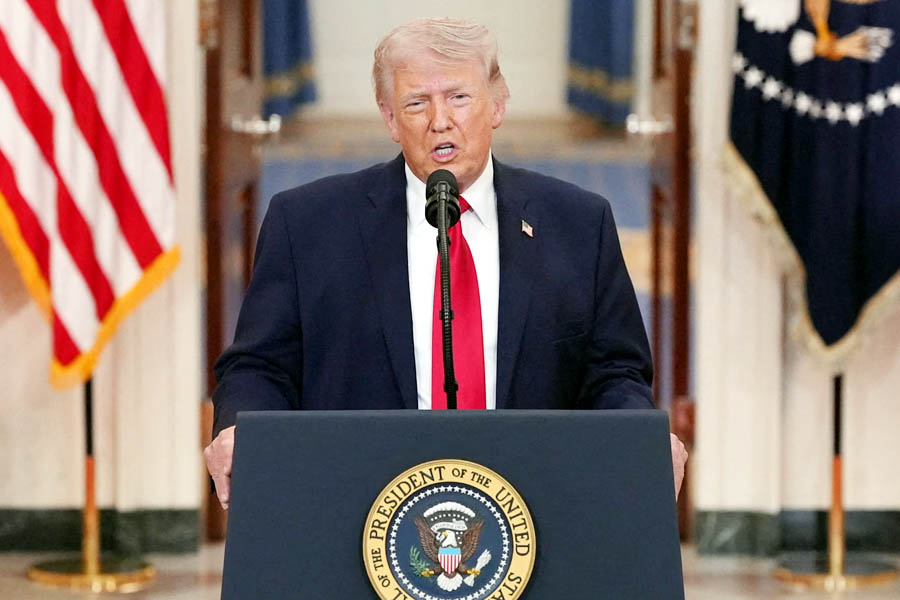
Washington, D.C. – Donald Trump used his first address to the nation since the start of the war in Iran to justify the costs that it is imposing on America and the world, while continuing to claim that he is close to winding up the conflict.
Trump said on Wednesday evening that Iran had been decimated and that the hard part of the war was done. He however added that the US would hit Iran "extremely hard" for the next two to three weeks.
Key developments:
- Trump sets "two to three weeks" timeline to conclude Iran war operations
- President says he "doesn't care" about Iran's 440kg highly enriched uranium stockpile
- Experts warn US now less secure from nuclear threat than before war began
- Trump urges nations using Strait of Hormuz to "just take it, protect it"
- Global energy crisis deepens as countries turn to coal, ration fuel
- India orders coal plants to run at full capacity; Japan allows less-efficient coal plants
- Sri Lanka introduces four-day work week; Thailand tells officials to remove ties
'I Don't Care' About Iran's Uranium Stockpile
Donald Trump has said he does not care about Iran's stock of highly enriched uranium (HEU), arguing it was deep underground and could be monitored by satellite, raising questions about one of the key US justifications for the war.
Experts said that if the US-Israeli offensive against Iran concluded with the Tehran government still in control of its 440kg HEU stockpile, it would be significantly closer to the capability of making nuclear warheads than if the US had pursued a potential negotiated settlement that was on the table at the time the US and Israel launched the war on 28 February.
Asked about the stockpile by Reuters news agency on Wednesday, Trump said: "That's so far underground, I don't care about that."
"We'll always be watching it by satellite," he added.
In his address to the nation from the White House on Wednesday night, Trump elaborated: "If we see them make a move, even a move for it, we will hit them with missiles very hard again."
Nuclear Experts Sound Alarm
Unless they were intended as a ruse to put Tehran off its guard, the president's remarks appeared to rule out a risky military mission to retrieve the HEU stockpile, which Iran is believed to have hidden down deep underground shafts.
The apparent decision to leave the HEU, which is roughly enough for about a dozen warheads, in Iran appeared to conflict with Trump's assertions that one of the principal war aims was to ensure it could never make a nuclear bomb.
"We are actually less secure now from the nuclear threat than we were before he started the war, because they still have the material and we still have no greater insight into the material and what they might do with it," said Emma Belcher, a nuclear expert and president of Ploughshares, a foundation promoting non-proliferation efforts.
She added: "We've also likely increased [Tehran's] calculus that they will seek nuclear weapons to prevent the very kind of attack we've just witnessed."
"The comment that you can just not worry about the material because you can see it from satellites really fundamentally misunderstands how to manage nuclear risk," Belcher said. "The issue isn't just whether we can see the material, it's whether we can verify, secure and constrain it. And in order to do that, you need diplomacy, inspections and sustained international cooperation."
Strait of Hormuz: 'Just Take It, Protect It'
The president also once again called for countries that receive oil through the strait of Hormuz to show "courage" and seize the key waterway, while saying Washington will not allow its Middle East allies to be harmed.
"The countries of the world that ... receive oil through the Hormuz Strait must take care of that passage," Trump said. "Just take it, protect it, use it for yourselves."
He also thanked "our allies in the Middle East – Israel, Saudi Arabia, Qatar, the UAE, Kuwait and Bahrain," saying: "They've been great, and we will not let them get hurt or fail in any way, shape or form."
Global Energy Crisis Deepens
Shrinking fuel stocks and soaring prices are leading countries around the world to burn coal, ration fuel, shorten work weeks and tell citizens to stay at home.
United States: The Trump administration announced it would pay French company TotalEnergies $1bn to kill plans for windfarms off the US east coast and redirect investments into oil and gas.
Asia: Coal is coming back across Asia. India has ordered coal-fired power plants to be run at full capacity. Japan is allowing less-efficient coal plants back on the electricity market. South Korea lifted caps on coal electricity and delayed its planned phaseout.
South and Southeast Asia: Sri Lanka has introduced fuel rationing and a four-day working week. Vietnam urged employers to let staff work from home. News anchors in Thailand took off their jackets on air as the government called on people to use less air conditioning and told officials to wear short-sleeved shirts without neckties.
Stay updated with the latest world headlines on our World Headlines Page.