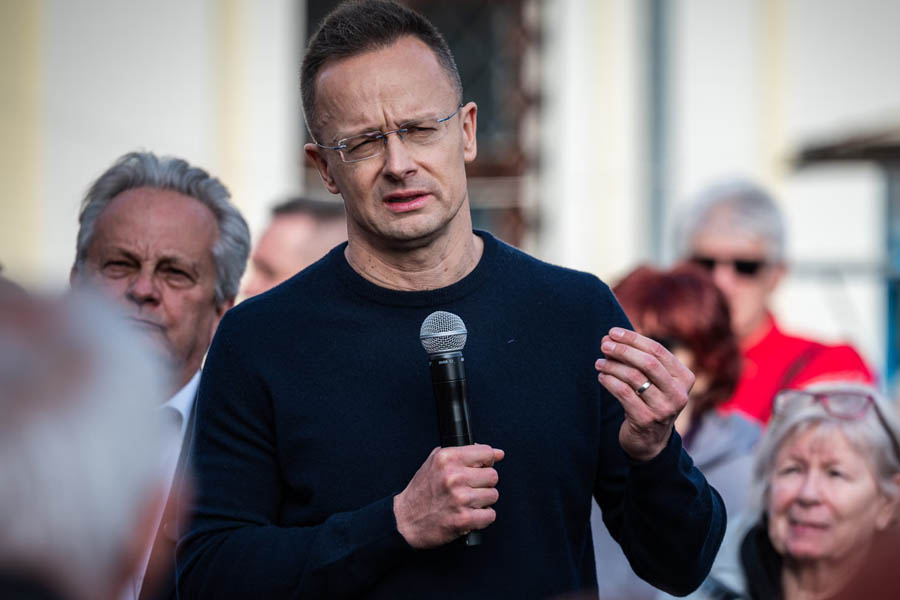
Ukraine has sharply criticized Hungary following the emergence of leaked audio recordings that appear to show Hungary's foreign minister communicating closely with Moscow. The controversy has intensified political tensions within Europe and raised fresh concerns about unity in the European Union.
Key developments:
- Leaked audio shows Hungary's foreign minister discussing EU sanctions with Russian counterpart
- Ukraine calls for formal investigation into Hungary's pro-Moscow stance
- Hungary claims communications were unlawfully intercepted
- Zelenskyy criticizes Hungary for blocking €90 billion EU aid package
- Russian military plane crashes in Crimea, 29 confirmed dead
- Russia tightening internet restrictions, isolating from global network
- EU leaders mark 4 years since Bucha massacre, demand accountability
Leaked Calls Spark Outrage
Ukraine's foreign minister, Andriy Sybiga, called for a formal investigation after the recordings surfaced. The audio allegedly captures Hungary's foreign minister, Peter Szijjarto, telling his Russian counterpart, Sergei Lavrov, that he would attempt to shape European Union sanctions in a way favorable to Moscow.
Sybiga condemned the conversations, describing them as deeply inappropriate and accusing Hungary of acting in the interests of Russia. He stated that such actions undermine European solidarity and must be investigated thoroughly.
The recordings were published as part of a joint media investigation just days before a crucial election in Hungary, where Prime Minister Viktor Orban faces significant political pressure.
Hungary Responds to Allegations
Peter Szijjarto did not deny the authenticity of the calls but instead claimed that his communications had been unlawfully intercepted. He described the situation as a major scandal involving foreign intelligence services and suggested that the timing of the leak was politically motivated.
The Hungarian government has not indicated any willingness to alter its foreign policy stance, which has often been seen as more aligned with Moscow compared to other European Union members.
European Leaders React
The revelations triggered strong criticism from several European leaders, including the prime ministers of Poland and Ireland. Many officials expressed concern that Hungary's actions could weaken the European Union's unified response to Russia's invasion of Ukraine.
Hungary has repeatedly blocked or delayed key European Union initiatives intended to support Ukraine, reinforcing its reputation as one of the most Russia-friendly countries within the bloc.
Zelenskyy Criticizes Hungary's Role
Ukrainian President Volodymyr Zelenskyy has also criticized Hungary, accusing its leadership of prioritizing relations with Moscow over European unity. He pointed to Hungary's decision to block a major financial support package for Ukraine, valued at ninety billion euros.
This delay has created serious challenges for Ukraine's economic stability and its preparations for the upcoming winter. Zelenskyy stated that a single political decision within Europe is holding back crucial assistance needed for recovery and defense.
Peace Talks and Diplomatic Efforts
Amid rising tensions, Ukraine continues to pursue diplomatic solutions to the conflict. Zelenskyy has indicated that he will engage with United States mediators and international partners to discuss a potential ceasefire focused on energy infrastructure.
Multiple rounds of high-level talks between Ukraine, Russia, and the United States have taken place this year in an effort to end the ongoing conflict. However, negotiations remain stalled, particularly over territorial disputes in eastern Ukraine.
Remembering Bucha and Calls for Accountability
European Union officials recently visited the town of Bucha, marking four years since the massacre that shocked the world. Leaders reiterated their support for holding those responsible accountable, emphasizing the need for justice in the face of alleged war crimes.
The visit served as a reminder of the human cost of the conflict and reinforced calls for continued international support for Ukraine.
Russian Military Plane Crash in Crimea
In a separate development, a Russian military transport plane crashed in the Crimean peninsula, resulting in the deaths of twenty-nine people on board. According to Russia's defense ministry, the aircraft lost contact during a scheduled flight before crashing into a cliff.
Initial reports suggest that technical issues may have caused the accident, although a full investigation is ongoing.
Russia's Internet Restrictions Raise Concerns
Experts and analysts have reported that Russia is gradually restricting its internet infrastructure, potentially isolating it from the global network. The effort includes increased blocking of messaging services and widespread mobile internet disruptions.
Zelenskyy criticized the move, describing it as a step backward that could significantly impact millions of users. Analysts warn that these restrictions may expand further, affecting communication, business operations, and daily life across the country.
Conclusion
The leaked calls between Hungarian and Russian officials have added a new layer of complexity to an already tense geopolitical landscape. As Ukraine continues to seek support and unity from its allies, divisions within the European Union risk undermining collective efforts.
With ongoing military, political, and technological developments, the situation remains fluid, and its outcome will likely shape the future of Europe for years to come.
Stay updated with the latest developments on the Russia-Ukraine war on our Russia-Ukraine War Page.