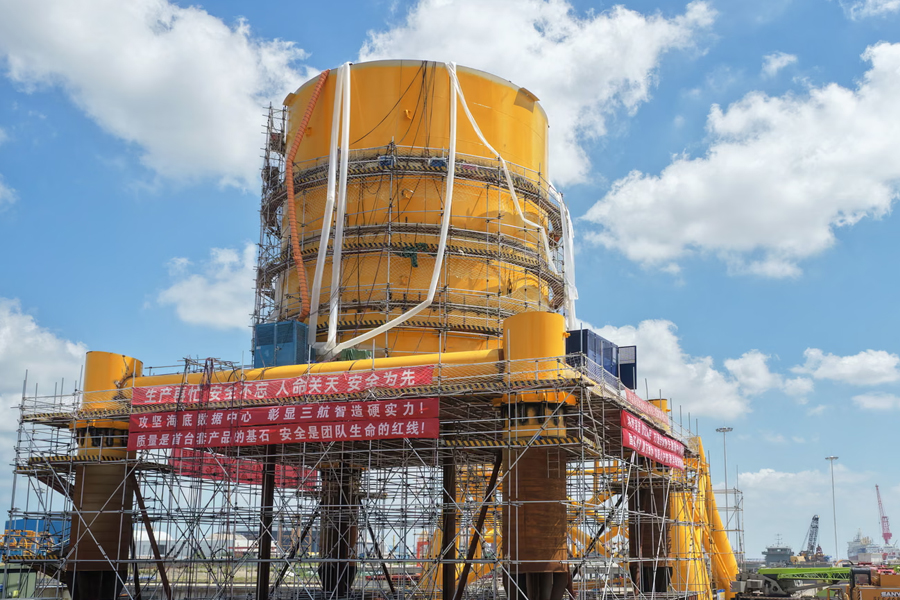
Shanghai, China – The world's first wind-powered underwater datacentre has begun operations off the coast of Shanghai, marking a breakthrough in sustainable AI infrastructure as China races to solve the immense energy challenges created by the country's artificial intelligence boom.
The Shanghai Lingang undersea datacentre demonstration project, which launched in May, has a capacity of 24 megawatts and represents a joint effort between HiCloud Technology and China Communications Construction, a state-owned enterprise. Located more than 6 miles (10km) off the coast of Shanghai, the datacentre is submerged 10 metres below the surface and powered entirely by a nearby offshore windfarm.
Key developments:
- World's first wind-powered underwater datacentre launches off Shanghai coast with 24MW capacity
- Submerged 10 metres below surface, powered entirely by offshore windfarm
- Reduces power consumption by more than 20% compared to land-based datacentres
- Natural seawater cooling eliminates need for energy-intensive water pumping systems
- 1.6 billion yuan (£177m) investment from Chinese government and partners
- Follows 2023 launch of world's first commercial underwater datacentre in Hainan
- UN warns datacentre water footprint could reach 9.3 trillion litres by 2030
- Microsoft proved concept in Orkney in 2018, but China accelerated commercial deployment
- Part of China's AI action plan calling for accelerated datacentre construction
- Clean energy supplies for AI infrastructure to be "significantly increased" by 2030
The AI Energy Crisis: A Growing Global Concern
Traditional land-based datacentres – the physical backbone of artificial intelligence – have come under intense scrutiny in recent years due to their enormous appetite for both electricity and freshwater. According to industry estimates, between 25% and 40% of total electricity demand in conventional datacentres comes solely from pumping chilled water around servers to prevent overheating.
The water consumption problem is equally alarming. This week, the United Nations University Institute for Water, Environment and Health warned that the water footprint of global datacentres could reach 9.3 trillion litres by 2030 – enough to service the annual domestic water needs of all 1.3 billion residents of sub-Saharan Africa.
How Underwater Datacentres Work
The Shanghai Lingang facility represents a radical departure from conventional datacentre design. By submerging servers 10 metres below the sea surface, engineers have harnessed the natural cooling properties of seawater – eliminating the need for energy-intensive cooling systems that plague land-based facilities.
According to the Chinese government, the underwater datacentre reduces power consumption by more than one-fifth compared with land-based equivalents. This efficiency gain comes from two key factors: renewable energy from offshore wind, and the natural cooling effect of being submerged in seawater.
"An underwater datacentre is likely a good idea," said Prof Rick Stafford, a marine biologist at Bournemouth University. "While the cooling using seawater will result in some localised elevated temperatures, these will not be far reaching."
China's AI Ambitions Drive Innovation
China has made support for artificial intelligence a central pillar of its economic and development strategy. Last year, Beijing released an ambitious AI action plan that called for the acceleration of datacentre construction nationwide. The government has also pledged that clean energy supplies for AI infrastructure will be "significantly increased" by 2030.
The Shanghai Lingang datacentre received 1.6 billion yuan (£177 million) in investment, according to Chinese government sources. The facility is located in Lingang, a hi-tech free-trade zone in eastern Shanghai that is also home to a Tesla gigafactory – underscoring the region's importance as a hub for advanced manufacturing and technology.
HiCloud previously launched the world's first commercial underwater datacentre in Hainan, a tropical island in southern China, in 2023. However, the Shanghai launch is the first project to be powered by offshore wind, marking a significant step toward carbon-neutral AI infrastructure.
Why China Beat the West to Commercial Deployment
China was not the first country to experiment with building underwater datacentres. In 2018, Microsoft launched a pioneering pilot project in the waters around Orkney, Scotland. Two years later, the company reported promising results – but progress has since stalled, and no commercial deployment has followed.
"Microsoft was earlier in proving the concept, while China moved further on commercial deployment because it was able to bring together market demand, industrial capability, marine engineering and policy support more quickly into a commercial project," said Dr Hanjiang Dong of Hong Kong Polytechnic University.
This analysis highlights a broader trend: China's ability to rapidly scale innovative technologies through coordinated government-industry collaboration, often outpacing Western competitors who face more fragmented regulatory and investment landscapes.
Underwater Datacentre Timeline: China vs Microsoft
| Year | Microsoft (Orkney, Scotland) | China |
|---|---|---|
| 2018 | Pilot project launched ✅ | — |
| 2020 | Promising results reported ✅ | — |
| 2023 | Progress stalled ❌ | First commercial underwater datacentre (Hainan) ✅ |
| 2025 | No commercial deployment ❌ | First wind-powered underwater datacentre (Shanghai) ✅ |
Environmental Considerations
Underwater datacentres are not without environmental risks. Experts have identified potential concerns including disturbance of marine sediments, localized heating of seawater, and possible impacts on marine ecosystems near the installation sites.
However, marine biologists who have reviewed the technology believe these risks are manageable with proper monitoring and mitigation strategies. The natural cooling effect means less energy consumption overall, which translates to reduced carbon emissions from power generation – a significant environmental benefit at a time when AI's carbon footprint is under increasing scrutiny.
Prof Rick Stafford of Bournemouth University noted: "While the cooling using seawater will result in some localised elevated temperatures, these will not be far reaching." He added that the overall environmental benefits of reduced energy consumption likely outweigh the localized impacts.
The Global Race for Sustainable AI
As artificial intelligence continues its rapid global expansion, the demand for computing power – and the energy and water required to support it – has become one of the defining challenges of the digital age. Major tech companies including Google, Amazon, Microsoft and Meta have all pledged to achieve carbon neutrality, but their datacentres remain significant contributors to global emissions and water consumption.
China's underwater datacentre offers a potential pathway forward. By combining renewable energy with innovative cooling solutions, the facility demonstrates that AI infrastructure can be both powerful and sustainable.
The Shanghai Lingang project is likely to be watched closely by technology companies and governments around the world. If the facility proves successful over the coming years, underwater datacentres could become a standard component of global AI infrastructure – with the ocean floor becoming the new frontier for computing.
🌟 The Big Picture
China's wind-powered underwater datacentre is more than just a technological milestone – it's a strategic response to the existential challenge facing the AI industry. As datacentres consume ever-increasing amounts of energy and water, innovative solutions like this could determine which nations lead the AI revolution and which fall behind. With 9.3 trillion litres of water projected for datacentre cooling by 2030, the race for sustainable AI infrastructure has never been more urgent.
🌊 For more breaking news and technology updates: Visit NewsOrbit - World Breaking News for the latest headlines from around the globe.