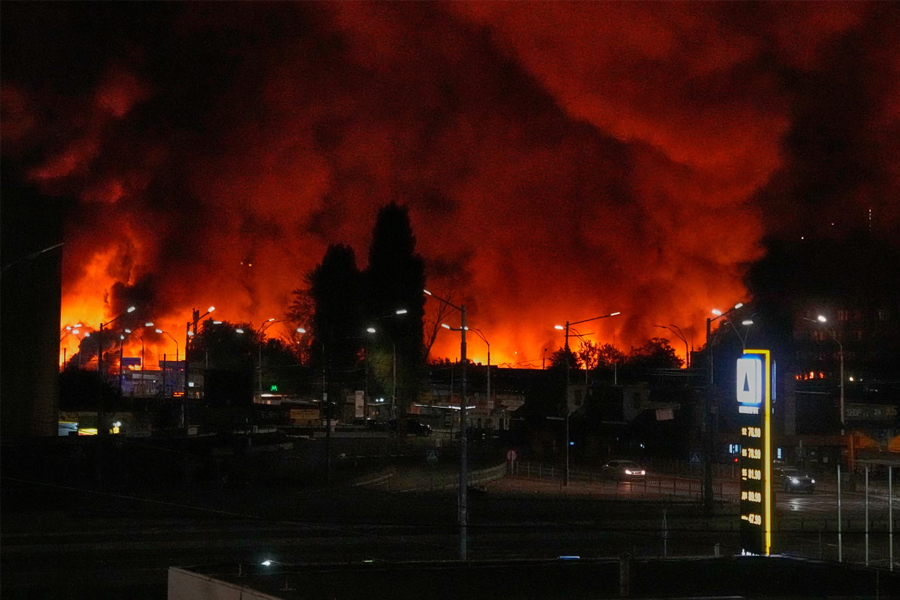
A fire burning in Kyiv after a Russian missile attack in the early hours of Sunday.
16 August 2026 | Kyiv, Moscow, Washington — Updated 23:30 GMT
Russian forces launched a missile attack on Kyiv early on Sunday, sparking fires in at least two districts of the Ukrainian capital, the city's mayor said. Kyiv's military administration said one person had been injured. Witnesses reported explosions in the city amid air alerts that sounded after 2am.
Mayor Vitali Klitschko, writing on Telegram, said falling debris had caused a fire in a non-residential part of a northern suburb. Several cars were on fire, and another fire had broken out in an area just south of the city centre, he said.
Ukraine says long-range strikes hit a Russian military airfield and a rocket centre that supports Russia's nascent Starlink-style satellite internet network. President Volodymyr Zelenskyy on Saturday said Flamingo cruise missiles struck the rocket facility, about 900km from Ukraine's border, as part of Kyiv's campaign to pressure Moscow to end the war by targeting sites deep inside Russia.
Welcome to the latest world headlines — where missile barrages, satellite warfare, and Russia's manpower crisis collide on the battlefields of Ukraine.
🇺🇦 UKRAINE WAR — KEY NUMBERS: Kyiv missile barrage • 1 injured • Fires in 2 districts • 900km range strike on rocket facility • 30,000 Russian casualties/month • 1,000 Russian recruits/day • 300,000 reservists called up in 2022 • 437 civilians killed in July (UN) • 1.3 million contract soldiers recruited since 2022 • $96m paid to recruiters.
Kyiv Under Missile Attack as Russia Intensifies Air Campaign
Russian forces launched a missile attack on Kyiv early on Sunday, sparking fires in at least two districts of the Ukrainian capital, the city's mayor said. Kyiv's military administration said one person had been injured. Witnesses reported explosions in the city amid air alerts that sounded after 2am.
Mayor Vitali Klitschko, writing on Telegram, said falling debris had caused a fire in a non-residential part of a northern suburb. Several cars were on fire, and another fire had broken out in an area just south of the city centre, he said. Unofficial Telegram channels posted photos of what were described as market stalls ablaze. Russia has in recent weeks been staging intensive air attacks on Kyiv and other Ukrainian cities.
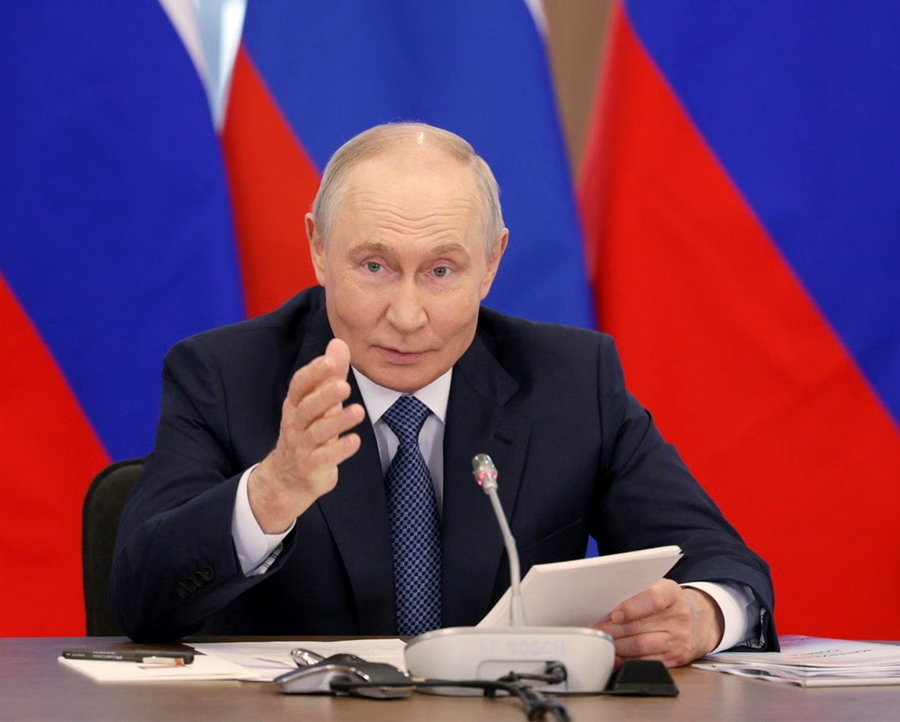
Putin recently signed a law expanding the pool of convicted prisoners eligible to sign contracts with the army.
Ukraine Strikes Russian Rocket Facility and Airfield in Long-Range Attack
Ukraine says long-range strikes hit a Russian military airfield and a rocket centre that supports Russia's nascent Starlink-style satellite internet network. President Volodymyr Zelenskyy on Saturday said Flamingo cruise missiles struck the rocket facility, about 900km from Ukraine's border, as part of Kyiv's campaign to pressure Moscow to end the war by targeting sites deep inside Russia.
— Volodymyr Zelenskyy, President of Ukraine
"It is important that Russia's war potential be reduced. Peace is needed, and this must be evident in Russia – through concrete damage to specific facilities," Zelenskyy wrote on X. He said the airfield hosted aircraft used to attack Ukraine.
Ukraine's armed forces said direct hits were recorded at the airfield in Russia's Nizhny Novgorod region and the Progress rocket centre in Samara region, sparking fires at both sites. The Samara plant produces rockets used to launch satellites for the Rassvet broadband network, which Russia is developing as an alternative to SpaceX's Starlink. Starlink operates in Ukraine but not in Russia, giving Kyiv an advantage in drone operations and battlefield communications.
In Samara region, local officials said air defences had repelled a "massive missile attack". "Samara's industrial infrastructure sustained localised damage," Ivan Noskov, head of the regional capital, said in an online post. Emergency services were working at the scene, he said.
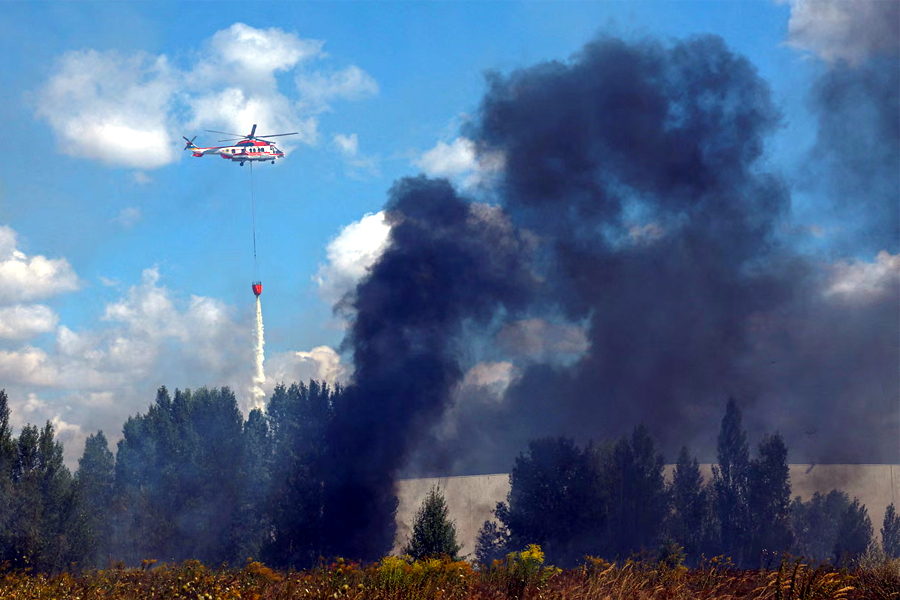
A firefighting helicopter drops water over a food warehouse damaged during Russian drone strikes near Kyiv, 12 August 2026.
Russian Strike Kills Three-Month-Old Baby as Civilian Toll Mounts
A Russian strike on an apartment block in south-eastern Ukraine on Saturday killed a three-month-old baby and wounded 11 people, local officials said. Drones hit the building in the town of Marhanets, said Oleksandr Hanzha, head of the Dnipropetrovsk regional military administration.
This attack comes after the United Nations reported that July was the deadliest month for Ukrainian civilians since the early weeks of Russia's invasion. At least 437 civilians were killed and 2,610 wounded last month.
Russian jet-powered drones have struck a home in northern Ukraine, killing a 29-year-old woman and her 9-year-old son. Meanwhile, Ukrainian drones have targeted Russian infrastructure, including a major port north of Moscow.
Kim Jong-un and Putin Exchange Letters on 'Unprecedentedly High Level' of Cooperation
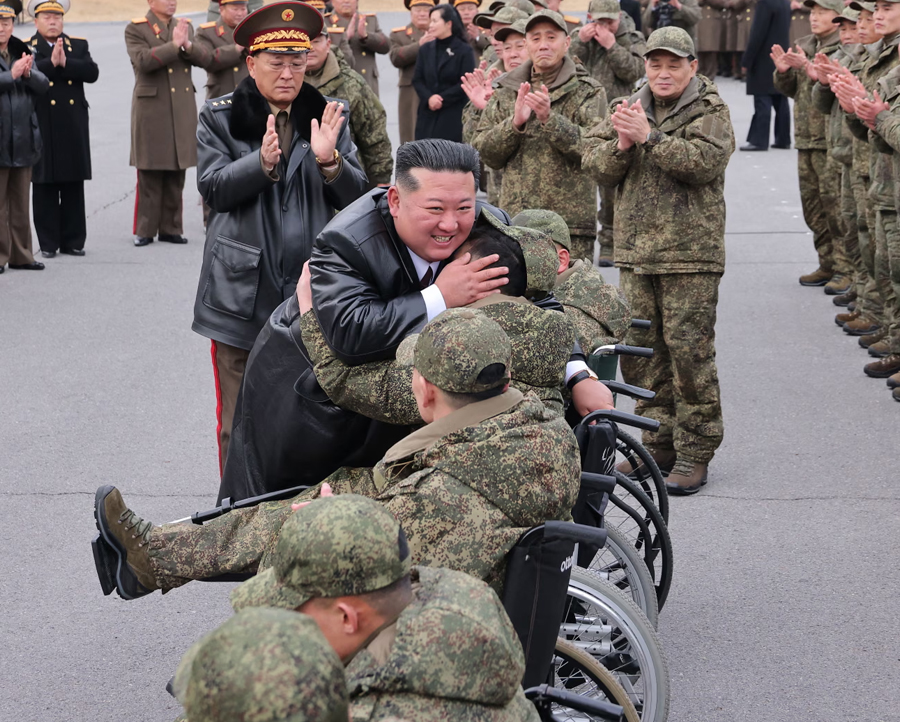
North Korean leader Kim Jong-un has told Russian president Vladimir Putin in a letter that he was "proud" of their countries' strong ties, state media reported. North Korea has become a key ally of the Kremlin, sending troops to support Moscow's war effort in return for economic benefits and military technology, analysts say. Kim added that he had a "firm belief" that Russia would thrive and defend its "territorial integrity" under Putin's "wise leadership".
In a letter to Kim delivered on Friday to mark Korea's liberation from Japanese colonial rule at the end of the second world war, Putin said relations between the two countries had reached the "unprecedentedly high level of comprehensive strategic partnership". "Our states are actively cooperating in all the sectors while making concerted efforts to ensure the regional security and stability," the Russian leader said.
The exchange of letters follows Ukraine's accusation this month that Moscow had launched North Korean ballistic missiles in a strike that killed at least nine people and wounded dozens. Kyiv has also recently said that up to 50,000 North Korean troops are due to deploy to Russia, although it has provided no evidence to back the claim or a timeframe for the deployment.
Zelenskyy Warns Egypt of Food Supply Threat Caused by Black Sea Strikes
Ukrainian president Volodymyr Zelenskyy has warned Egyptian counterpart Abdel Fattah al-Sisi of possible food supply shortages caused by Russian strikes on cargo vessels in the Black Sea. "Ukraine is one of the largest food suppliers to Egypt and to a significant number of other countries in Africa and the Middle East. These supplies are now under serious threat because of Russia's war," Zelenskyy said on X.
"We are already seeing a significant reduction in supplies, and this could have very unpleasant consequences due to rising prices and shortages," he said, adding that the two countries had agreed to work on solutions.
Russia on Friday dismissed the idea of a ceasefire with Ukraine in the Black Sea, saying it saw no grounds for "half-measures" that would offer a respite to the other side. In a statement, foreign ministry spokesperson Maria Zakharova accused Ukraine of "brazen acts of terrorism" against shipping, while making no mention of Russia's own attacks.
Russia's Recruiters Scramble to Avoid Second Mass Mobilisation as Losses Mount
Russia is losing 30,000 casualties a month, and the country's regions are under pressure to feed the 'meat-grinder'. Experts say it may not be enough.
In kitchens and Telegram chats across Russia, the same question is being asked with growing frequency: will Vladimir Putin order another mobilisation?
Nearly five years into the war, Russia is scrambling to find enough soldiers to replenish its ranks, as voluntary recruitment slows and its forces suffer heavy losses on the battlefield in Ukraine.
With Putin showing no sign of abandoning his far-reaching territorial demands, even as Russia's summer offensive stalls, the Kremlin faces a growing manpower headache.
— Aleksei Tabalov, Human Rights Activist
"The problem for the Kremlin is that it is getting much harder to find people willing to fight, even for crazy money," said Aleksei Tabalov, a human rights activist and director of an organisation that helps Russian conscripts.
Putin last resorted to mobilisation in September 2022, when a series of dramatic battlefield setbacks forced the Kremlin to call up 300,000 reservists to stabilise the front.
Since then, Moscow has avoided another deeply unpopular call-up by relying largely on high paid voluntary contracts to fill the ranks with roughly 1.3 million contract soldiers Russia has recruited since.
Men, particularly from Russia's poorer regions, have been offered life-changing signing bonuses and salaries on open-ended contracts amounting to several years of local wages, alongside substantial payouts to their families if they are killed.
But Russia's heavy losses mean it must continue finding new soldiers at a high rate.
Western estimates put Russian casualties at more than 30,000 killed and wounded a month, a toll that reflects the army's attritional "meat grinder" tactics, in which troops are repeatedly sent forward in small assault groups despite heavy losses.
🇷🇺 RUSSIA'S MANPOWER CRISIS — KEY NUMBERS
- Monthly casualties: 30,000+ (killed and wounded)
- Daily recruits: ~1,000 (enough to replenish losses, not expand)
- 2022 mobilisation: 300,000 reservists called up
- Contract soldiers recruited: 1.3 million since 2022
- Recruiter payments: $96m (7.7bn roubles)
- Civilian deaths (July): 437 killed, 2,610 wounded
- UN report: Deadliest month since early invasion
Coercive Recruitment Tactics Intensify Across Russian Regions
Moscow, meanwhile, now recruits roughly 1,000 soldiers a day, according to calculations by Janis Kluge, a Russia expert at the German Institute for International and Security Affairs, which means most new recruits are used to replenish depleted units rather than expand Russia's offensive capacity.
Top Russian officials have dismissed reports of an impending call-up, with former president Dmitry Medvedev describing them as "nonsense" and a "lying provocation" by Ukraine.
Two people familiar with discussions in Moscow also said there was no indication that Putin had decided to order another mass mobilisation. A senior western official likewise said there were no signs that a decision had been taken.
But fears that another call-up may be on the way have nevertheless increasingly entered everyday conversations.
In Telegram chats used by local sports teams, work colleagues and groups of friends, Russians swap rumours about a possible mobilisation and share advice on securing exemptions or avoiding the draft. Some speculate that a new call-up could come after September's elections to the Duma.
"It's guesswork right now whether mobilisation will actually happen," said Ivan Chuviliaev, a spokesperson for Get Lost, a group that helps Russian soldiers desert.
But he said the renewed speculation was already being exploited to boost recruitment.
— Ivan Chuviliaev, Get Lost (helps Russian soldiers desert)
"The panic around mobilisation is being used by officials to pressure men into signing contracts," Chuviliaev said. "The message is: mobilisation is coming anyway, so you might as well sign a contract now and get a payout before you're forced to fight."
Over the summer, lawyers and activists have documented increasingly coercive recruitment tactics in several regions, with men detained on the street by police, taken from workplaces or summoned to stations – before being brought to military recruitment offices and pressed to sign contracts.
"It has turned into a hunt for people," said Tabalov. "Under various pretexts, through deception, blackmail, violence and threats, they are forcing them to sign contracts."
Tabalov said recruiters were increasingly targeting what he described as "socially marginalised" men, including those with debts, criminal cases or other vulnerabilities that could be used to put pressure on them to enlist.
In the southern Penza region, where some of the most aggressive draft methods have been reported, videos posted online have shown men being driven away in vans as relatives protested outside recruitment offices. Activists say some have been threatened with prosecution or beaten until they agreed to sign.
The search has widened elsewhere too. Universities, technical colleges and vocational schools have been encouraged to recruit students into newly formed drone units, offering another source of manpower for the military. Putin recently signed a law expanding the pool of convicted prisoners eligible to sign contracts with the army, including people convicted of "serious and especially serious crimes".
The Recruitment Industry: Bonuses, Pressure and Regional Targets
Much of the responsibility for finding soldiers has been pushed down to Russia's regions.
Governors and local administrations are expected to meet recruitment targets set by Moscow, giving the Kremlin some distance from the drive while leaving regional officials responsible for finding enough men in their own territories.
Around that system, a lucrative recruitment industry has emerged. Regional governments offer thousands of dollars not only to soldiers who sign contracts but also to those who find them, with "bring a friend" schemes paying residents for every person they persuade to enlist.
Private recruiters and public-sector employees scour social media for candidates, while advertisements for military contracts have become ubiquitous online. Russian regions have paid recruiters at least 7.7bn roubles ($96m) since such schemes were introduced, according to the independent Russian outlet IStories.
One recruiter in central Russia, speaking to the Guardian on condition of anonymity, said his organisation was expected to find between 20 and 30 men each month, with bonuses for exceeding the target and penalties for falling short.
"It was easier last year," the recruiter said. "Now it is getting harder."
The recruiter said mobilisation was also being discussed in his office, but that there had been no orders or indications that a new draft was imminent.
Another mass call-up, however, would carry significant political risks for the Kremlin.
The 2022 call-up triggered one of the biggest episodes of domestic disruption since the invasion began, prompting a mass exodus of Russians and a sharp drop in Putin's approval ratings.
It would also come at a potentially sensitive moment. Recent polling suggests confidence in the course of the war is weakening, with the share of Russians who believe the campaign in Ukraine is going well falling to its lowest level since April 2022.
For now, analysts say Moscow is more likely to step up recruitment efforts through higher bonuses, pressure on regional officials and increasingly coercive tactics.
Whether that will be enough could ultimately determine if Putin resorts to another mobilisation, said Tabalov, the activist.
— Aleksei Tabalov, Human Rights Activist
The options before the Kremlin, Tabalov said, could range from another mass call-up to a more selective mobilisation, sending existing conscripts to the front or quietly calling up reservists for frontline service.
"I don't think they'll be able to recruit enough people under the current system," Tabalov said. "Then they'll be faced with the question of what form mobilisation should take."
🇺🇦 UKRAINE WAR: THE NUMBERS THAT DEFINE THE MOMENT
🇺🇦 UKRAINE AT A GLANCE
Injured in Kyiv barrage
Districts on fire
Range of Ukrainian strike
Civilians killed in July (UN)
🗣️ KEY VOICES
Volodymyr Zelenskyy:
"It is important that Russia's war potential be reduced. Peace is needed, and this must be evident in Russia."
Aleksei Tabalov (Activist):
"It is getting much harder to find people willing to fight, even for crazy money."
Ivan Chuviliaev (Get Lost):
"The panic around mobilisation is being used by officials to pressure men into signing contracts."
Russian Recruiter:
"It was easier last year. Now it is getting harder."
🇷🇺 RUSSIA'S MANPOWER CRISIS
⚠️ COERCIVE RECRUITMENT TACTICS
🇰🇵 NORTH KOREA & INTERNATIONAL
🇺🇦 THE FINAL VERDICT: MISSILE BARRAGES, SATELLITE WARFARE, AND MANPOWER CRISIS
✅ WHAT'S HAPPENING:
- Kyiv under missile barrage; fires in 2 districts
- Ukraine strikes Russian rocket facility 900km away
- Zelenskyy warns Egypt of food supply threats
- Kim-Putin letters affirm "comprehensive strategic partnership"
- Russia dismisses Black Sea ceasefire idea
⚠️ THE CHALLENGES:
- Russia losing 30,000 casualties/month
- Recruitment slowing; coercive tactics intensifying
- 3-month-old baby killed in Russian strike
- July deadliest month for civilians (437 killed)
- Mobilisation fears grow across Russia
- Romania finds second drone in territory
"It is important that Russia's war potential be reduced. Peace is needed, and this must be evident in Russia," Zelenskyy declared, as Ukraine struck a Russian rocket facility 900km away and Kyiv came under missile barrage. Russia is losing 30,000 casualties a month, and recruiters are scrambling to find soldiers through increasingly coercive tactics — detaining men on the street, threatening them with prosecution, and offering bonuses. Putin recently signed a law expanding prisoner recruitment. North Korea's Kim Jong-un and Putin exchanged letters affirming "unprecedentedly high" cooperation, as mobilisation fears grow across Russia.
— World Headlines Analysis
Stay updated with the latest world headlines, Ukraine war developments, and breaking news on our World News Page.