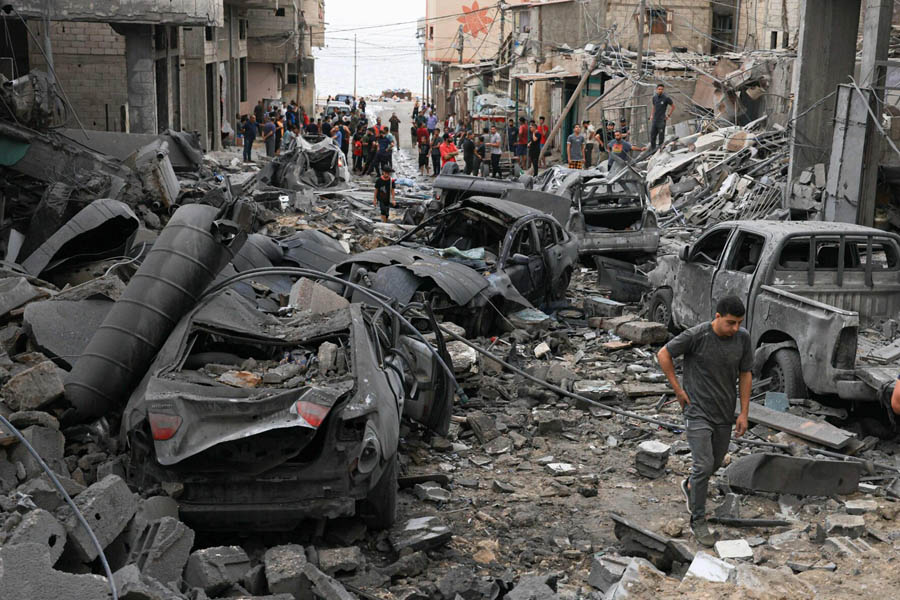
Escalation in Israel-Hamas Conflict: Ground Operations Expand Across Gaza Strip — Khan Younis Under Attack as Humanitarian Crisis Worsens
Gaza Strip – The Israeli military has dramatically expanded its ground operations "all across the Gaza Strip," pushing into southern Gaza's largest city, Khan Younis, after weeks of concentrated bombing and ground maneuvers in the north. The IDF confirmed on Tuesday that its forces had entered the heart of Khan Younis, a densely populated city where hundreds of thousands of displaced Palestinians had sought refuge following earlier evacuation orders for northern Gaza.
The intensification marks a new and dangerous phase in the conflict that began after Hamas's October 7 attacks. Israeli officials describe the southern offensive as essential to dismantle Hamas battalions they say are embedded within civilian infrastructure. However, international aid agencies warn that the ground expansion has created a humanitarian catastrophe of "unimaginable proportions," with overcrowded shelters, collapsing medical facilities, and a growing death toll that local health authorities now place above 16,000.
Evacuation Orders and a Population with Nowhere Left to Go
The Israeli military dropped leaflets over Khan Younis and sent Arabic text messages ordering residents to evacuate to designated "safe zones" along the coast near Rafah. But for hundreds of thousands who had already fled south in recent weeks, the orders represent a devastating psychological blow. "We came here because they told us it was safe. Nowhere is safe in Gaza," said Umm Ahmed, a mother of four sheltering in a UN-run school in Khan Younis.
Aid agencies, including the UN Office for the Coordination of Humanitarian Affairs (OCHA), have described the evacuation zone as shrinking by the day. With Gaza's borders sealed by both Israel and Egypt, civilians have no exit. The designated "safe zones" lack adequate food, water, sanitation, and medical care, and have themselves been struck by airstrikes multiple times over the past week.
Military Offensive in Southern Gaza: What We Know
IDF Chief of Staff Herzi Halevi told reporters that the southern operation is "no less powerful" than the northern campaign, with ground forces, armored units, and air support engaging Hamas fighters in tunnel networks beneath Khan Younis. Israeli intelligence suggests senior Hamas leaders, including Yahya Sinwar, may be hiding in the tunnel complexes beneath the city. The IDF also claims to have struck over 400 targets across Gaza in the past 48 hours, including weapons depots and command centers.
Critics, including human rights organizations, charge that the military's strategy fails to distinguish between combatants and civilians. Philippe Lazzarini, head of UNRWA, stated: "The evacuation orders are impossible to implement. People are being pushed into smaller and smaller pockets of land, with no sanitation, no clean water, and no safety."
Humanitarian Crisis: Hospitals Collapsing, Supplies Exhausted
The medical infrastructure in southern Gaza is on the verge of total collapse. At Nasser Hospital in Khan Younis — the largest remaining medical facility in southern Gaza — doctors report performing surgeries without anaesthetics, using vinegar as a disinfectant. Dr. Mohammed Qandeel, a trauma surgeon, described the scene: "We are receiving dozens of wounded every hour — many of them children with shrapnel wounds, burns, and blast injuries. Our morgue is overflowing. We have run out of body bags."
The World Health Organization has recorded over 350 attacks on healthcare facilities in Gaza since October 7. As of December 5, fewer than half of Gaza's 36 hospitals remain partially functional, and most of those are in the south, now directly threatened by the expanding ground operation.
International Response: UN Chief Appeals for Restraint
United Nations Secretary-General António Guterres issued an urgent appeal to Israel to halt the southern offensive, invoking Article 99 of the UN Charter for the first time in his tenure — a rare and powerful move designating the Gaza situation as a threat to international peace and security. "We are witnessing a humanitarian catastrophe unfolding in real time," Guterres said. "The people of Gaza are being told to move like human pinballs — bouncing between ever-shrinking pockets of the south, without any of the basics for survival."
The United States, while continuing to provide military and diplomatic support to Israel, has also urged greater care to protect civilians. Vice President Kamala Harris said: "Too many innocent Palestinians have been killed. Israel must do more to distinguish between Hamas terrorists and civilians." However, the Biden administration has not called for a permanent ceasefire, instead backing temporary pauses to allow hostage releases and aid delivery.
Casualty Figures and the Toll on Civilians
Gaza's Ministry of Health, whose figures are considered reliable by UN agencies, reports that over 16,000 Palestinians have been killed since October 7, including more than 7,000 children. Thousands more are trapped beneath rubble, unreachable by rescue crews. The ministry has also reported that over 42,000 people have been wounded — overwhelming a healthcare system already paralyzed by lack of fuel and supplies.
In Israel, official figures hold that 1,200 people — primarily civilians — were killed in the October 7 Hamas attack, with over 240 taken hostage. The IDF reports that 85 Israeli soldiers have been killed since the ground invasion began. Families of the remaining hostages have intensified pressure on Prime Minister Benjamin Netanyahu to prioritize a deal for their release, even as military operations expand.
What Comes Next: A Long and Bloody Winter
As ground operations spread across Gaza, the civilian population faces an impossible choice: remain in harm's way or flee to areas that lack the most basic humanitarian provisions. Aid convoys continue to be delayed or blocked, and fuel shortages have forced the shutdown of water desalination plants, internet services, and sewage pumping stations. The risk of epidemic disease, including cholera and respiratory infections, grows by the day.
The expansion of the conflict into southern Gaza also raises the specter of a second front with Hezbollah in Lebanon, which has exchanged cross-border fire with Israel daily. For now, the world watches as the Gaza Strip endures what UN officials now call "the most intense bombing campaign of the 21st century." The coming weeks will determine whether diplomatic pressure can alter Israel's strategy — or whether the death toll will continue its tragic, relentless climb.
Related Coverage: For continuous updates on the Israel-Hamas war, visit our Israel-Gaza War Hub and follow Middle East Breaking News for live developments.
Global Post Headline — independent coverage of the Israel-Gaza war and Middle East crisis. globalpostheadline.com | Follow live: Israel-Gaza-War.html | middle-east-breaking.php

Authentic Nepali crafts, pashmina, singing bowls — worldwide shipping.