Unraveling the Shadows: Israel's Covert Strikes on Key Figures in the Middle East
A fortnight ago, Sayyed Razi Mousavi existed as an enigma on the internet, leaving behind no digital footprint on search engines or in reports covering Iran's military activities and the broader Middle Eastern region. While maintaining a low profile online, Mousavi had played a crucial role in the heart of Syria, Damascus, for more than thirty years. During this time, he served as the chief aide to the now-deceased General Qassem Soleimani, who led the Iranian Quds Force. His death on Christmas Day 2023 marked the first high-profile assassination of a Iranian military figure since Soleimani himself was killed in a US drone strike in January 2020.
Target 1: Sayyed Razi Mousavi — The Ghost of Damascus
Date Killed: December 25, 2023
Location: Sayyed Zeynab area, south of Damascus, Syria
Method: Three missiles fired by Israeli warplanes
Role: Quds Force senior commander, liaison to Assad regime and Hezbollah
Mousavi's role as a liaison with the Assad regime and Lebanon's Hezbollah during the brutal crackdown on dissenters since March 2011 had been an open secret. In 2021, he assumed the position of Iran's senior commander in Syria. However, his two-decade-long clandestine existence came to an abrupt end on Christmas Day when Israeli warplanes launched three missiles into Iran's main military compound in the Sayyed Zeynab area south of Damascus, killing Mousavi instantly. Iranian media confirmed the death, with Iranian President Ebrahim Raisi vowing retaliation, calling Mousavi a "martyr" and warning Israel would pay the price.
Target 2: Saleh al-Arouri — Hamas's Deputy Leader
Date Killed: January 2, 2024
Location: Dahiyeh, southern suburb of Beirut, Lebanon
Method: Israeli drone strike
Role: Founder of Hamas's military wing, deputy political leader
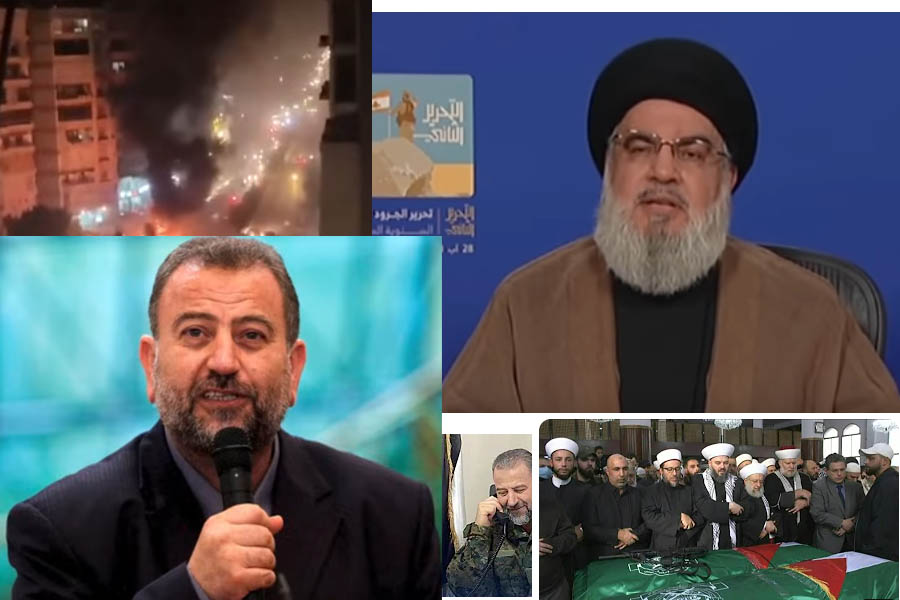
In stark contrast to Mousavi's elusive profile, Saleh al-Arouri had long lived in the spotlight of conflict. As a founder of Hamas's military branch and deputy political leader of the Palestinian organization, al-Arouri played a prominent role in overseeing operations in the West Bank. Despite political pressures that led him to move from Qatar to Turkey and eventually to Lebanon, he remained visible, maintaining connections with Hezbollah and Iranian officials. The strike in Dahiyeh — the first Israeli attack inside Beirut since the 2006 Lebanon War — represented a significant escalation. Lebanese Prime Minister Najib Mikati condemned the attack as a "new Israeli crime."
The October 7 Connection
Al-Arouri's involvement in the planning of Hamas's mass killings in Israel on October 7, 2023, along with negotiations surrounding the exchange of Hamas-held hostages for women and children in Israeli prisons during the Gaza conflict, kept him at the forefront of regional conflicts. On January 2, an Israeli drone struck a building in Dahiyeh, the southern suburb of Beirut and Hezbollah's stronghold, claiming the lives of al-Arouri, two senior Hamas commanders — Samir Fandi and Azzam al-Aqraa — and several others. The precision strike, which occurred in a Hezbollah-controlled area, demonstrated Israel's ability to reach its enemies even in heavily fortified locations.
A History of Targeted Killings
Israel, known for its discreet military operations, rarely claims responsibility for such targeted assassinations. Over the years, the country has employed this strategy against various high-profile figures, including the 2004 assassination of Hamas's spiritual leader, Ahmed Yassin (killed by an Israeli helicopter missile strike in Gaza). Additionally, Israel has consistently targeted Iranian and Hezbollah positions, as well as Assad regime installations in Syria. Other notable Mossad operations include the assassination of Iranian nuclear scientists (2010-2012), the killing of Hezbollah commander Imad Mughniyeh in Damascus (2008), and more recently, the killing of Al Qaeda's second-in-command Abdullah Ahmed Abdullah in Tehran (2020). The doctrine of "targeted killing" has been a cornerstone of Israeli counter-terrorism and counter-proliferation strategy for decades.
The Shadow War: Iran vs. Israel
The recent eliminations of Mousavi and al-Arouri underscore Israel's commitment to disrupting and dismantling networks it perceives as threats. The covert nature of these operations also reflects the delicate geopolitical dance in the Middle East, where state and non-state actors vie for influence, often resorting to clandestine methods to achieve their objectives. The strikes come amid a broader "shadow war" between Israel and Iran, characterized by maritime attacks, cyber-operations, and covert assassinations spanning Syria, Iraq, Lebanon, and even Iranian soil. Since October 7, this shadow war has intensified, with Israel reportedly striking Iranian targets in Syria more than 100 times.
Notable Israeli Targeted Killings (2000-2024)
- Ahmed Yassin (2004) — Hamas founder & spiritual leader
- Imad Mughniyeh (2008) — Hezbollah military commander
- Muhammad al-Dura (various) — Hamas bomb-makers
- Iranian nuclear scientists (2010-2012) — 5 scientists killed
- Qassem Soleimani (2020) — Quds Force commander (US strike)
- Sayyed Razi Mousavi (Dec 2023) — Iran's senior Syria commander
- Saleh al-Arouri (Jan 2024) — Hamas deputy leader
Regional Reactions and Escalation Risks
The back-to-back assassinations have sent shockwaves through the region. Iran has vowed retaliation, with Foreign Minister Hossein Amir-Abdollahian warning that Israel "will pay a heavy price." Hezbollah leader Hassan Nasrallah warned of a "response" to the Beirut strike, raising fears of a full-scale war on Israel's northern border. In the days following al-Arouri's killing, Hezbollah launched increased rocket and drone attacks on northern Israel, though the group stopped short of all-out war. Meanwhile, the United States called for restraint and denied any involvement in the strikes. The assassinations have complicated ongoing hostage negotiations, with Hamas suspending some contacts in protest.
Mossad's Long Reach
The precision of the Beirut drone strike — targeting a building in a densely populated Hezbollah stronghold — underscored Mossad's intelligence capabilities. Israeli intelligence reportedly tracked al-Arouri for months, awaiting the right operational window. The use of a drone rather than a missile strike minimized civilian casualties (only al-Arouri and his aides were killed). The operation sent a clear message: no figure involved in the October 7 attacks is safe, regardless of their location. Mossad chief David Barnea had publicly vowed to hunt down every Hamas leader involved in the massacre, comparing the effort to the post-Munich 1972 campaign.
The Future of the Shadow War
As the region continues to grapple with instability and shifting alliances, Israel's covert strikes serve as a stark reminder of the intricate web of power dynamics and the lengths to which nations are willing to go to protect their interests in the shadows of the Middle East. The assassinations of Mousavi and al-Arouri are unlikely to be the last in this escalating shadow war. Iran has signaled its intent to retaliate, possibly through its proxies — Hezbollah, Iraqi militias, or the Houthis. The coming months will determine whether the conflict remains in the shadows or erupts into a direct, open confrontation.
Related Coverage: For ongoing updates on the Middle East crisis and Israel's military operations, visit our Middle East Breaking News page and Israel-Gaza War Hub.
Global Post Headline — independent Middle East and intelligence coverage. globalpostheadline.com | Follow live: middle-east-breaking.php