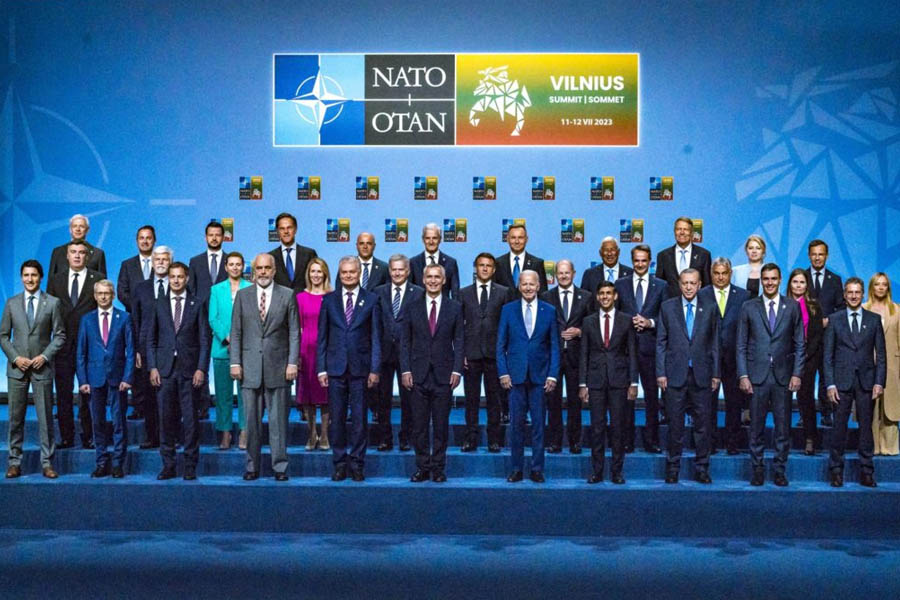
NATO Summit Fails to Grant Membership to Ukraine, Vows Increased Support — Vilnius Summit Delivers Security Guarantees Without Membership Timeline
Vilnius, Lithuania – The recent two-day summit of the North Atlantic Treaty Organization (NATO) held in Vilnius, Lithuania, centered on the issue of granting membership to Ukraine. While major nations pledged additional arms support to the country, the conference did not make any immediate decision regarding Ukraine's NATO membership — a disappointment for Kyiv, which had hoped for a clearer path to joining the alliance.
Ukrainian President Volodymyr Zelensky expressed his disappointment at the lack of a membership decision and a specific timeframe. Ahead of the conference, President Zelensky tweeted that the event would be "meaningless" without setting a deadline for Ukraine's NATO membership. The tweet, which was seen as unusually sharp criticism of the alliance, underscored the frustration in Kyiv after months of lobbying for a concrete invitation.
NATO Chief Jens Stoltenberg confirmed that no decision had been made on Ukraine's membership, but he believed that the country was close to joining the alliance. "Ukraine's future is in NATO," Stoltenberg said at the closing press conference. "We reaffirmed that Ukraine will become a member of the alliance. But the focus now is on ensuring Ukraine prevails as a sovereign, independent nation."
🏛️ The 2008 Promise and the Current Reality
In 2008, NATO had stated that Ukraine could potentially join the organization in the future. However, due to current circumstances — including the ongoing war with Russia — a "Fast Track" decision on granting membership was not possible. The 2008 Bucharest summit declaration that Ukraine and Georgia "will become members of NATO" has been repeated at every subsequent summit, but without a concrete roadmap, it has become a source of frustration in Kyiv.
According to NATO provisions — particularly Article 5 — if any of its member countries face an attack from other nations, NATO is obligated to declare war against the aggressor. Consequently, admitting Ukraine as a member at this time would potentially trigger NATO's involvement in a direct conflict with Russia — a risk that alliance members are unwilling to take. Nevertheless, Ukraine has accepted the condition that it cannot join NATO during wartime but continues to push for membership as soon as possible after the conflict ends.
📋 Membership Requirements: Economic, Political, and Military Criteria
NATO emphasizes that Ukraine must first meet specific economic, political, and military qualifications before membership can be considered. The organization is currently supporting Ukraine, and the scale of assistance in the event of a war with Russia would increase dramatically after becoming a member. Key requirements include:
- Democratic governance: Functioning democratic institutions and civilian control of the military
- Reforms: Anti-corruption measures and judicial reform
- Military interoperability: Compatibility with NATO forces and command structures
- Territorial disputes: Resolution of border issues (complicated by Russian occupation)
US President Joe Biden also shared that Ukraine is not currently prepared to join NATO, and meeting other qualifying criteria is essential. "There is no shortcut to membership," Biden said. "But we will continue to support Ukraine as it makes the necessary reforms."
🤝 G7 Security Guarantees: A Bridge to Membership
After the conference, President Biden met with President Zelensky and pledged continued support to Ukraine through the G-7 countries. The support includes the provision of modern military equipment to bolster all three branches of Ukraine's defense forces—land, air, and sea. Biden stated, "All of our colleagues agree that Ukraine's future lies in NATO, and we make it clear that our cooperation will continue and extend into the future."
The G7 Joint Declaration of Support for Ukraine, signed on July 12, commits member nations to provide Ukraine with "security assurances" — including military equipment, intelligence sharing, training, and economic support — for the duration of the war and beyond. While not a mutual defense treaty like NATO's Article 5, the declaration is intended to deter future Russian aggression by making clear that an attack on Ukraine would be met with a united Western response.
Although Ukraine did not secure NATO membership at this summit, it will receive support from the G-7 countries, which includes the transfer of defense equipment, training, and technology. British Prime Minister Rishi Sunak emphasized that this assistance will send a "strong message to Russia" about Western resolve. "Ukraine's friends are not going anywhere," Sunak said. "We will stand with Ukraine for as long as it takes."
Additionally, an agreement was reached to train pilots in Romania to fly the F-16 jet aircraft provided by the US to Ukraine, starting from August. The training is a significant step toward providing Ukraine with modern fighter jets, a capability it has long requested. The US has also begun transferring F-16s from Denmark and the Netherlands, with the first Ukrainian pilots expected to be ready for combat by early 2024.
📜 NATO's Historical Context and Expansion
Founded in 1949, NATO initially consisted of 12 countries, including the United States, Britain, Canada, and France. With the addition of Sweden — which formally joined in March 2024 — the alliance now comprises 32 member countries from Europe and North America. NATO member countries commit to defending each other against any attack from any source under Article 5 of the Washington Treaty.
Originally formed to counter the expansion of the Soviet Union in Europe during the Cold War, NATO's membership has expanded significantly since the collapse of the USSR to include Eastern European countries, such as Albania, Bulgaria, Hungary, Poland, Romania, and the three Baltic states (Estonia, Latvia, Lithuania). Each enlargement has been met with Russian opposition, and Ukraine's pursuit of NATO membership has been a particular flashpoint, triggering hostilities with Russia based on security concerns.
Russian President Vladimir Putin has repeatedly cited NATO expansion as a justification for the invasion of Ukraine. Moscow demands that NATO withdraw its promise of membership to Ukraine and roll back its presence in Eastern Europe — demands the alliance has rejected.
🔮 What's Next for Ukraine and NATO?
While Ukraine's NATO membership remains pending, the nation's cooperation with the G-7 and support from other NATO member countries signal continued commitment to strengthening Ukraine's security and defense capabilities. The Vilnius summit also saw the creation of a new NATO-Ukraine Council, which gives Ukraine an equal seat at the table for consultations on security issues — a symbolic but important upgrade from the previous NATO-Ukraine Commission.
For Ukraine, the summit was a mixed result. The lack of a membership timeline was a clear disappointment, but the G-7 security guarantees and the agreement on F-16 training were tangible gains. "We received the security guarantees we have been asking for," Zelensky said after the summit. "But we will continue to push for NATO membership. It is our only guarantee of lasting security."
The path forward will depend on the outcome of the war. If Ukraine can liberate its territory and demonstrate that it is a stable, democratic, and capable partner, NATO membership will become increasingly likely. If the war drags on or Ukraine suffers setbacks, the prospect of membership could recede further. For now, the alliance has bought time — but not a final decision.
Related Coverage: For more on NATO and European security, visit UK-Europe News and Russia-Ukraine War Hub.
Global Post Headline — independent coverage of NATO, European security, and global politics. globalpostheadline.com | Follow updates: Europe News | Politics Section

Experience the Himalayas with expert Sherpa guides. Trekking, expeditions, and cultural tours in Nepal, Tibet & Bhutan.
Plan Your Nepal Trip →
Authentic Nepali crafts, pashmina, singing bowls — worldwide shipping.