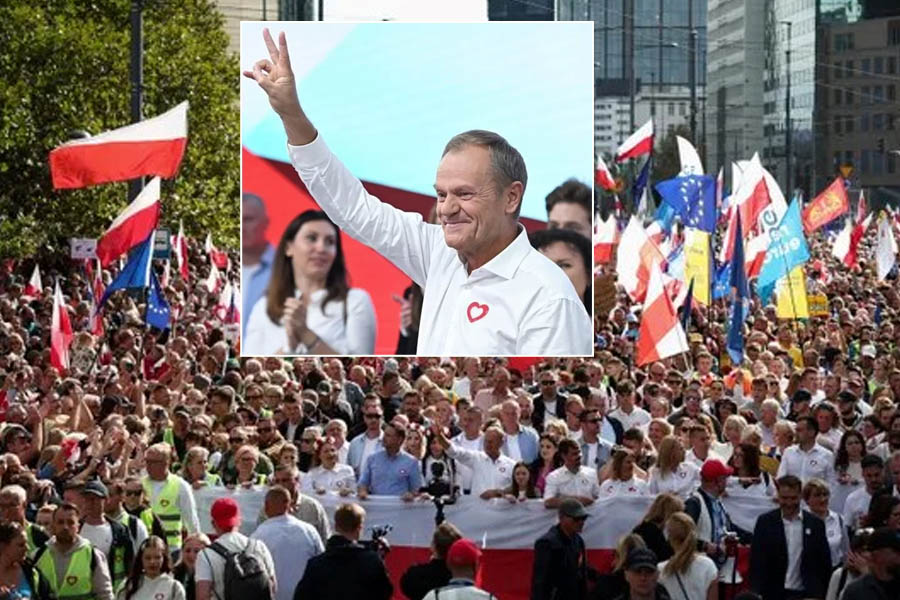
Poland Election Results: Civic Coalition Led by Donald Tusk Claims Victory, Signaling a Potential Shift in Political Landscape — End of an Era for PiS After 8 Years
Warsaw, Poland – In a historic turn of events, Poland's political landscape has witnessed a seismic shift as the right-wing populist Law and Justice party (PiS) secured the most seats in the general election but fell short of securing a third term in office, according to exit poll data released late Sunday night. The country now stands on the brink of change, with the centrist opposition, led by former European Council President Donald Tusk's Civic Coalition, holding the promise of a new era for the Central European nation.
According to the exit poll conducted by Ipsos, PiS garnered 36.8% of the votes, while Tusk's Civic Coalition followed closely at 31.6%. The center-right Third Way coalition and the left-wing Lewica party secured 13% and 8.6% respectively, giving the opposition bloc a clear path to forming a coalition government. This outcome effectively ends PiS's eight-year rule under the leadership of party chairman Jarosław Kaczyński, marking the most significant political change in Poland since the fall of communism.
🗳️ A Historic Voter Turnout: Democracy in Action
Emotions ran high in the streets of Warsaw as Donald Tusk, the veteran politician and former Prime Minister (2007-2014), addressed a jubilant crowd of supporters gathered outside Civic Coalition headquarters. "Poland won, democracy has won," Tusk declared, his voice echoing the hopes of millions. "This is the end of the bad times, this is the end of the PiS government. Poland deserves better, and today, Poland chose better."
The atmosphere at Civic Coalition's headquarters was electric as supporters celebrated what they believe to be the return of democratic values, judicial independence, and a fresh start for Poland. Tusk's party, along with potential allies — the center-right Third Way and left-wing Lewica — is poised to form a coalition government that would command a majority in the 460-seat Sejm, the lower house of parliament.
The election saw a remarkable voter turnout of 72.9% — the highest in Poland's post-communist history — with long queues forming outside polling stations well into the night. Young voters turned out in impressive numbers, many voting for the first time, reflecting their belief in the power of change and their rejection of PiS's conservative social policies, including the country's near-total ban on abortion. Meanwhile, PiS loyalists expressed a mix of hope and uncertainty, chanting party slogans and waving Polish flags in the face of potential defeat.
📊 The Numbers Behind the Victory
Despite PiS's attempts to maintain power, the tides turned against them, especially with the emergence of the center-right Third Way coalition, which promised tax reforms and an alternative vision for the country. Third Way, a alliance between Poland 2050 and the Polish People's Party, attracted moderate voters disillusioned with both PiS's social conservatism and what some saw as Tusk's establishment credentials.
Poles living abroad also played a significant role, with over 600,000 registered expatriates participating in the electoral process — a record number. Their votes overwhelmingly favored opposition parties, underscoring the global interest in Poland's future direction and the diaspora's desire for a more pro-European Poland.
A crucial aspect of this election was the simultaneous referendum held by the PiS government, touching on topics such as immigration policies, retirement age, and EU relations. The opposition encouraged its supporters to boycott the referendum, focusing solely on the parliamentary election. As a result, the referendum failed to reach the required 50% turnout threshold, rendering it invalid — a symbolic blow to PiS's strategy.
🔍 Ensuring a Fair Process: The Watchdogs
Concerns lingered throughout the campaign about potential attempts to manipulate the results, given PiS's control over state media and public institutions. Thousands of Polish volunteers — from civil society organizations like the Civic Watchdog Association — monitored polling stations across the country to ensure a fair process. International observers from the Organization for Security and Co-operation in Europe (OSCE) also deployed monitors, concluding that the election was conducted "professionally" despite concerns about media bias.
Despite these concerns, Borys Budka, head of the Civic Coalition parliamentary faction, exuded confidence in the victory. "Even if they try any tricks, it wouldn't change the result," Budka asserted, emphasizing the resilience of the democratic process and the size of the opposition's margin. "The people have spoken, and their voice is clear."
🌍 What This Means for Europe and the World
As Poland awaits the final results (expected later this week), the nation stands at a crossroads. The promise of a new coalition government led by Tusk raises hopes for improved relations with the European Union, which had frozen billions in recovery funds over PiS's rule-of-law violations. Tusk, who served as European Council President from 2014 to 2019, is seen as a bridge-builder to Brussels and a staunch defender of European values.
Tusk has pledged to unblock EU funds, restore judicial independence, protect media freedom, and liberalize abortion laws — all policies that PiS had rolled back. He has also vowed to maintain Poland's strong support for Ukraine in its war against Russian aggression, while repairing strained relations with Germany and other EU partners.
With the specter of a "Polexit" — Poland leaving the EU — fading, Poland seems poised to embrace a future guided by unity, democracy, and progress. For markets and investors, Tusk's victory signals policy predictability and better relations with Brussels. For human rights advocates, it offers hope for LGBTQ rights, women's reproductive freedom, and judicial independence.
📅 The Path Forward: Coalition Building
While the exit poll results are promising for the opposition, the final official results may take several days to certify. However, opposition leaders have already begun informal coalition discussions. Tusk's Civic Coalition (KO) is expected to form a government with Third Way (Trzecia Droga) and the New Left (Lewica). Together, the three parties would command approximately 248 seats in the 460-seat Sejm, a comfortable majority.
President Andrzej Duda, a PiS ally who remains in office until 2025, has the constitutional duty to nominate a Prime Minister. While he may first give PiS the opportunity to form a government, the numbers make that impossible. Duda has indicated he will respect the election outcome, though he has also warned against "excessive triumphalism." Tusk could be sworn in as Prime Minister by early December.
The world watches attentively as Poland steps into a new chapter, one that could redefine the nation's trajectory on the global stage. After eight years of populist rule that tested the limits of democratic backsliding, Poland appears ready to return to the European mainstream. For Tusk, it is a remarkable political comeback — from being ousted by PiS in 2015 to returning as the man who defeated them.
Related Coverage: For more on Polish politics and European affairs, visit Poland's 2025 Presidential Election Preview and UK-Europe News Hub.
Global Post Headline — independent coverage of European politics and global affairs. globalpostheadline.com | Follow updates: Europe News | Politics Section

Experience the Himalayas with expert Sherpa guides. Trekking, expeditions, and cultural tours in Nepal, Tibet & Bhutan.
Book Your Adventure →
Authentic Nepali crafts, pashmina, singing bowls — worldwide shipping.