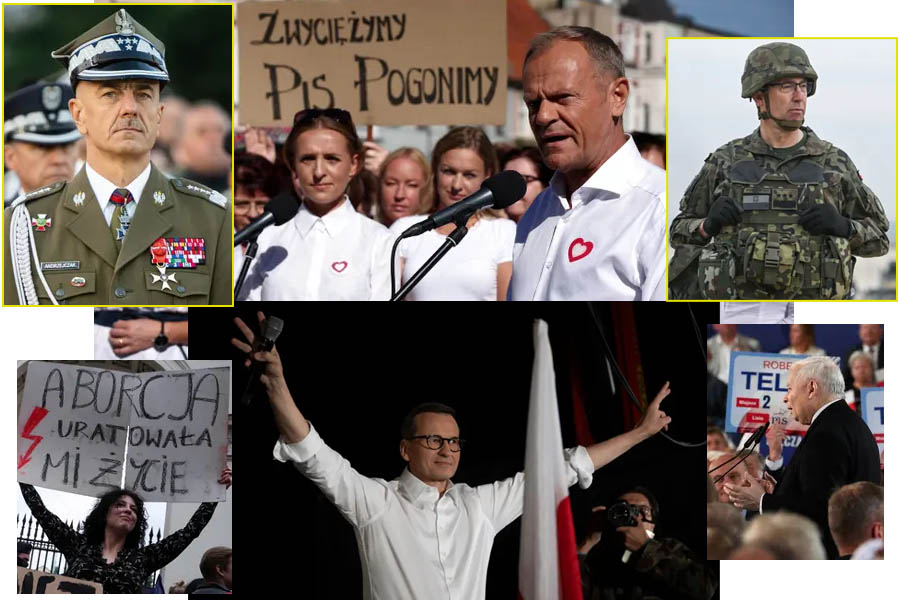
Poland's Political Landscape in Turmoil: Generals Resign Amidst Tense Election Atmosphere — Military Leadership Crisis Shakes PiS Days Before Vote
In a dramatic turn of events, Poland finds itself on the precipice of a crucial parliamentary election, marred by high-stakes political maneuvers and the sudden resignation of two of its top military leaders. General Rajmund Andrzejczak, chief of the general staff, and Lt Gen Tomasz Piotrowski, the operational commander, tendered their resignations just days before the decisive vote — sending shockwaves through the nation and dealing a significant blow to the ruling Law and Justice (PiS) party's campaign narrative of national security and military strength.
The resignations, announced late Monday evening, came without public explanation from the generals themselves. However, Polish media reports suggest long-simmering tensions between the military leadership and the defense ministry, which is controlled by PiS loyalists. The generals reportedly objected to what they saw as political interference in military appointments and the politicization of the armed forces ahead of the election.
🎖️ Political Turbulence and Military Resignations: A Blow to PiS
The abrupt resignations of these military commanders have dealt a significant blow to the ruling Law and Justice (PiS) party, which has campaigned heavily on a platform of safeguarding Poland's security, modernizing the armed forces, and serving as a reliable NATO ally on the front lines of the Russia-Ukraine war. With the resignations, PiS now faces internal discord and difficult questions about its ability to protect the nation from external threats — questions that opposition parties have seized upon.
Analysts suggest that the generals' departure serves as a symbolic act, indicating a lack of confidence in the current political leadership. The tension between the military top brass and the defense ministry had been brewing for months, reportedly over disagreements about promotions, defense procurement, and the government's use of the military for border security and public order tasks. This dramatic move underscores the deep-seated concerns within the military establishment about civilian interference — a rare public rupture in a country where the military has traditionally remained apolitical.
Opposition leader Donald Tusk, head of the Civic Coalition (KO), called the resignations "unprecedented and deeply alarming." Speaking to reporters, Tusk said: "A government that loses the trust of its top generals days before an election is a government that has failed the most basic test of leadership. Poland's security cannot be a political football."
🗳️ Election Dynamics and Opposition's Strategy: Female Voters Could Tip the Scales
As Poland braces for its upcoming elections on October 15, opposition groups — led by prominent figures like former prime minister and European Council president Donald Tusk — are seizing the opportunity to challenge the PiS party's stronghold. The televised election debate, watched by over 5 million viewers — roughly 15% of the electorate — showcased the opposition's resilience, particularly Joanna Scheuring-Wielgus, the candidate from Nowa Lewica (The Left), who deftly navigated a challenging environment and landed several blows against PiS representatives on issues of women's rights and healthcare.
One of the pivotal factors in this election is the active engagement of female voters. Sociologists indicate that the opposition's success in mobilizing undecided female voters could tip the scales. Concerns about women's rights, healthcare, and access to reproductive services — Poland already has one of Europe's most restrictive abortion laws — have become central issues, reflecting a broader societal desire for change and progress. PiS has maintained its conservative stance on social issues, while opposition parties have promised liberalization.
"Women are angry," said Dr. Agnieszka Graff, a political sociologist at the University of Warsaw. "They see what is happening in neighboring countries — Germany, the Czech Republic, even Slovakia — where reproductive rights are protected. They ask why Poland is going backward. That anger could translate into votes — and not for PiS."
📊 Tight Race and Polling Data: A Fragmented Parliament Looms
The latest surveys paint a picture of a closely fought electoral struggle, with the possibility of a fragmented parliament requiring complex coalition negotiations.
An IBRiS poll commissioned for Polsat places the Law and Justice-led coalition at 34.6%, closely followed by the Civic Platform-led coalition (KO) at 27.9%, with The Left securing 11.4%. Notably, the Third Way party is projected to miss parliamentary entry according to this poll, which would complicate opposition coalition arithmetic.
A concurrent Kantar poll conducted for TVN mirrors this intensity, with the Law and Justice-led group at 34%. However, the Civic Platform-led coalition garners 30%, The Left 10%, and Third Way 9%. Crucially, this poll suggests that these three opposition groupings — KO, The Left, and Third Way — could amass a majority of seats (approximately 231 of 460) if their support translates into votes on election day. The margin of error means the race is essentially tied.
The significance of smaller parties cannot be overstated. Their performance could be the decisive factor in shaping the political landscape of Poland. With the larger coalitions in such close competition, the alliances and decisions made by these smaller entities may sway the balance of power significantly. The Confederation party (Konfederacja), a far-right libertarian group polling around 8%, could also play a spoiler role.
🌍 Global Interest Amidst EU Tensions and Humanitarian Crisis
Against the backdrop of the ongoing conflict in Ukraine — where Poland serves as a key hub for Western military aid — and strained relations with the European Union over rule-of-law issues, Poland's elections have garnered international attention. The outcome could have far-reaching implications, potentially altering the nation's political course and influencing its position within the European community, NATO, and the broader transatlantic alliance.
PiS has been at odds with Brussels over judicial independence, media freedom, LGBTQ rights, and migration policy, leading to the freezing of billions in EU recovery funds. A change in government would likely reset Warsaw-Brussels relations, unblocking funds and restoring Poland's role as a constructive EU member. Conversely, a PiS victory (even if it requires coalition partners) could lead to continued friction with Brussels and potential Article 7 procedures.
On Ukraine, all major parties support continued aid to Kyiv, but PiS has been particularly vocal in its opposition to Ukrainian grain imports, which have hurt Polish farmers. Tusk has signaled a more conciliatory approach to both Ukraine and the EU, promising to unblock EU funds and restore judicial independence.
📅 Coalition Building: The Key to Poland's Future
Given the razor-thin margins and the possibility of a fragmented parliament, coalition building becomes paramount. The alliances forged in the aftermath of the election could determine the nation's policies, both domestically and on the international stage. Poland may witness intricate negotiations, as political leaders strategize to form stable coalitions capable of governing effectively.
If PiS wins, it would likely need to partner with Confederation — a party that is even more euroskeptic and socially conservative — a coalition that might alarm Brussels and Washington. If the opposition wins, Tusk's KO would need to form a coalition with The Left and Third Way — a potentially unwieldy alliance given their ideological differences on economic and social issues. However, all three parties have committed to restoring democratic norms and EU relations, providing a common platform.
🔮 Poland at a Crossroads
Poland stands at a crossroads, with its citizens poised to make decisions that will reverberate through the nation's future. The upcoming elections are not merely a contest of parties; they represent the aspirations and hopes of the Polish people for a different kind of governance — one that balances tradition and progress, security and change, national sovereignty and European integration.
As the nation hurtles towards a pivotal moment in its political history, the outcome of the upcoming elections remains shrouded in uncertainty. The generals' resignations may prove to be a turning point, swaying undecided voters who prioritize national security. Or the issue may fade, and the election may be decided on economic concerns, including high inflation and the cost of living.
As Poland prepares to cast its votes, the world holds its breath, anticipating the outcome that will shape Poland's destiny in the years to come. One thing is certain: regardless of who wins, Poland's political landscape will look very different after October 15.
Related Coverage: For more on Polish politics, visit Poland Election Results: Tusk's Victory and Poland's 2025 Presidential Election Preview.
Global Post Headline — independent coverage of European politics and global affairs. globalpostheadline.com | Follow updates: Europe News | Politics Section

Experience the Himalayas with expert Sherpa guides. Trekking, expeditions, and cultural tours in Nepal, Tibet & Bhutan.
Book Your Adventure →
Authentic Nepali crafts, pashmina, singing bowls — worldwide shipping.