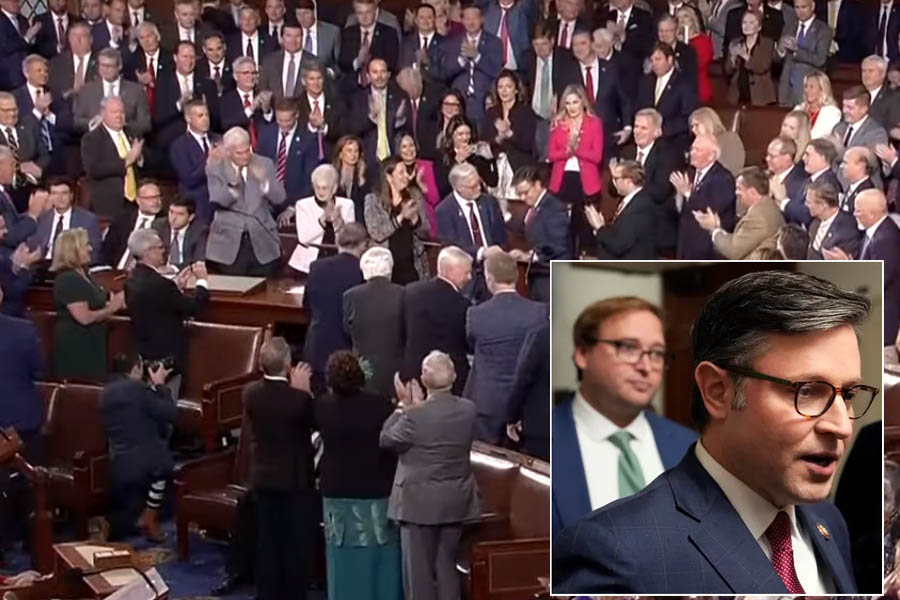
Republican Mike Johnson Elected House Speaker After Weeks of Chaos — Louisiana Congressman Becomes 56th Speaker as GOP Ends Three-Week Leadership Crisis
Washington, D.C. — October 26, 2023 — In a historic turn of events that ended one of the longest speaker vacancies in American congressional history, Republican Congressman Mike Johnson of Louisiana was elected the 56th speaker of the House on Wednesday. The vote, split sharply along party lines, saw Johnson securing the support of all 220 Republicans present, while 209 Democrats cast their votes for their leader, Hakeem Jeffries of New York. Johnson, needing 215 votes due to a few absences, emerged victorious after three weeks of paralyzing GOP infighting that followed the unprecedented ouster of former speaker Kevin McCarthy.
The election came after the Republican conference rejected three previous nominees — Steve Scalise, Jim Jordan, and Tom Emmer — each failing to secure the necessary 217 votes amid bitter divisions between the party's establishment wing and its hardline conservative faction. Johnson, a relatively low-profile congressman first elected in 2016, emerged as a consensus candidate on his fourth ballot, uniting a fractured GOP that had publicly aired its grievances and paralyzed House operations for 22 days.
"At this time of great crisis, it is our duty to work together, as previous generations of great leaders have, to face these great challenges and solve these great problems. We will rebuild the trust of the American people that has been eroded. The United States House of Representatives is back in business, and the people's House is open for the people's work."
— Speaker Mike Johnson, October 25, 2023
🏛️ The Road to the Speakership: Three Weeks of GOP Turmoil
Johnson's path to the speakership was marked by extraordinary challenges within the Republican party. The crisis began on October 3, when eight House Republicans — led by Rep. Matt Gaetz of Florida — joined all Democrats to remove Kevin McCarthy of California from the speakership, the first time in history that a speaker had been ousted by a floor vote. McCarthy's removal came just nine months after he endured 15 ballots to win the gavel in January 2023, foreshadowing the deep divisions that would plague the conference.
Following McCarthy's ouster, House Majority Leader Steve Scalise (R-LA) won the GOP nomination but withdrew after failing to secure enough votes, as hardliners refused to support him. Next, Judiciary Committee Chairman Jim Jordan (R-OH) lost three consecutive floor votes as more Republicans defected with each ballot. After Jordan's withdrawal, Majority Whip Tom Emmer (R-MN) won the nomination but dropped out within hours after former President Donald Trump publicly opposed him, revealing the former president's continued grip on the party.
Finally, on the fourth attempt, the conference turned to Johnson — a former constitutional lawyer, vice chairman of the House Republican Conference, and a relatively unknown figure nationally. His low profile, combined with his reputation as a principled conservative without high-profile enemies, allowed him to unite warring factions. All 220 Republicans present voted for him — a striking show of unity after weeks of public dysfunction.
🤝 Bipartisan Outreach: Biden Vows Cooperation, Jeffries Warns of Extremism
In the aftermath of Johnson's election, President Joe Biden extended an olive branch, vowing to cooperate with House Republicans in the interest of the American people. "Even though we have real disagreements about important issues, there should be mutual effort to find common ground wherever we can," President Biden said in a statement. "The American people expect their leaders to govern responsibly, to fund the government, to provide disaster relief, and to address the challenges at our border. I look forward to working with Speaker Johnson on these urgent priorities."
However, House Democratic Leader Hakeem Jeffries struck a more cautionary tone. While congratulating Johnson, Jeffries emphasized the importance of protecting the democratic process and warned about Johnson's past actions — particularly his role in supporting efforts to overturn the 2020 presidential election results. Johnson had crafted a legal brief supporting a Texas lawsuit that sought to invalidate electoral votes from key battleground states won by Biden, a case the Supreme Court ultimately dismissed.
"We will work across the aisle where we can, but we will not compromise on our core democratic values," Jeffries said. "The American people deserve a House that functions, but also one that rejects extremism and respects the will of the voters."
📜 Johnson's Record: From Election Challenges to Conservative Advocacy
Johnson's elevation to the speakership has brought renewed scrutiny to his legislative record and past statements. A graduate of Louisiana State University's Paul M. Hebert Law Center, Johnson served as a constitutional lawyer and senior legal counsel for the Alliance Defending Freedom before entering politics. He was first elected to Congress in 2016, representing Louisiana's 4th congressional district, which includes Shreveport and surrounding rural areas.
As a lawmaker, Johnson has been a consistent conservative voice, voting against certification of the 2020 election results, opposing the Respect for Marriage Act (which codified same-sex marriage protections), and supporting strict abortion restrictions. He has served on the House Judiciary Committee and the Armed Services Committee, building relationships across the Republican conference without accumulating high-profile enemies.
His role in the 2020 election challenge has drawn particular criticism from Democrats. Johnson was one of more than 100 House Republicans who signed an amicus brief supporting Texas's lawsuit seeking to overturn Biden's victories in Georgia, Michigan, Pennsylvania, and Wisconsin. The Supreme Court rejected the case on standing grounds. When asked about his position in a recent interview, Johnson said he was "fulfilling his constitutional duty" to ensure election integrity — a stance that resonates with Trump-aligned Republicans but alarms Democrats and independent observers.
⚠️ Looming Challenges: Government Shutdown Deadline and 2024 Elections
Speaker Johnson faces immediate and daunting challenges. The most pressing is the government funding deadline: current funding expires in less than one month (November 17, 2023). Johnson must navigate the same treacherous waters that contributed to McCarthy's downfall — hardline Republicans demanding deep spending cuts and policy riders, while Democrats and the White House insist on clean funding bills. A shutdown, if it occurs, would be the fourth in a decade and would further erode public confidence in Congress.
Johnson has indicated he will pursue a "two-step" continuing resolution that would fund parts of the government until January and others until February, a strategy designed to pressure the Senate and White House while giving hardliners a sense of progress. But whether he can hold the 218 votes needed to pass such a measure remains uncertain.
Beyond the funding fight, Johnson must also address: the $100 billion supplemental request for Ukraine, Israel, and border security; reauthorization of the Federal Aviation Administration; and the 2024 appropriations process. And all of it unfolds against the backdrop of the 2024 presidential election, where control of the House will be fiercely contested.
"Mike Johnson inherits the most difficult speakership in modern history," said Norman Ornstein, a congressional scholar at the American Enterprise Institute. "He has the smallest majority in nearly a century, a conference divided between pragmatists and hardliners, and a former president who demands fealty. He'll need Herculean political skills just to keep the government open — let alone pass a legislative agenda."
"We extend a hand of partnership where possible, but we will draw a line where necessary. Extremism has no place in the people's House." — Hakeem Jeffries
"We have differences, but I believe we can find common ground. The American people sent us here to solve problems, not to posture." — Mike Johnson
📊 Historical Context: The Longest Speaker Vacancies
The 22-day vacancy between McCarthy's removal and Johnson's election ranks among the longest speaker vacancies in U.S. history. The longest was in 1856, when the House took 133 ballots over two months to elect a speaker amid intense sectional divisions over slavery. More recently, in 1923, the House took nine ballots over four days. The 2023 crisis was notable for its duration and its cause — the first-ever successful motion to vacate the speakership.
The paralysis meant that the House could not consider any legislation for three weeks, including emergency funding for Israel and Ukraine, disaster relief, and routine appropriations. The shutdown of legislative business underscored the fragility of the GOP majority and raised questions about the viability of the modern speakership.
As Johnson takes the helm, the eyes of the nation remain fixed on Capitol Hill. The success of his speakership will depend not only on his ability to unite the deeply divided Republican conference but also on his capacity to navigate the complex political landscape in the months to come — including potential challenges to his leadership from the same hardline faction that toppled McCarthy.
Original Reporting: This analysis was first published on 26 October 2023. Continuous coverage at Global Post Headline US Desk.
Global Post Headline — independent coverage of US politics. globalpostheadline.com | Follow: US Desk | Politics Section


Authentic Nepali handicrafts, pashmina, singing bowls.