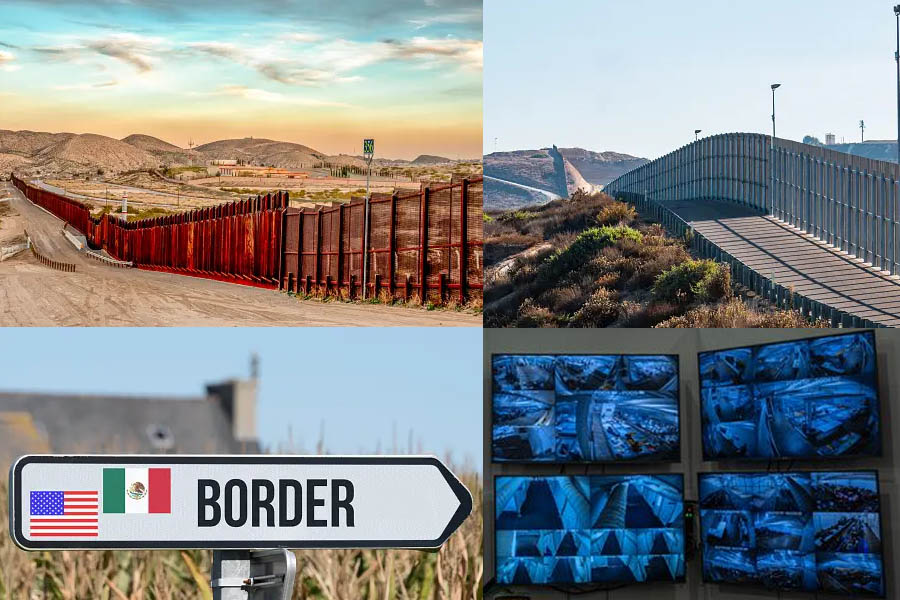
Texas SB4 Immigration Law Sparks Federal-State Showdown: Governor Abbott's Border Enforcement Gamble Challenges Biden Administration
Austin, Texas — December 19, 2023 — In a dramatic escalation of the ongoing border security battle, Texas Governor Greg Abbott signed Senate Bill 4 (SB4) into law, a controversial measure that grants Texas law enforcement officers sweeping new powers to arrest migrants suspected of entering the United States illegally. The law, set to take effect in March 2024, directly challenges nearly 150 years of federal supremacy over immigration enforcement and sets the stage for a historic constitutional showdown between the Lone Star State and the Biden administration.
SB4 allows any Texas law enforcement officer — from state troopers to local police — to arrest individuals suspected of unlawful entry from Mexico. Those arrested face misdemeanor charges for first-time offenses (up to six months in jail) and felony charges for subsequent entries (up to 20 years). The law also empowers state judges to order deportations, a function traditionally reserved exclusively for federal immigration courts.
- 📜 Creates new state crime of "illegal entry from a foreign nation"
- 👮 Authorizes all Texas law enforcement to arrest without federal consultation
- ⚖️ Allows state judges to order removal to Mexico (not necessarily country of origin)
- 🚫 Penalties: Misdemeanor (up to 6 months) → Felony (2-20 years) for repeat offenses
- ⏰ Effective: March 2024 (currently blocked by litigation)
⚖️ Constitutional Clash: Federal Supremacy vs. State Authority
The legal foundation of SB4 rests on a contested interpretation of the U.S. Constitution's Supremacy Clause and the federal government's "plenary power" over immigration — a doctrine affirmed by the Supreme Court as early as 1875. Under current law, immigration enforcement is an exclusively federal domain, with ICE and CBP holding sole authority over arrests, detention, and deportation. States may "cooperate" with federal authorities but cannot create parallel enforcement systems.
Governor Abbott and SB4's sponsors argue that the Biden administration's "open border policies" have created an emergency that justifies state intervention. "Texas has the sovereign right to defend itself against an invasion," Abbott declared at the bill-signing ceremony. "The federal government has abdicated its duty, and we will step in to protect our citizens."
Legal experts, however, are deeply skeptical. Thirty former U.S. immigration judges — appointed by both Republican and Democratic presidents — have condemned the measure as "flagrantly unconstitutional." In a joint statement, they warned that SB4 "usurps federal authority, invites racial profiling, guarantees wrongful arrests of U.S. citizens and legal residents, and would cause irreparable family separations."
The Biden administration has already signaled its intent to sue. Attorney General Merrick Garland stated that the Justice Department "will not hesitate to challenge state laws that interfere with federal immigration enforcement." The ACLU and the Texas Civil Rights Project have filed separate lawsuits, arguing that SB4 violates the Constitution and would lead to "chaos at the border."
🚨 Border Crisis Escalates: Smugglers Shift Tactics, Overwhelm Resources
SB4 was signed against the backdrop of record-breaking migrant crossings. In December 2023, U.S. Customs and Border Protection was averaging over 7,000 apprehensions daily — a number that has overwhelmed holding facilities and processing centers across the Southwest. Smugglers have adapted to increased enforcement at traditional crossings like El Paso and Eagle Pass by shifting operations to more remote areas, particularly in Arizona and California.
The Lukeville, Arizona border crossing — a remote port of entry — has become a new epicenter, with thousands of migrants crossing daily through the Sonoran Desert. The surge forced U.S. Customs to close the legal crossing entirely, redirecting all available personnel to processing. The closure has devastated local communities that depend on cross-border trade and tourism. Arizona Governor Katie Hobbs has deployed state National Guard troops to assist federal authorities, echoing Texas's complaints about insufficient federal resources.
"We are seeing a fundamental shift in smuggling patterns," said Brandon Judd, president of the National Border Patrol Council. "Cartels are exploiting every weakness in our system. They send large groups to remote areas knowing that we don't have the manpower to process them all. The result is that people who have legitimate reasons to cross are stuck in hours-long lines, while those crossing illegally are released into the interior."
🏛️ Political Fallout: The 2024 Election Shadow
The Texas-federal clash cannot be separated from the 2024 presidential election. Governor Abbott, a Republican, has made border security the centerpiece of his political identity — and by signing SB4, he has positioned himself as a national conservative leader willing to confront the Biden administration directly. Polls show that immigration is the top issue for Republican primary voters, and Abbott's aggressive posture has won praise from figures like Donald Trump and Florida Governor Ron DeSantis.
President Biden, facing low approval ratings on border management, has struggled to craft a response that satisfies both progressives (who decry any enforcement as cruel) and moderates (who demand order). The administration has proposed supplemental funding for additional border agents and asylum officers, but Republican-controlled House has tied any funding to passage of restrictive asylum measures identical to Trump-era policies — a non-starter for Senate Democrats.
The Supreme Court, with its 6-3 conservative majority, will ultimately decide SB4's fate. Legal observers note that the Court has upheld state cooperation with federal enforcement (as in Arizona v. United States, 2012) but has never allowed a state to create its own deportation system. How the justices rule could fundamentally reshape American federalism and immigration enforcement for generations.
- ⚡ "SB4 is dead on arrival in federal court." — Ilya Somin, George Mason University
- ⚡ "Texas is inviting a constitutional crisis." — David Leopold, former AILA president
- ⚡ "The Supreme Court has never permitted this. They won't start now." — Steve Vladeck, UT Austin
- ⚡ "Abbott knows the law will be blocked — this is political theater." — Elora Mukherjee, Columbia Law
👥 Community Impact: Fear and Uncertainty
Even before SB4 takes effect, immigrant communities across Texas are reporting increased fear and hesitancy to interact with law enforcement — including reporting crimes or serving as witnesses. Civil rights organizations have launched hotlines and "know your rights" campaigns, advising immigrants to carry identification at all times and to refuse to answer questions about their immigration status without an attorney present.
"This law is designed to terrorize immigrant families," said Jackie Varas, policy director at the Texas Immigration Law Council. "It's not about border security — it's about making life so unbearable for undocumented immigrants that they flee, regardless of whether they've lived here for 20 years, have citizen children, and contribute to our economy."
Abbott's office rejects these characterizations, insisting that SB4 includes protections for crime victims and witnesses and that officers will receive training to avoid racial profiling. Critics remain unconvinced, pointing to Texas's history of controversial immigration enforcement, including "show me your papers" provisions in previous laws that were struck down by federal courts.
🔮 The Road Ahead: Litigation, Politics, and the Future of Immigration Enforcement
As legal challenges wind through the courts — likely reaching the Supreme Court by late 2025 or early 2026 — the political debate over immigration will only intensify. If SB4 is upheld, other Republican-led states (Florida, Arizona, Iowa, Missouri) have already signaled they will pass similar laws, creating a patchwork of state immigration enforcement that would fundamentally alter the relationship between states and the federal government.
If SB4 is struck down, Abbott and his allies will use the defeat to rally conservative voters, arguing that the courts are protecting federal "open borders" policies. Either outcome, legal scholars note, will produce winners and losers — but the underlying crisis at the border, driven by economic desperation, climate change, and political instability in sending countries, will remain unresolved.
"Lawsuits and legislation can't deport poverty or climate change," said Dr. Cecilia Menjívar, a UCLA sociologist specializing in migration. "Until the U.S. addresses the root causes of migration — and works with regional partners to create legal pathways — we will continue to see this cycle of crisis and political theater."
For now, all eyes are on the federal district court in Austin, where the first hearing on SB4 is scheduled for early 2024. The ruling — and the inevitable appeals — will shape not just Texas's future, but the constitutional balance of power in the United States.
Original Reporting: This analysis was first published on 19 December 2023. Continuous coverage at Global Post Headline US Desk.
Global Post Headline — independent coverage of US immigration policy and constitutional law. globalpostheadline.com | Follow: US Desk | Politics Section


Authentic Nepali handicrafts, pashmina, singing bowls.