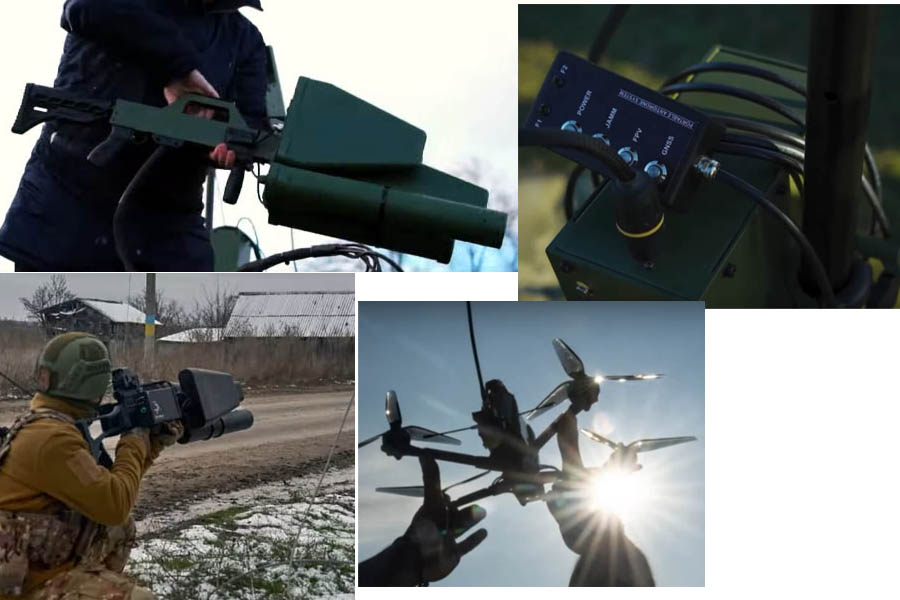
Ukraine's Signal-Jamming Guns: A Game-Changer in Countering Russian Kamikaze Drones — Portable Electronic Warfare Reshapes Battlefield Dynamics
As the conflict between Ukraine and Russia continues to evolve, so do the tactics and technologies employed on the battlefield. One striking development in this ongoing war is the rise of kamikaze drones — unmanned aerial vehicles designed to carry explosive payloads and conduct precision strikes — and the corresponding race to develop effective countermeasures. In response to this emerging threat, Ukraine has embraced a technological solution that has proven to be remarkably effective in countering these drones: signal-jamming guns. This article explores the features, pricing, and future importance of Ukraine's signal-jamming guns in the context of modern electronic warfare.
Nearly two years into the conflict, kamikaze drones — also known as loitering munitions — have become a common and deadly tool for both Ukrainian and Russian forces. Russia has deployed thousands of Iranian-made Shahed drones, while Ukraine has used domestically-produced drones and Western-supplied systems. These drones are designed to fly over the battlefield, identify targets, and ultimately crash into them, detonating their payloads upon impact. Their ability to evade traditional air defense systems — they are small, slow, and fly at low altitudes — has presented a significant challenge for military forces on both sides.
🚁 The Rise of Kamikaze Drones: A New Era of Warfare
The Ukraine-Russia war has been a testing ground for drone warfare on an unprecedented scale. Both sides have deployed tens of thousands of drones, ranging from small commercial quadcopters to purpose-built military loitering munitions. Russian forces have relied heavily on Iranian-designed Shahed-131 and Shahed-136 drones, which are essentially low-cost cruise missiles. Ukraine has deployed Turkish-made Bayraktar TB2 drones, as well as domestically-produced attack drones and FPV (first-person view) racing drones converted into munitions.
The proliferation of drones has fundamentally changed the nature of the battlefield. Drones can loiter for hours, identify targets of opportunity, and strike with precision — all while the operator remains safely out of range. Traditional air defense systems, designed to intercept larger aircraft and missiles, are often ineffective against small, slow-moving drones. The cost disparity is also staggering: a Shahed drone costs approximately $20,000-50,000, while a surface-to-air missile costs $500,000 or more. Using expensive missiles to down cheap drones is economically unsustainable — a challenge that has driven the search for more cost-effective countermeasures.
🔫 The Role of Signal-Jamming Guns: Electronic Warfare on the Frontline
In the face of the growing threat posed by kamikaze drones, Ukraine has turned to signal-jamming guns as a key element of its defense strategy. These devices — often referred to as "drone jammers" or "electronic warfare (EW) rifles" — are designed to disrupt the communication link between a drone and its operator, effectively rendering the drone unable to carry out its intended mission. By jamming the GPS and radio frequency signals that drones rely on, Ukrainian forces gain a tactical advantage in neutralizing this airborne threat without resorting to conventional means.
When a drone loses contact with its operator, most are programmed to either return to their launch point or hover in place. In either case, the immediate threat is neutralized. Some jammers are powerful enough to force the drone to land immediately, allowing troops to capture it for intelligence purposes. The effectiveness of these devices has been demonstrated repeatedly on the battlefield, with Ukrainian soldiers using them to down Russian drones ranging from small reconnaissance quadcopters to larger Shahed attack drones.
⚙️ Features of Signal-Jamming Guns: Technology Behind the Innovation
Signal-jamming guns come with a range of features that make them effective in countering drone threats. These devices utilize electronic countermeasure techniques to interfere with the drone's communication signals, disrupting its control link and rendering it inert. Most jammers operate across multiple frequency bands — typically 2.4 GHz and 5.8 GHz, which are used by consumer and military drones alike — and also jam GPS signals (L1 and L2 bands).
Portable and lightweight — typically weighing between 2 and 5 kilograms (4-11 pounds) — these "guns" are designed for ease of use on the battlefield. Shaped like a rifle, they are aimed at the target drone and activated with a trigger. The effective range varies by model, from 500 meters to over 2 kilometers. Some advanced models include directional antennas that focus the jamming signal, increasing range and reducing interference with friendly electronics.
Ukrainian forces have been seen using a variety of jammers, including domestically-produced models as well as Western-supplied systems. The Australian-made DroneGun Tactical, for example, has been widely photographed in Ukrainian hands. Ukrainian engineers have also improvised, mounting jamming equipment on vehicles and even adapting commercial off-the-shelf components for military use — a testament to the rapid innovation driven by wartime necessity.
💰 Price Considerations: Cost-Effective Defense
The cost-effectiveness of signal-jamming guns adds to their appeal as a viable solution for countering kamikaze drones. While traditional air defense systems can be expensive to acquire and maintain — a single Patriot missile costs approximately $4 million — signal-jamming guns offer a far more economical option. A portable drone jammer typically costs between $1,000 and $5,000, depending on power output and features. The relatively lower cost of these devices allows for broader deployment, enhancing the overall defensive capabilities of Ukrainian forces without straining their resources.
The economic calculus is clear: downing a $20,000 drone with a $1,000 jammer is a winning trade. When compared to the cost of the damage a drone can inflict — destroying a $5 million howitzer or a $100 million air defense radar — the savings are even more dramatic. This cost-effectiveness has driven a global surge in demand for counter-drone technology, with militaries and civilian security forces alike seeking affordable solutions to the drone threat.
Ukraine has also benefited from international donations of counter-drone equipment. The United States, United Kingdom, and other allies have supplied jammers as part of military aid packages. Additionally, crowdfunding campaigns by Ukrainian NGOs have raised millions to purchase commercial jammers for front-line units, demonstrating grassroots support for electronic warfare capabilities.
🔮 Future Importance: The Evolution of Electronic Warfare
As the conflict in Ukraine serves as a testing ground for emerging technologies, the importance of signal-jamming guns is likely to grow. The ongoing evolution of drone capabilities — including autonomous operation, artificial intelligence targeting, and swarm tactics — and the adaptation of countermeasures underscore the dynamic nature of modern warfare. Signal-jamming technology is expected to continue advancing, becoming an integral part of military strategies not only in Ukraine but also globally.
However, the electronic warfare race is a constant back-and-forth. As jammers become more sophisticated, drone manufacturers develop frequency-hopping, spread-spectrum, and encrypted communication links that are harder to jam. Russia has already modified some of its drones to be resistant to existing jammers, using fiber-optic cables for command guidance or pre-programmed GPS coordinates for autonomous flight. In response, Ukraine is developing artificial intelligence-powered jammers that can adapt to new frequencies in real-time.
The future battlefield will likely see the integration of multiple counter-drone layers: electronic warfare (jamming), kinetic interceptors (small missiles or net-firing drones), directed energy weapons (lasers and microwaves), and artificial intelligence-powered detection systems. Ukraine's experience is already shaping military thinking around the world. The U.S. Department of Defense has increased funding for counter-drone systems, and NATO is developing new doctrines for electronic warfare based on lessons learned from Ukraine.
The Ukraine-Russia conflict has also demonstrated the importance of electronic warfare at all levels of warfare — from strategic jamming of satellite communications to tactical jamming of individual drones. The country that masters the electromagnetic spectrum, it is becoming clear, will have a decisive advantage on the battlefield. Ukraine's adoption of signal-jamming guns represents a significant step forward in countering the threat posed by kamikaze drones. As the conflict continues, the effectiveness, affordability, and portability of these devices make them a crucial component of Ukraine's defense strategy.
The success of signal-jamming guns in disrupting drone operations highlights the importance of staying ahead in the technological arms race that defines modern warfare. In the skies above Ukraine, a silent battle is being waged — one not of bullets and bombs, but of radio frequencies and electronic signals. And in that battle, the jammer has proven to be a surprisingly effective weapon.
Related Coverage: For more on military technology and the Ukraine war, visit Russia-Ukraine War Hub and Technology Section.
Global Post Headline — independent coverage of military technology and the Russia-Ukraine war. globalpostheadline.com | Follow updates: War News | Tech

Experience the Himalayas with expert Sherpa guides. Trekking, expeditions, and cultural tours in Nepal, Tibet & Bhutan.
Plan Your Nepal Trip →
Authentic Nepali crafts, pashmina, singing bowls — worldwide shipping.