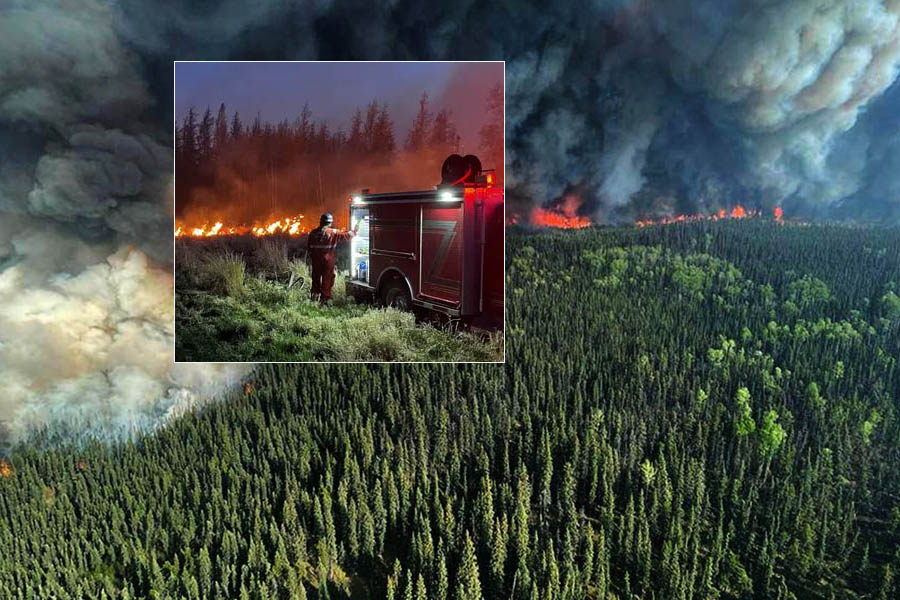
Canada Battling Widespread Forest Fires with International Support as Smoke Reaches Europe — Worst Wildfire Season on Record
Ottawa — June 29, 2023 — Canada is confronting its most devastating wildfire season in recorded history, with fires that ignited in late April across British Columbia and Alberta now spreading to Eastern provinces, displacing tens of thousands, disrupting oil and gas production, and generating smoke plumes that have traversed the Atlantic Ocean to reach the United Kingdom. The unprecedented crisis has triggered the largest international firefighting mobilization in Canadian history, with over eight countries sending personnel and equipment to assist overstretched Canadian crews.
The scale of the disaster is staggering. According to the Canadian Interagency Forest Fire Center (CIFFC), there are currently 427 active wildfires burning across the country, of which 232 are categorized as "out of control" — meaning they are not responding to suppression efforts and are expected to continue spreading. British Columbia reports 81 active fires (28 out of control), Alberta faces 72 active wildfires, and Quebec and Ontario have seen unprecedented fire activity in regions that rarely experience such intense blazes.
- 🔥 Quebec: Over 100 active fires — state of emergency declared in multiple regions
- 🔥 British Columbia: 81 active fires, 28 out of control — evacuations in Interior and Peace regions
- 🔥 Alberta: 72 active wildfires — oil and gas operations suspended, production cuts
- 🔥 Ontario: 50+ fires — smoke blankets Toronto, Ottawa, and surrounding areas
- 🔥 Nova Scotia: Historic fires near Halifax — largest evacuation in province's history
🌍 Smoke Crosses the Atlantic: UK Records Canadian Wildfire Haze
In a dramatic illustration of the fires' intensity, smoke from Canadian wildfires has now reached the United Kingdom, according to the UK Met Office. The smoke, which previously enveloped New York City in a toxic orange haze earlier in June, has been carried across the Atlantic by the jet stream — powerful high-altitude winds that have transported particulate matter over 3,000 miles. The Met Office confirmed that the smoke was visible in satellite imagery and had caused "milky skies" and vivid sunsets across parts of England and Scotland.
The transatlantic smoke journey follows weeks of deteriorating air quality across North America. In early June, New York City recorded its worst air pollution levels in decades, with the Air Quality Index (AQI) exceeding 400 — classified as "hazardous" — as smoke from Quebec fires blanketed the Northeast. Major League Baseball games were postponed, Broadway shows were canceled, and millions were advised to stay indoors. Washington D.C., Philadelphia, and Boston also experienced dangerous air quality levels.
"This is a clear signal of how interconnected our atmosphere is," said Dr. Michael Fromm, an atmospheric scientist at the Naval Research Laboratory. "What happens in remote Canadian forests doesn't stay in Canada. The smoke affects air quality across continents and contributes to global climate feedback loops."
🌎 International Response: Allies Rally to Support Canada
Facing a crisis beyond national capacity, Canada has received unprecedented international assistance. United States President Joe Biden pledged American support, deploying over 600 U.S. firefighters and specialized equipment, including air tankers and incident management teams. The U.S. also shared real-time satellite data and weather forecasting to aid firefighting efforts.
Other allies have also committed resources:
- South Africa — Deployed 200 specialized firefighters with experience in extreme terrain
- Australia & New Zealand — Sent 150 firefighting personnel, including incident command specialists
- France, Portugal & Spain — Dispatched over 280 firefighters, including aerial firefighting experts
- Mexico & Costa Rica — Provided logistical support and equipment
"This is what global solidarity looks like," said Canadian Prime Minister Justin Trudeau during a press conference. "We are grateful for the swift response from our allies. These fires are a reminder that climate change knows no borders — and neither should our response."
🔥 Provincial Breakdown: From Coast to Coast
The fires have impacted nearly every province, with varying degrees of severity:
Quebec: The province has been hit hardest in recent weeks, with over 100 active fires, many sparked by lightning strikes during dry thunderstorms. The city of Sept-Îles and the Côte-Nord region have seen mass evacuations. Hydro-Quebec was forced to reduce power transmission as smoke damaged equipment. Premier François Legault described the situation as "unprecedented in modern Quebec history."
Nova Scotia: In late May, historic fires near Halifax forced the evacuation of over 16,000 residents — the largest evacuation in the province's history. More than 200 homes and structures were destroyed. While rain helped contain those fires, the province remains under heightened alert.
Alberta: The fires that began in late April forced over 30,000 evacuations in May, including the entire town of Edson. Energy companies suspended production at oil sands sites and natural gas facilities, reducing national output by an estimated 300,000 barrels per day at the peak.
British Columbia: Despite being early in the fire season, BC has already seen aggressive blazes in the Cariboo, Bulkley-Nechako, and Peace River regions. The province has enacted a state of emergency and campfire bans across most regions.
🌡️ Climate Connection: Trudeau Points to Climate Change
Prime Minister Trudeau has explicitly linked the severity of the fires to climate change, stating that Canada is experiencing "the effects of a warming planet in real time." Officials note that the 2023 fire season has broken multiple records: the total area burned by late June exceeded 8 million hectares — surpassing any full year on record (the previous record was 7.6 million hectares in 1989).
Climate scientists point to several factors: extreme heat events (some regions saw temperatures 10-15°C above average), prolonged drought conditions across Western Canada, earlier spring snowmelt, and an increase in lightning strikes (which cause over 50% of fires in Canada).
"We are in uncharted territory," said Dr. Mike Flannigan, a wildfire researcher at Thompson Rivers University. "The fire season is starting earlier, ending later, and burning with an intensity we've never seen. Canada is warming at twice the global average rate — the Arctic is warming even faster. This is the new normal, and it will get worse before it gets better."
🍁 Ontario's Controversy: Premier Ford Resists Campfire Ban
While regions like Quebec and Nova Scotia have enacted strict fire bans, Ontario Premier Doug Ford has faced criticism for refusing to implement a province-wide campfire ban, despite more than 50 active fires in the province and smoke blanketing Toronto and Ottawa. Ford has attributed the fires to "lightning strikes and unattended campfires," but environmental groups and opposition leaders have urged him to acknowledge the role of human-caused climate change.
"You cannot fight climate change by pretending it doesn't exist," said Mike Schreiner, leader of the Ontario Green Party. "Weeks of smoke, record heat, and dozens of fires — this is not normal. The Premier needs to show leadership, not deflection."
Ford eventually enacted a partial fire ban for Northern Ontario but allowed campfires to continue in many regions, drawing criticism from firefighters who warn that even small sparks can ignite catastrophic blazes given current conditions.
📈 Economic and Environmental Toll
The economic impact of the fires is already measured in billions of dollars. Energy production — a cornerstone of the Canadian economy — has been disrupted, with oil sands operators reducing output and natural gas producers shutting in wells. Forestry operations have been halted across millions of hectares. Tourism has suffered as popular destinations like Banff, Jasper, and the Cabot Trail remain under smoke advisories.
Environmentally, the fires have released an estimated 600 million metric tons of carbon dioxide — equivalent to nearly one year's worth of Canada's total emissions. This carbon release creates a dangerous feedback loop: fires release carbon, which accelerates warming, which creates conditions more favorable to fires.
As Canada grapples with extreme heat, prolonged droughts, and unprecedented challenges, officials are increasingly discussing the need for proactive measures to address the growing wildfire risk — including more investment in firefighting capacity, prescribed burns, and community resilience planning. But as the 2023 season demonstrates, even the best preparations may be insufficient in the face of climate-amplified fire behavior.
Original Reporting: This crisis update was first published on 29 June 2023. Continuous coverage at Global Post Headline US-Canada Desk.
Global Post Headline — independent coverage of natural disasters and climate emergencies. globalpostheadline.com | Follow: US-Canada Desk | Climate Section


Authentic Nepali handicrafts, pashmina, singing bowls.