When AI Becomes the Browser: How Machines Are Rebuilding the Internet
For more than thirty years, the internet has been shaped around human habits. We search, click, scroll, compare, and decide. But a quiet transformation is underway. The next version of the web is no longer being designed primarily for humans—it is being rebuilt for machines that can think, decide, and act on our behalf.
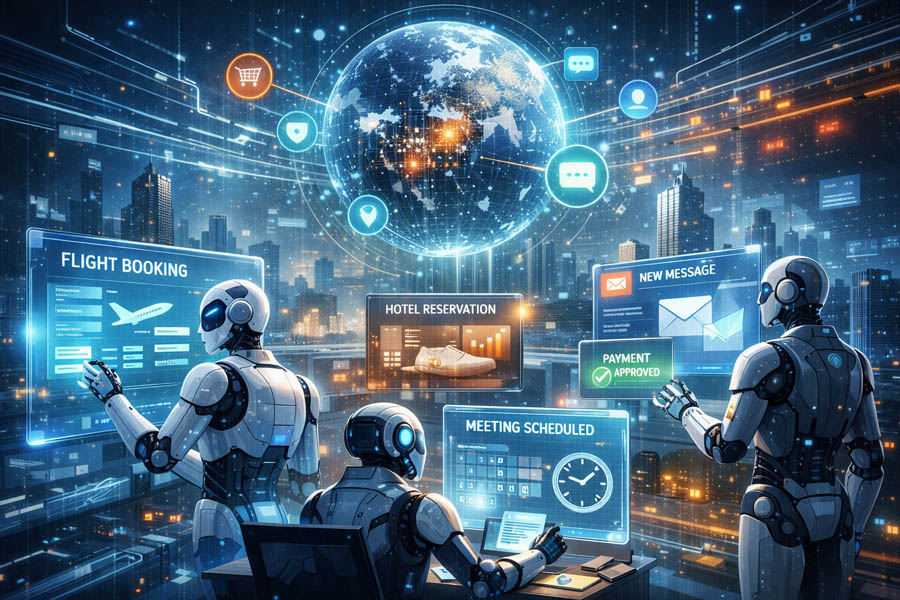
In this new era, artificial intelligence will browse websites, shop online, book services, manage emails, and complete digital chores in the background. Humans will focus on intent and outcomes, while AI handles execution. This paradigm shift is called the "Agentic Web" —and it's arriving faster than most realize.
What is the Agentic Web?
The Agentic Web refers to an internet ecosystem where AI agents act autonomously on behalf of users—browsing, comparing, negotiating, and completing transactions without constant human oversight. Unlike today's web, which requires manual navigation, the agentic web is designed for machine-to-machine interaction.
A Future Imagined Long Ago
As early as 1999, Sir Tim Berners-Lee, the creator of the World Wide Web, envisioned a smarter internet. He imagined "intelligent agents" that could read information, interpret meaning, and take action without constant human guidance. It was a vision ahead of its time—limited by the computational constraints of the era.
Although the web has expanded dramatically since then—through social media, mobile apps, and cloud platforms—the experience has remained largely manual. Humans still do the heavy lifting: navigating interfaces, filling out forms, and stitching together information from multiple sites.
Tim Berners-Lee envisions "intelligent agents" for the web
Rise of APIs and cloud computing sets foundation
LLMs like ChatGPT demonstrate reasoning capabilities
Agentic web protocols emerge - The machine-driven internet
Why Artificial Intelligence Changes the Rules
The rise of artificial intelligence, particularly large language models (LLMs), is finally making that early vision achievable. Tools like ChatGPT can already summarize reports, answer complex questions, and reason across vast amounts of information. But until recently, these systems could only explain what to do—they could not actually do it.
That is changing with the emergence of AI agents: systems that combine language understanding with tools, permissions, and memory, allowing them to take real actions online. These agents represent a fundamental shift from information retrieval to autonomous execution.
From Searching to Delegating
The shift became visible around 2022, when many users began asking chatbots questions instead of typing keywords into search engines. These early "answer engines" are only the beginning. The next evolution—action engines—will not just answer questions but complete tasks.
Real-World Example: Delegated Trip Planning
Imagine planning a vacation from London to New York. Instead of visiting multiple websites, you tell an AI agent your preferences: travel dates, budget, and comfort level. The agent delegates to specialized sub-agents—one checks flights, another searches hotels, a third looks for rentals. These agents communicate directly with airlines, hotels, and rental services, compare options, and present you with the best itinerary. Once approved, the agent completes all bookings automatically.
According to technology leaders, agents capable of handling complex, multi-step tasks are approaching quickly. But for them to scale, the web itself must evolve.
The API Barrier
Websites communicate through application programming interfaces, or APIs. These define what a service can do—book appointments, process payments, issue refunds. The problem is that APIs were built for human developers, not for AI systems that reason in natural language. Each API has its own structure and documentation style, making it difficult for agents to operate independently.
Teaching the Web to Talk to AI
To solve this, AI researchers are developing standardized protocols that let agents discover what online systems can do and take action without custom integrations. Instead of studying technical documentation, an AI agent can simply ask a service what actions it supports—booking flights, canceling subscriptions, or issuing refunds—and then perform those actions directly on the user's behalf.
Agents Working Together
This level of automation requires agents to communicate, negotiate, and coordinate with one another. New protocols are emerging that allow agents to advertise their capabilities and divide work efficiently. Major technology companies are racing to define these standards, knowing that the dominant framework will shape how the next generation of the web operates.
A New Digital Power Struggle
As agents take center stage, a new platform battle is forming—similar to the browser wars of the 1990s. Browsers themselves are being reimagined as intelligent assistants rather than collections of tabs and links. Agent-powered platforms can already track flights, fetch documents, manage emails, and complete purchases without users switching between multiple applications.
Advertising in an Agent-Driven World
Today's internet economy depends on capturing human attention. In an agent-driven web, marketers may need to appeal to algorithms instead of eyeballs. Travel platforms, for example, will compete to be selected by AI agents based on price, reliability, and alignment with a user's past preferences.
Risks and Safeguards
Autonomous agents also introduce risks. They can misunderstand instructions, make errors, or be manipulated through hidden commands embedded in web content. To reduce harm, developers are introducing safeguards such as limited permissions, trusted-service lists, and human approval for sensitive actions.
Safety Measures Being Developed
• Limited permission scopes for agents
• Trusted-service whitelists
• Human approval for financial transactions
• Audit trails for all agent actions
• Rate limiting to prevent abuse
From Pull to Push: The Proactive Internet
Developers increasingly envision a shift from a "pull" internet—where users initiate every action—to a "push" model, where agents act proactively. In this future, AI schedules meetings, flags important research, and handles routine tasks automatically. It is a quieter, faster, and more automated internet—one that fulfills a vision imagined decades ago.
The web will still serve humans, but it will increasingly be navigated, negotiated, and operated by machines. That transformation may redefine how we live and work online.
What This Means for You
As an individual, the agentic web means less time spent on routine digital tasks. As a business owner, it means optimizing your online presence for machine consumption. As a developer, it means learning new protocols for agent interaction. The shift is inevitable—and those who prepare early will thrive.