AI Is Not Killing Jobs — It's Creating New Careers for Humans
Every new technology comes with panic. When machines arrived, people feared farmers would vanish. When computers entered offices, clerks worried they were finished. Now it's artificial intelligence—and once again, the fear is loud: "AI will take all jobs."
But history tells us something important: technology doesn't just destroy work—it reshapes it. AI is already creating jobs that didn't exist a few years ago. Surprisingly, many of these roles don't reward people for being more robotic—but for being more human.
The Big Picture
According to the World Economic Forum, AI will displace 85 million jobs by 2025—but create 97 million new ones. The net gain is positive, but the skills required are changing dramatically.
A humorous mock job ad once circulated online asking for a "killswitch engineer" at OpenAI—someone whose job would be to unplug the servers if AI ever went wild. It's a joke, yes. But it highlights a serious reality: humans are still firmly in control.
Why AI Still Needs People
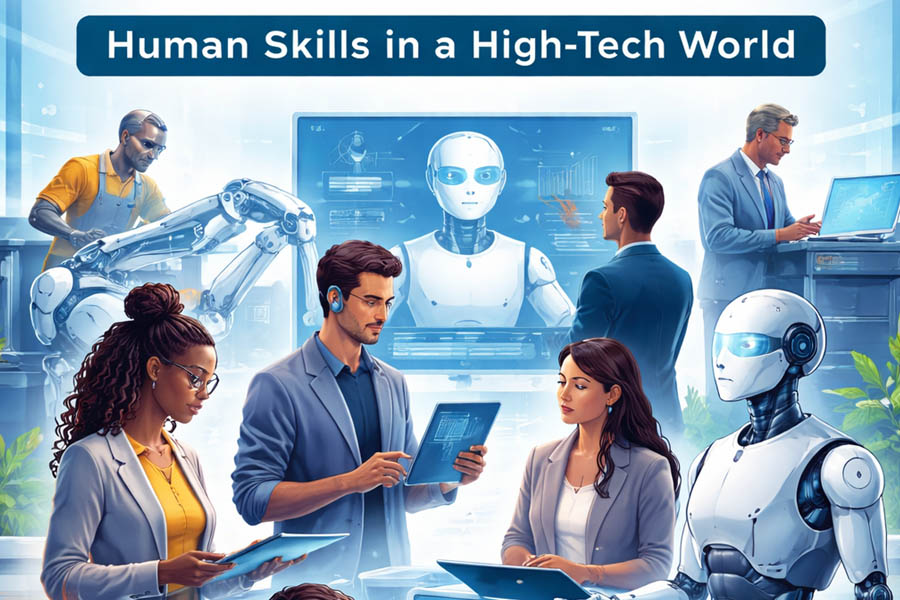
AI is fast, tireless, and great with patterns. But it struggles with emotions, ethics, real-world chaos, and human behavior. That's why the future of work isn't about humans versus machines—it's about humans working with machines.
The most valuable jobs emerging today combine:
- Human judgment
- Communication skills
- Domain expertise
- Ethical responsibility
New AI Jobs Explained in Simple Language
1. Data Annotators (Now Highly Skilled)
Earlier, data annotation meant low-paid workers tagging images or text. Today, advanced AI needs experts who truly understand the subject.
Examples:
- Doctors training medical AI systems
- Lawyers helping AI understand legal contracts
- Finance professionals teaching AI about risk
A startup called Mercor connects subject-matter experts with AI companies, and many experts earn around $90 per hour.
Why humans matter here: AI needs real-world knowledge, not just data.
2. Forward-Deployed Engineers (Problem-Solvers on Site)
Forward-deployed engineers are not just coders. They go directly into companies and help AI tools work in real environments.
This role was popularized by Palantir, where engineers often worked closely with clients to solve urgent problems. Today, startup incubator Y Combinator reports a sharp rise in demand for these roles.
Why humans matter here: Every company is different, and AI needs customization.
3. Human Support for AI Systems
Even smart machines fail in unexpected moments. Consider self-driving taxis from Waymo. They can drive on their own—but if something goes wrong, passengers need reassurance from a human.
These remote support workers must understand both the technology and human emotions under stress.
According to Cornerstone OnDemand's CEO, coding skills alone are no longer enough—communication and empathy now add real value.
Why humans matter here: Machines can't calm people down.
4. AI Risk and Governance Specialists
AI systems can:
- Leak sensitive data
- Make biased decisions
- Crash business operations
That's why companies hire specialists to set rules, monitor behavior, and prevent damage. Research led by Cisco shows that AI risk and governance roles are growing faster than many traditional IT jobs.
Why humans matter here: Ethics and responsibility can't be automated.
5. Chief AI Officer (The AI Decision-Maker)
Many large companies now appoint a Chief AI Officer to manage how AI is used across the organization. According to IBM, large businesses often use more than ten AI models at the same time.
The Chief AI Officer ensures:
- AI supports business goals
- Risks are controlled
- People and machines work together
Why humans matter here: Strategy and leadership remain human strengths.
How Ordinary People Can Prepare for the AI Era
Actionable Steps
- Learn basic AI concepts (prompt engineering, LLM basics)
- Strengthen communication and empathy skills
- Develop deep expertise in one field
- Practice ethical and critical thinking
- Take free AI courses from Google, IBM, or DeepLearning.AI
Pros and Cons of AI-Driven Jobs
Pros
- New career opportunities
- Higher value for human skills
- Better pay for expertise
- More meaningful work
- Remote work possibilities
Cons
- Some traditional jobs will decline
- Continuous learning is necessary
- Transition can be difficult for some workers
- Poor oversight can cause harm
Conclusion
AI is not the end of work—it's the beginning of a new kind of work. Machines will handle tasks. Humans will handle meaning, responsibility, and judgment.
In the AI age, your greatest asset is not just what you know—but how human you are.