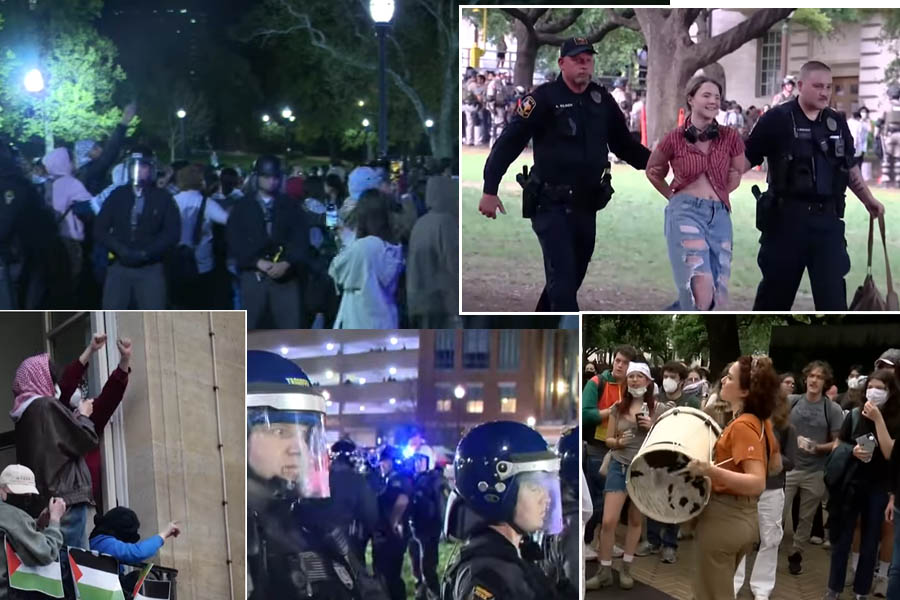
The Voice of Protest: College Campuses Echo with Calls for Gaza — Student Activism Sweeps from Columbia to Sciences Po as War Continues
As the Gaza conflict enters its seventh month with a civilian death toll exceeding 34,000 according to local health officials, the reverberations are felt not only in the Middle East but across college campuses worldwide. From the ivy-covered walls of Columbia University in New York to the historic halls of Sciences Po in Paris, student activism has ignited in response to the ongoing war, with impassioned protests, encampments, and sit-ins capturing the attention of both local communities and global audiences.
The demonstrations represent one of the most significant waves of student activism since the Vietnam War era, drawing parallels to the anti-war protests of the 1960s and 1970s. Students are demanding that their universities divest from companies tied to Israel, call for an immediate and permanent ceasefire, and publicly condemn the mounting civilian casualties in Gaza.
🇫🇷 Paris: Sciences Po at the Center of French Student Activism
In Paris, the prestigious Sciences Po — France's most elite political science university — found itself at the center of a fervent demonstration as hundreds of pro-Palestinian activists staged sit-ins and protests within its historic walls. The clashes between pro-Palestinian and pro-Israeli demonstrators underscored the deeply polarized sentiments surrounding the Gaza conflict, highlighting the urgency felt by many to speak out against the violence unfolding thousands of miles away.
On April 25, over 150 students occupied the main building of Sciences Po's Paris campus, hanging Palestinian flags from windows and chanting "Free Palestine." The university administration, led by director Mathias Vicherat, decided to move classes online and called in police to clear the occupation. Video from the scene showed police officers removing students who had barricaded themselves inside. Eleven students were reportedly detained.
"We are not here to hate anyone. We are here to say that a genocide is happening in Gaza, and our university should not be silent," said Léa, a 21-year-old Sciences Po student who participated in the occupation. Similar protests have since spread to the Sorbonne and other French universities.
🇺🇸 United States: Columbia University Becomes Epicenter of National Movement
Across the Atlantic, the United States witnessed a surge in protests on college campuses, with Columbia University emerging as the focal point of a rapidly spreading national movement. The administration faced mounting pressure in the wake of police interventions and arrests during protests, sparking intense debates about academic freedom, student rights, free speech, and the university's role in fostering dialogue amidst contentious geopolitical issues.
On April 17, Columbia University President Minouche Shafik testified before a House committee about antisemitism on campus — testimony that many protesters felt unfairly targeted pro-Palestinian speech. The following day, students set up a "Gaza Solidarity Encampment" on the university's main lawn, demanding divestment from companies with Israel ties. The encampment grew to include over 100 tents and hundreds of students.
On April 18, Shafik authorized the New York Police Department to clear the encampment. Police arrested over 100 students, including Ilhan Omar's daughter, Isra Hirsi. The dramatic scenes of students being led away in zip-tie handcuffs were broadcast worldwide, sparking solidarity encampments at Yale, NYU, MIT, University of Michigan, and dozens of other universities across the country.
As one protester at Columbia University articulated: "We're here for Palestine. This is not about us. This is not about the students. This is not about the college. This is about something so much more. It's about the 34,000 dead in Gaza. It's about the children who will never grow up."
🎓 Protests Spread Nationwide: A New Student Movement
By late April, the protests had spread to over 100 U.S. campuses, from Harvard to the University of Texas, from the University of California system to Emory University in Atlanta. At Yale, 45 protesters were arrested after refusing to leave an encampment. At NYU, police arrested 120 demonstrators. At the University of Southern California, administrators canceled the main commencement ceremony, citing safety concerns.
The demands across campuses are remarkably consistent: immediate ceasefire in Gaza, divestment from companies profiting from the conflict, amnesty for students disciplined for protesting, and public acknowledgment of what protesters call a "genocide" in Gaza. Many university administrations have refused to meet these demands, citing commitments to donor relations, investment policies, and neutrality on geopolitical issues.
⚠️ The Free Speech vs. Hate Speech Debate
Yet, amidst the fervor of activism, concerns have been raised about the boundaries between free speech and hate speech. Instances of harassment and antisemitic incidents on college campuses have underscored the challenges of navigating sensitive political discourse while upholding principles of inclusivity and respect. Jewish students at Columbia and other universities have reported feeling unsafe, with some saying chants like "From the river to the sea, Palestine will be free" are interpreted as calls for the elimination of Israel.
The Anti-Defamation League reported a 300% increase in antisemitic incidents on college campuses since October 7. Meanwhile, Muslim and Arab students have reported increased Islamophobia and discrimination. University leaders find themselves caught between protecting free expression and ensuring campus safety — a tension that has no easy resolution.
Rep. Elise Stefanik (R-NY), who questioned university presidents at a December House hearing that led to the resignation of Harvard's Claudine Gay and Penn's Liz Magill, has called for Shafik's resignation. Meanwhile, hundreds of Columbia faculty members have signed a letter defending student protesters' rights and criticizing Shafik's decision to call police.
⚖️ The Delicate Dance Faced by University Leaders
The delicate dance faced by university leaders in addressing these protests reflects the complex web of stakeholders involved, from students and faculty to alumni, donors, community members, and political figures. Negotiations between protesters and administrators have become emblematic of the broader struggle to reconcile divergent viewpoints and uphold core values of academic freedom and social justice while maintaining order and safety.
At Columbia, negotiations between student representatives and administration continued for days before breaking down. Students demanded full divestment and amnesty; the administration offered expedited review of divestment proposals but refused amnesty. The impasse led to continued encampments and, ultimately, another police intervention on April 30.
"This is not about negotiation — it's about a moral line in the sand," said one Columbia protester. "You cannot negotiate about whether Palestinian lives matter."
📚 Echoes of History: Student Activism's Enduring Legacy
As tensions continue to simmer, the protests serve as a poignant reminder of the enduring legacy of student activism in shaping social and political discourse. From the civil rights movement of the 1960s to the anti-war protests of the Vietnam era, from the anti-apartheid divestment campaigns of the 1980s to the Occupy movement of 2011, college campuses have long been incubators of change and catalysts for progress. The current Gaza protests may prove to be the next chapter in this long tradition.
With the Gaza conflict casting a long shadow over global consciousness, the voices of protest ringing out from college campuses offer a glimpse of hope amidst the turmoil, a testament to the power of collective action and the enduring spirit of solidarity in the face of adversity. As negotiations unfold and demonstrations persist, the world watches with bated breath, awaiting the outcome of this pivotal moment in history.
The coming weeks will determine whether this student movement can achieve concrete changes in university policies — and whether it can maintain momentum through final exams and summer break. What is already clear is that a new generation of activists has found its voice, and the establishment is taking notice.
Related Coverage: For more on the Gaza war and its global impact, visit Israel-Gaza War Hub and Iran Strikes Israel: Tensions Escalate.
Global Post Headline — independent coverage of global affairs and social movements. globalpostheadline.com | Follow updates: Gaza War Hub | International News

Experience the Himalayas with expert Sherpa guides. Trekking, expeditions, and cultural tours in Nepal, Tibet & Bhutan.
Book Your Adventure →
Authentic Nepali crafts, pashmina, singing bowls — worldwide shipping.