614 Electric Vehicles Imported Through Korala Border in One Week & New Budget 2083/84 Raises EV Prices
614 Electric Vehicles Enter Nepal via Korala Border in One Week
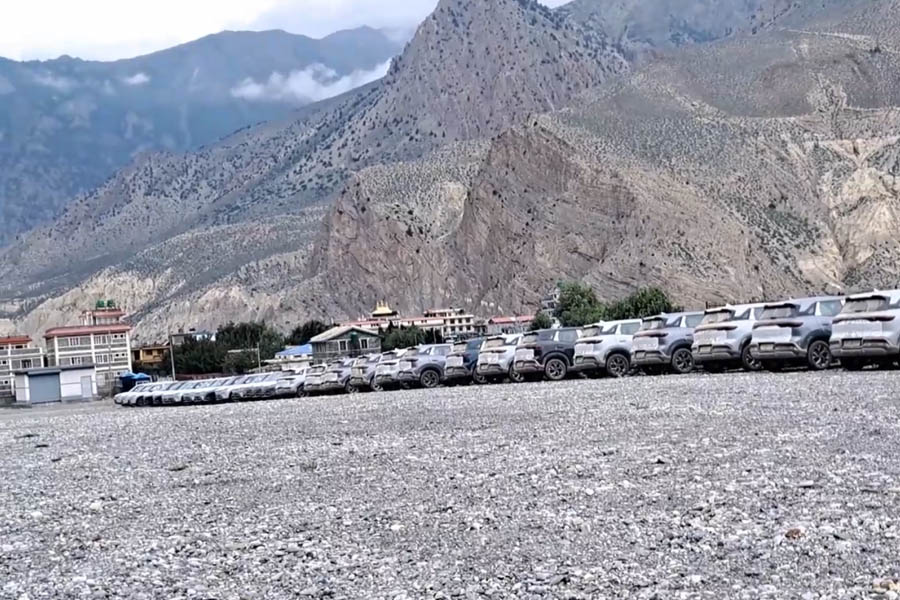
Mustang, Nepal – A total of 614 electric vehicles (EVs) manufactured by Chinese companies entered Nepal through the Nepal–China Korala border checkpoint within a one-week period. According to the Mustang Customs Office at Nhechung, Lo Manthang–1, a total of 614 EVs were imported between May 20 and May 28 (Jestha 7–15 on the Nepali calendar) through the Korala border crossing.
Mustang Customs Chief Bidur Chudal stated that customs clearance for all imported vehicles has already been completed. He noted that this is the first major batch of electric vehicles arriving after the winter season and added that customs officials have received information that many more vehicles are on their way through the Korala checkpoint.
Charging Infrastructure Challenge: After customs clearance, vehicles are transported through Lo Manthang to Jomsom, where they are charged before continuing. Currently, there is one EV charging station in Chhoser/Charang of Upper Mustang and two charging stations in Jomsom. The limited number of charging stations has created delays, forcing transporters to wait in line for charging services.
The Korala border crossing was brought into full operation on September 16, 2024 (Bhadra 31, 2081) as an alternative to the Tatopani and Rasuwagadhi border points. Since its full operation began, both imports and exports between Nepal and China have increased significantly, with EVs emerging as a major import category.
New Budget 2083/84 Shifts EV Tax Structure
Nepal's newly announced tax policy for the upcoming fiscal year 2083/84 is expected to substantially increase the prices of electric vehicles. According to Dhruv Thapa, former president of the NADA Automobiles Association of Nepal, EV prices could rise by as little as NPR 200,000 and as much as NPR 10 million (1 crore) depending on the vehicle category and value.
The government has removed the previous excise duty on electric vehicles and introduced a new Clean Infrastructure Investment Fee (CIIF) under the budget. This marks a fundamental shift from taxation based on motor power (kilowatt capacity) to taxation based on the vehicle's Cost, Insurance, and Freight (CIF) value expressed in Nepali rupees.
Previous vs. New Tax Structure
Previous system: EV taxes were determined largely by motor power, with customs duties ranging from 15% to 80% and excise duties from 5% to 50%.
New system (2083/84):
- Customs duty remains fixed at 20% for all EVs
- Road construction fee remains at 5%
- Value Added Tax (VAT) remains at 13%
- New Clean Infrastructure Investment Fee (CIIF) ranging from 2.5% to 130% based on vehicle's customs value
New CIIF Rates by Vehicle Customs Value
| Vehicle Customs Value (NPR) | CIIF Rate |
|---|---|
| Up to NPR 2 million | 2.5% |
| NPR 2–3 million | 20% |
| NPR 3–4 million | 35% |
| NPR 4–5 million | 90% |
| Above NPR 5 million | 130% |
*In addition to CIIF, vehicles are also subject to 20% customs duty, 5% road fee, and 13% VAT.
Industry Concerns Over Unscientific Tax Structure
Automobile dealers and industry representatives argue that the new tax structure is unstable and unscientific.
Automobile industry representatives have expressed strong concerns about the new tax structure, arguing that tax calculations should be based on US dollars rather than Nepali rupees because exchange-rate fluctuations could move vehicles into different tax brackets. Industry sources warn that EVs priced between NPR 6 million and NPR 7 million could become significantly more expensive, with additional taxes of NPR 2–2.5 million, pushing final prices to NPR 9–9.5 million. Even standard Chinese-brand EV models could see price increases of NPR 200,000–400,000.
Official distributors of electric vehicles in Nepal estimate that the starting price of popular EV models could increase to between NPR 3.1 million and NPR 3.6 million under the new tax regime. Industry leaders argue that the policy creates uncertainty for consumers and businesses, especially when exchange rates are fluctuating.
Similarly, some higher-priced EV models are expected to become NPR 200,000–300,000 more expensive. Distributors have warned that certain EV models may no longer remain commercially viable in Nepal under the new tax structure, potentially forcing them to reduce imports or discontinue some vehicle lines altogether.
Former Energy Minister Kulman Ghising Criticizes Policy
Former Energy Minister Kulman Ghising criticized the government's policy, arguing that it discourages electric vehicle adoption rather than promoting it. He said the new tax structure contradicts Nepal's national goals of increasing consumption of domestically generated clean energy, reducing imports of petroleum products, and promoting environmentally friendly transportation.
Ghising warned that, after accounting for customs duty, CIIF, road fees, and VAT, the overall tax burden on many electric vehicles could become comparable to that on conventional petrol and diesel vehicles, undermining the economic case for EV adoption.
Price Volatility Concerns
Industry leaders also expressed concern that vehicle prices could become highly volatile because taxes are now tied to the CIF value converted into Nepali rupees. Former NADA President Dhruv Thapa warned that even small changes in exchange rates could push a vehicle into a different tax bracket, causing sudden price increases or decreases.
He argued that the new system could make EV prices fluctuate in a manner similar to gold, silver, or fuel prices, creating uncertainty for importers, dealers, and consumers alike. Despite the government's stated commitment to promoting clean transportation, many stakeholders in Nepal's automobile sector believe the new tax policy may slow the growth of the country's rapidly expanding electric vehicle market.
Korala Border Update: The Korala crossing continues to gain importance as a trade gateway. With more EV shipments expected, customs authorities are preparing for increased volumes. However, the limited charging infrastructure along the route from Korala to Jomsom remains a logistical bottleneck for transporters.
Hashtags: #NepalEV #KoralaBorder #Budget2083 #ElectricVehicle #CleanEnergy #NepalEconomy #CIIF #NADA
Global Post Headline — Nepal's trusted source for national news, economy and automobile updates. globalpostheadline.com