Russia's Deadly Ballistic Missile Attack on Odesa: 'Harry Potter Castle' Destroyed — Iskander-M Strike Kills Civilians, Injures Dozens
In the ongoing conflict between Russia and Ukraine, the recent ballistic missile attack on the Black Sea port city of Odesa has once again highlighted the devastating toll of war. On April 30, 2024, Russia targeted Odesa with Iskander-M ballistic missiles, resulting in a tragic loss of life and widespread destruction. Among the casualties, at least four people lost their lives, and 32 others, including children, were injured in what Ukrainian officials are calling a deliberate attack on civilian infrastructure.
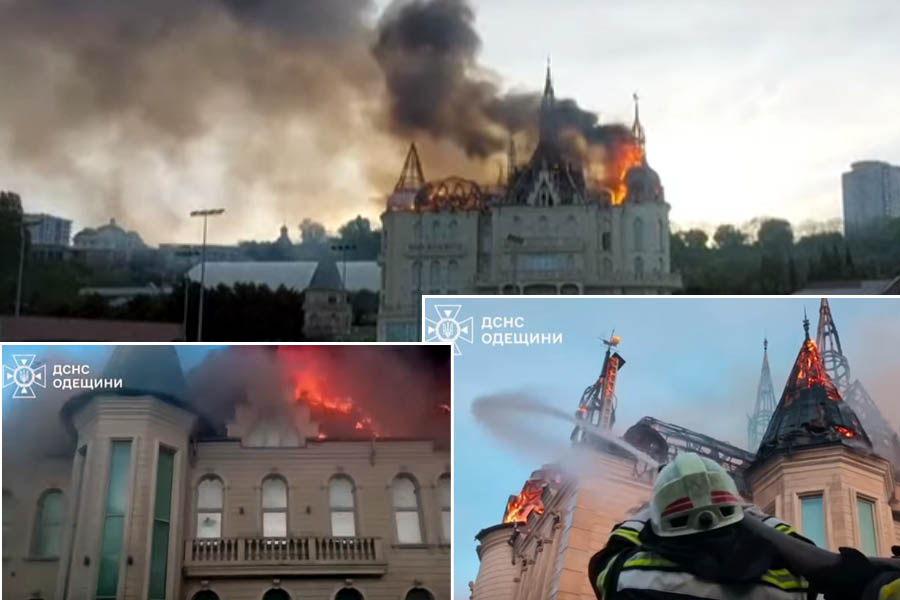
The targeted strike hit an educational institution, which has been dubbed 'Harry Potter Castle' by locals, owing to its unique architectural resemblance to the famous fictional castle from the beloved book and film series. This building, the residence of prominent former MP Serhiy Kivalov, bore the brunt of the attack, leaving it in ruins and engulfed in flames. The whimsical nickname now stands in grim contrast to the reality of war, as rescue workers sifted through debris searching for survivors.
🎯 The Attack: Iskander-M and Cluster Warhead
What makes this attack particularly heinous is the use of a cluster warhead, making the missiles harder to intercept and exponentially increasing the devastation on the ground. Cluster munitions are banned by over 100 countries under the Convention on Cluster Munitions, though neither Russia nor Ukraine is a signatory. The weapons scatter dozens or hundreds of smaller submunitions over a wide area, posing a long-term threat to civilians who may encounter unexploded ordnance.
The deliberate targeting of civilian infrastructure, including educational institutions, is a blatant violation of international humanitarian law and further underscores the brutality of modern warfare. The building, while owned by a politician, was being used as a civilian educational facility at the time of the attack. Images from the scene showed the building's distinctive turrets and spires reduced to rubble, with smoke pouring from the structure.
"This is not a military target," said Odesa Mayor Hennadii Trukhanov. "This is a civilian building that happened to be a local landmark. Children studied here. The only thing Russian missiles know how to do is destroy the lives of ordinary people."
🏛️ Serhiy Kivalov: The Target or the Location?
The building is owned by Serhiy Kivalov, a former member of the Ukrainian parliament and a prominent lawyer. Kivalov was not present at the time of the attack, and there is no evidence that the building was being used for military purposes. Russian state media has claimed that the building was being used as a "nationalist hub," a claim that Ukrainian officials have dismissed as propaganda designed to justify attacks on civilian infrastructure.
"Russia is trying to justify the unjustifiable," said Ukrainian Foreign Ministry spokesperson Oleg Nikolenko. "They claim this was a military target, but the world can see the truth: this was a beautiful building where young people studied. Russia is a terrorist state."
Kivalov himself, speaking from an undisclosed location, condemned the attack and called for international action. "They destroyed a building that was a symbol of Odesa's architectural heritage," he said. "But more importantly, they killed and injured innocent people. This is a war crime."
⚔️ Ukraine's Military Challenges: Troop Shortages and Training Gaps
This tragic incident comes amid a backdrop of escalating tensions and military maneuvers in the region. Ukraine, already facing a dire shortage of troops, is struggling to defend its sovereignty against Russian aggression. A recent report by the Washington Post revealed a significant decline in the number of Ukrainian soldiers receiving training at US bases, exacerbating the country's military challenges.
The decline in training capacity is due in part to the diversion of US military resources to other theaters, as well as political delays in aid packages. Ukrainian commanders report that new recruits are arriving at the front with minimal preparation, leading to higher casualty rates and decreased combat effectiveness. "We are throwing men into battle with two weeks of training against an enemy that has months of preparation," one Ukrainian officer told the Washington Post on condition of anonymity.
Furthermore, NATO's Secretary-General, Jens Stoltenberg, admitted to the organization's failure in providing timely weapons support to Ukraine. Despite ongoing pleas from Ukrainian President Volodymyr Zelensky for expedited deliveries, bureaucratic hurdles and insufficient aid packages have hampered Ukraine's ability to defend itself effectively. The $61 billion US aid package finally passed in April 2024 after months of delay, but weapons are only now beginning to reach the front lines.
📜 Russia's Victory Day Propaganda: Seized Western Equipment
In a brazen display of aggression and propaganda, Russia has seized Western military equipment, including American-made Abrams tanks, from Ukrainian territories and plans to showcase them during its Victory Day celebrations in Moscow on May 9. This blatant disregard for international norms and the glorification of war trophies only serves to escalate tensions and prolong the suffering of the Ukrainian people.
The captured equipment, which includes not only Abrams tanks but also Bradley infantry fighting vehicles, M777 howitzers, and various small arms, will be paraded through the streets of Moscow in what Russian officials call a "display of military might." Ukrainian officials have condemned the planned exhibition as a "grotesque propaganda stunt" designed to distract from Russia's military failures.
"They are celebrating the destruction of weapons that were meant to protect innocent people," Zelensky said. "This is not victory. This is barbarism." The exhibition is expected to draw large crowds and will be broadcast on state television, reinforcing the Kremlin's narrative that the West is being defeated in Ukraine.
🌍 The Humanitarian Crisis Deepens
As the conflict enters its third year, the humanitarian crisis deepens, with innocent civilians bearing the brunt of indiscriminate attacks and displacement. Over 15 million Ukrainians have been displaced since the full-scale invasion began, and an estimated 10 million are without reliable access to electricity. The attack on Odesa is a grim reminder that no city in Ukraine is safe from Russian missiles.
The international community must act decisively to hold perpetrators of war crimes accountable and redouble efforts to broker a peaceful resolution to the Ukraine-Russia conflict. The International Criminal Court has already issued arrest warrants for Vladimir Putin and other Russian officials, but enforcement remains a challenge. "Justice is coming," Zelensky vowed. "The world will not forget."
The tragic events unfolding in Odesa serve as a sobering reminder of the human cost of war and the urgent need for global solidarity in support of peace, justice, and the protection of civilian lives. Only through concerted diplomatic efforts and a commitment to upholding fundamental principles of humanity can we hope to end the cycle of violence and build a more secure and peaceful future for all.
Related Coverage: For more on the Russia-Ukraine war, visit Ukraine's Military Admits Setbacks as Russia Advances and Russia-Ukraine War: Recent Escalations Analysis.
Global Post Headline — independent coverage of the Russia-Ukraine war and humanitarian crises. globalpostheadline.com | Follow updates: War News | Politics

Experience the Himalayas with expert Sherpa guides. Trekking, expeditions, and cultural tours in Nepal, Tibet & Bhutan.
Plan Your Nepal Trip →
Authentic Nepali crafts, pashmina, singing bowls — worldwide shipping.