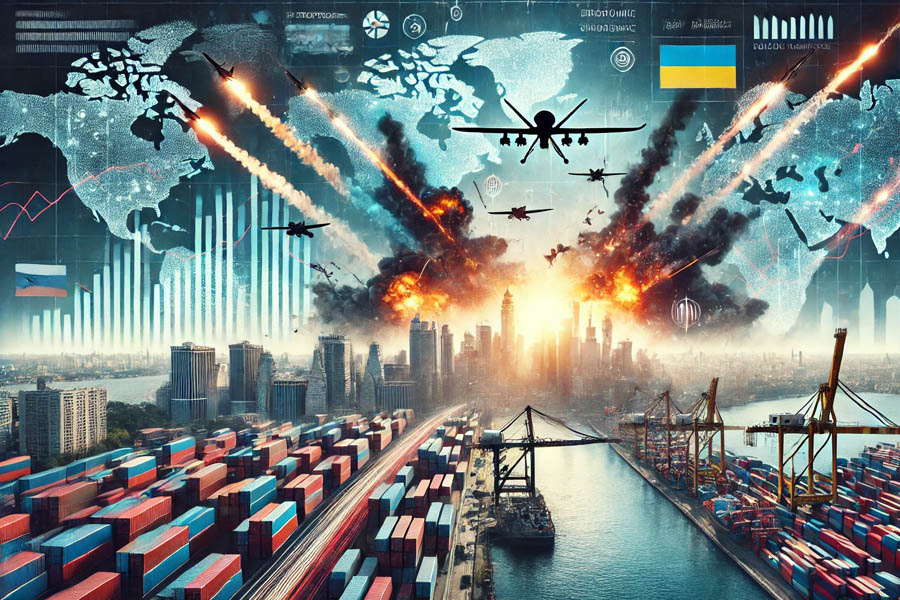
Russia-Ukraine War and U.S. Trade Policies: A World at a Crossroads — Kyiv Under Drone Attack as Trump's Tariff Threats Loom
The escalating conflict between Russia and Ukraine continues to reshape global dynamics, with fresh developments marking a deeply unsettling chapter in modern geopolitics. Simultaneously, U.S. trade policies — particularly President-elect Donald Trump's proposed tariffs — are poised to deliver seismic economic ripples, placing these two issues at the forefront of international attention as the world enters 2025.
On the battlefields of eastern Ukraine, Russian forces have intensified their aerial campaign against civilian infrastructure, while Western allies debate the level of military support to provide Kyiv. Meanwhile, in Washington, Trump has signaled a dramatic shift in trade policy that could upend North American economic integration and escalate tensions with China. Together, these developments represent a dangerous convergence of military aggression and economic nationalism.
🚁 Kyiv Under Siege: The Drone Onslaught Intensifies
In the early hours, waves of Iranian-made Shahed drones supplied by Russia descended upon Kyiv, Ukraine's capital. Swarming from multiple directions, the attack reflects an increasingly sophisticated and relentless campaign by Russia to destabilize Ukraine's energy infrastructure and terrorize civilian populations. Kyiv's mayor, Vitali Klitschko, reported widespread damage despite Ukrainian air defenses intercepting 50 out of 73 drones in the prior day's assaults. Nevertheless, the drones that bypassed defenses inflicted significant destruction and casualties, underscoring the devastating potential of even a fraction of these unmanned aerial vehicles.
Ukraine's air force reported that Russia launched the drones in waves designed to overwhelm air defense systems. Explosions were heard across the capital, with debris falling on residential buildings and starting fires. At least three civilians were injured, and power outages were reported in several districts as energy infrastructure was targeted. "The enemy is trying to destroy our energy system before winter," President Volodymyr Zelenskyy said in his nightly address. "We need more air defense systems from our partners."
The Pentagon closely monitors these developments, highlighting the role of external actors such as Iran and North Korea in bolstering Russia's arsenal. US intelligence officials have confirmed that Russia has received ballistic missiles from North Korea as well as drone technology from Iran, enabling sustained long-range strikes that would otherwise be beyond Russian domestic production capacity.
Recent use of U.S.-supplied long-range ATACMS missiles by Ukraine to target Russian ammunition depots and airfields signifies a shift in tactics, albeit a measured one due to limited missile supplies. However, these countermeasures have elicited sharp responses from Moscow, with Russia citing them as justification to update its nuclear doctrine — a move largely interpreted as saber-rattling but not without concern in Western capitals. President Vladimir Putin signed the revised doctrine in November, lowering the threshold for nuclear response to conventional attacks.
🇩🇪 European and Global Responses: Germany Prepares for the Worst
The ripple effects of this conflict are felt far beyond Ukraine's borders. Germany has taken steps to bolster its civil defense infrastructure, announcing plans to convert basements, garages, and subway stations into emergency shelters — a move reminiscent of World War II preparations. The German Interior Ministry has identified over 500,000 potential shelter spaces and is allocating €1.5 billion for upgrades.
Concurrently, reports from Moscow boast of Russia's hypersonic missile advancements and increased weapon production, now estimated to outpace the European Union's combined output by a staggering 4-to-1 ratio. According to NATO intelligence assessments, Russia is producing approximately 250,000 artillery shells per month, compared to the EU's combined capacity of 60,000. This production disparity has become a critical vulnerability for Ukraine as Western stockpiles dwindle.
These developments evoke a chilling sense of Cold War-era brinkmanship, with NATO urging businesses in the U.S. and Europe to adopt "wartime resilience" strategies. Jens Stoltenberg, the outgoing NATO Secretary General, warned that "the alliance must prepare for a long conflict" and called for increased defense spending among member nations. "We are witnessing the most dangerous security environment in decades," Stoltenberg said.
Yet European nations grapple with the challenge of maintaining unity. The rise of pro-Russian sentiments in certain EU states — including Slovakia, Hungary under Viktor Orbán, and recently Romania — adds complexity to the alliance's strategy, potentially weakening collective support for Ukraine. Orbán has repeatedly blocked EU military aid packages and called for peace negotiations on Russian terms, alarming Western allies.
💰 U.S. Trade Policies: Trump's Tariff Shocks on the Horizon
As the war rages in Europe, U.S. domestic policy could further disrupt the global landscape. Former President Donald Trump, the President-elect for the 2024 election, has unveiled a bold and controversial trade agenda. He promises to impose a 25% tariff on all goods from Canada and Mexico and an additional 10% tariff on Chinese imports. These measures, intended to assert economic dominance and pressure trading partners on border security and fentanyl trafficking, could have profound implications for North American partnerships and global markets.
The proposed tariffs, particularly the across-the-board levy on Canadian and Mexican imports, would significantly disrupt supply chains — especially in the automotive, agriculture, and energy sectors, where integrated North American production has been the norm for three decades under NAFTA and its successor, the USMCA. Experts warn that such policies could escalate costs for American consumers and businesses, reignite inflation, and trigger retaliatory measures from US allies.
"A 25% tariff on Canadian and Mexican goods would be catastrophic for the North American economy," said Mary Lovely, a trade economist at the Peterson Institute for International Economics. "It would violate the USMCA trade agreement that Trump himself negotiated. The resulting trade war would cost hundreds of thousands of American jobs."
Trump's rhetoric ties this assertive trade policy to his broader geopolitical strategy, positioning himself as a dealmaker who can end the war in Ukraine swiftly — potentially by pressuring Ukraine to cede territory — while reasserting American power on the global stage. His nominees for key Cabinet positions, including Marco Rubio for Secretary of State and Robert Lighthizer for Trade Representative, are known hardliners on China and critics of multilateral trade agreements.
While the U.S. economy might leverage its current strength against a weakened Chinese economy — which is grappling with a real estate crisis, deflation, and slow post-COVID recovery — experts warn that such policies could alienate allies and spark retaliatory measures, deepening economic divides. Canada has already threatened "proportional retaliation" against US goods, while Mexico has signaled it would respond with its own tariffs, potentially targeting US agricultural products from Republican-leaning states.
⚠️ A Dangerous Crossroads: Military Aggression Meets Economic Nationalism
The intertwining of military aggression and economic maneuvering paints a complex picture of the current global order. Russia's intensified military campaign in Ukraine and its nuclear posturing highlight the precariousness of peace, while U.S. trade policies threaten to reshape international relations further by alienating traditional allies and potentially sparking trade wars.
For Ukraine, the next few months are critical. Winter is approaching, and Russia is expected to launch a renewed campaign against energy infrastructure, hoping to freeze Ukrainian civilians into submission. The Biden administration has pledged an additional $5 billion in military aid before Trump takes office in January, but the long-term trajectory of US support remains uncertain.
For global trade, Trump's inauguration on January 20, 2025, could usher in the most protectionist US trade policy since the 1930s. Countries around the world are already planning contingency measures — diversifying supply chains, building trade relationships outside the US, and preparing for potential trade wars.
As nations brace for escalating conflict and economic upheaval, the choices made by global leaders in the coming months will shape the trajectory of this volatile era. From the streets of Kyiv to the halls of Washington and Moscow, the stakes could not be higher. The world stands at a crossroads — and the path chosen in the next several months will define international relations for a generation.
Related Coverage: For more on the Russia-Ukraine war and global trade, visit Russia-Ukraine War News Hub and International Trade Section.
Global Post Headline — independent coverage of global geopolitics and international affairs. globalpostheadline.com | Follow updates: War News | Trade

Experience the Himalayas with expert Sherpa guides. Trekking, expeditions, and cultural tours in Nepal, Tibet & Bhutan.
Plan Your Nepal Trip →
Authentic Nepali crafts, pashmina, singing bowls — worldwide shipping.