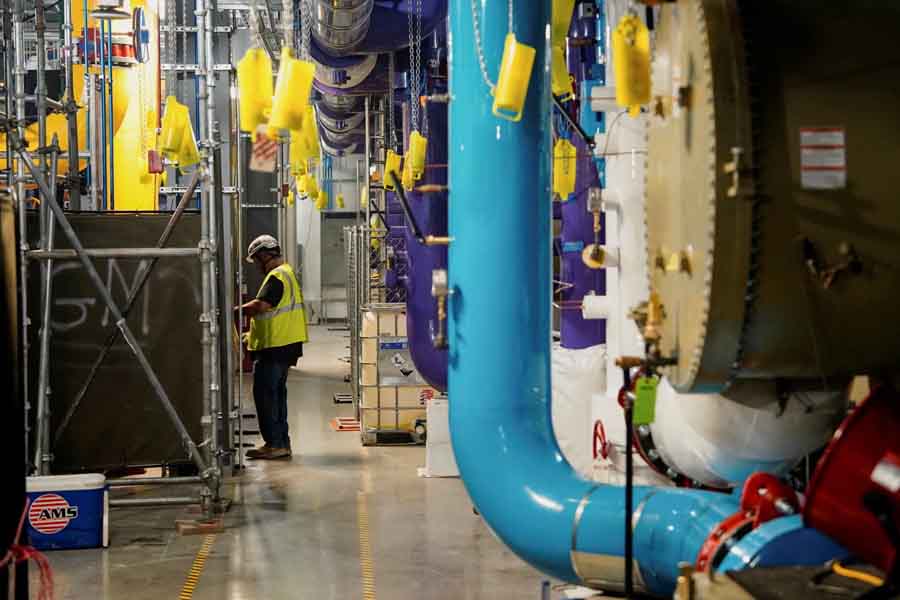
Inside a Microsoft datacentre. The company's carbon emissions rose by 25% over the past year to 20m mTCO₂e, driven primarily by the expansion of datacentre infrastructure.
11 July 2026 | San Francisco, London — Updated 17:30 GMT
Microsoft, Amazon and Google's collective carbon emissions have increased by nearly a fifth in the past year, driven largely by datacentre construction.
In the financial year ending March 2026, the three tech companies emitted 119m mTCO₂e (metric tonnes of carbon dioxide equivalent), or roughly half the emissions of France. The previous year, they emitted roughly 101m mTCO₂e, roughly equivalent to the 2024 emissions of Czechia.
The US companies' climate ambitions have been hit in recent years by a boom in demand for cloud services, such as storing data or running servers over the internet, related to training and operating chatbots and other AI products.
Meanwhile, the Bank of England has been handed powers to regulate important tech firms including Amazon and Google, amid fears that system failures could threaten financial stability and harm consumers.
Welcome to the latest tech news — where AI infrastructure, carbon emissions, and financial regulation collide.
🤖 TECH NEWS — KEY NUMBERS: Microsoft, Amazon, Google emit 119m mTCO₂e (half of France) • Microsoft emissions up 25% to 20m • Google emissions up 18% • Amazon emissions up 16% • $765bn AI datacentre spending in 2026 • 1,200 datacentres expected by 2030 • 1.3% of world electricity consumption • Bank of England regulates Amazon, Google, Oracle, Microsoft.
Tech Giants' Carbon Emissions Surge to Half of France's Total
Microsoft, Amazon and Google's collective carbon emissions have increased by nearly a fifth in the past year, driven largely by datacentre construction.
In the financial year ending March 2026, the three tech companies emitted 119m mTCO₂e (metric tonnes of carbon dioxide equivalent), or roughly half the emissions of France. The previous year, they emitted roughly 101m mTCO₂e, roughly equivalent to the 2024 emissions of Czechia.
The US companies' climate ambitions have been hit in recent years by a boom in demand for cloud services, such as storing data or running servers over the internet, related to training and operating chatbots and other AI products.
— Cecilia Rikap, Economics Professor, University College London
Cecilia Rikap, an economics professor at University College London, said: "Claims by Microsoft, Amazon and Google about their clouds being ecologically friendly and sustainable are a marketing strategy. Governments should remember these expanding carbon footprints when the very same companies offer addressing the ecological crisis with AI solutions.
"And, as migration to their clouds expands, and companies store data and train and use AI models and all sorts of digital technologies, these other companies are outsourcing their own digital/AI carbon footprint to cloud giants. Basically, shifting to the cloud helps other corporations obscure their environmental footprint."
📊 TECH EMISSIONS — KEY NUMBERS
- Combined emissions (2026): 119m mTCO₂e (half of France)
- Combined emissions (2025): 101m mTCO₂e (equivalent to Czechia)
- Microsoft increase: 25% (20m mTCO₂e)
- Google increase: 18%
- Amazon increase: 16% overall, 20% supply chain
- AI datacentre spending (2026): $765bn
- Datacentres expected by 2030: 1,200
- Projected electricity consumption: 1.3% of world usage
Microsoft, Google, Amazon: Emissions Rise Amid AI Boom
These increases were documented in the companies' annual sustainability reports, which they have released over the past weeks. In its report released on Thursday, Microsoft said its carbon emissions had increased by 25% over the past year to 20m mTCO₂e, "driven primarily by the expansion of our datacentre infrastructure".
Google said its emissions had increased 18% over the past year, "driven by increases in supply chain activities that supported the rapid expansion of our business". The search company says its AI systems have come up with solutions that have already helped to reduce emissions elsewhere by 41m tonnes of CO2 last year.
Amazon reported a 16% increase in emissions overall, and a 20% increase in supply chain emissions, which included datacentre building and construction. In its report, it still framed this as "making progress" towards its goal of net zero emissions in 2040.
The bulk of these emissions come from a big, global push to build the infrastructure for artificial intelligence. The world's biggest tech companies are on track to spend $765bn (£570bn) this year, mostly on building AI datacentres – in locations from Norway to North Tyneside.
Experts Warn: AI Investment Driving Emissions, Carbon Credits Scarce
It is a drastic reversal in a years-long push by big technology companies to cut their carbon emissions. Prior to this year, Microsoft's emissions appeared to have flatlined, at 16m mTCO₂e, in 2023 and 2024. All three companies still say they aim to achieve net zero emissions: Google and Microsoft by 2030, Amazon by 2040.
"The increases in total carbon emissions are strongly correlated with [the companies'] AI investment," said Shaolei Ren, a professor of electrical engineering at University of California, Riverside.
He noted that Microsoft's sustainability report also suggested that there were fewer carbon credits available on global markets to offset its emissions. "While companies are actively investing in or purchasing carbon credits, the figure suggests a possible lack of credit supply in the carbon market to meet the technology companies' needs … Everyone is talking about the lack of physical goods and infrastructure like power, but there may also be a lack of virtual goods – carbon credits."
— Shaolei Ren, Professor, University of California, Riverside
1,200 Datacentres Expected by 2030 as AI Demand Surges
Proposals for building datacentres across the global tech sector are becoming more numerous and ambitious as demand for AI tools, and investment by AI companies in the models that underpin them, increases. JLL, a US property consultancy, expects about 1,200 datacentres to be built globally between now and 2030, with demand overwhelmingly driven by AI.
The datacentre boom is accompanied by vast projected power demands. The Uptime Institute, which rates and inspects datacentres, estimates that big datacentre projects announced last year would consume 1.3% of the world's electricity usage, or a near-doubling of current datacentre demand. The majority of that new power demand will come from US projects, it said.
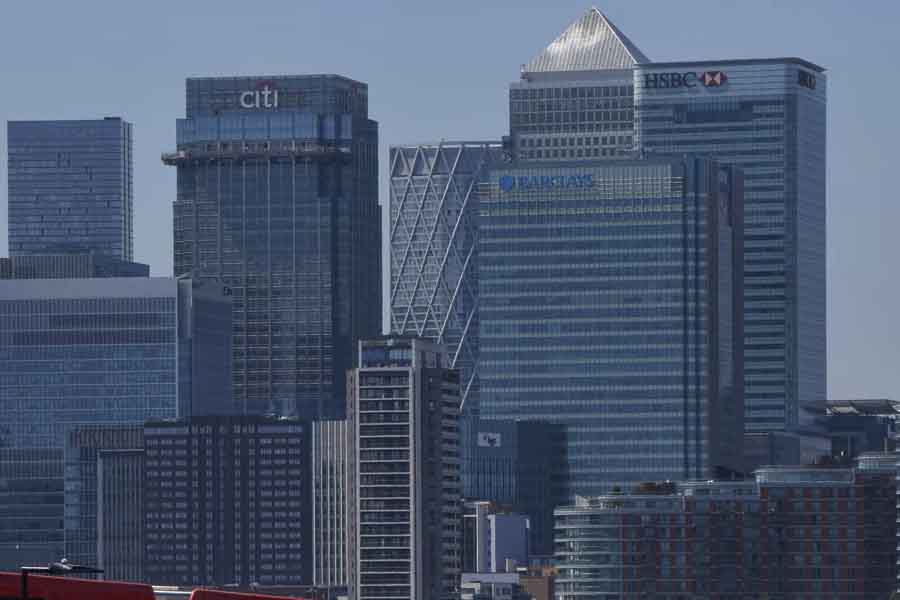
The BoE and City regulator the Financial Conduct Authority will aim to ensure the four main providers of cloud and tech services to banks are resilient and actively reducing the risk of cyber attack.
Bank of England Handed Powers to Regulate Amazon, Google, Oracle and Microsoft
The Bank of England has been handed powers to regulate important tech firms including Amazon and Google from next week, amid fears that system failures could threaten financial stability and harm consumers.
From Monday, the Bank and fellow City regulator the Financial Conduct Authority (FCA) will be in charge of ensuring that four large-scale providers of cloud and tech services to banks are resilient and actively reducing the risk of cyber-attacks and major outages that could disrupt services for millions of people and businesses across the UK.
This will mean having "direct" oversight of local arms of Amazon Web Services, Google Cloud, Oracle and Microsoft, all of which have been identified as "critical third parties" by the UK government, according to an announcement on Friday.
— Meg Hillier, Treasury Committee Chair
The companies will have to prove they are carrying out adequate stress testing, showing how they respond to imagined emergency scenarios that put their operations under severe strain. They will also be forced to report to the Bank of England and FCA any major incidents such as cyber-attacks, power outages and the impacts of natural disasters.
🏛️ BANK OF ENGLAND REGULATION — KEY DETAILS
- Regulated companies: Amazon Web Services, Google Cloud, Oracle, Microsoft
- Regulators: Bank of England and Financial Conduct Authority (FCA)
- Status: "Critical third parties" identified by UK government
- Requirements: Stress testing, incident reporting, resilience plans
- Effective from: Monday
- Context: 2,000+ companies disrupted by Amazon glitch in October 2025
- Background: Lloyds Banking Group among affected companies
- Parliamentary pressure: Treasury committee pushed for regulation
Tech Glitches Cause Banking Chaos: The Risks of Reliance on Foreign Tech Firms
The companies' technologies have become a crucial part of day-to-day banking operations, including to store data, run automated fraud detection programmes and carry out digital banking services.
However, relying more on online technologies – and a move away from physical branches and cash – has come with risks, with glitches half a world away causing large-scale chaos for everyday banking customers up and down the UK.
Last October, Lloyds Banking Group was among more than 2,000 companies whose online services were disrupted by a glitch at Amazon's cloud computing services operations in Northern Virginia, a major tech hub near Washington DC. The episode prompted renewed warnings over the perils of relying on a small number of foreign firms for operating services across the internet, including crucial government and financial services.
Overall, customers at Britain's main banks and building societies suffered the equivalent of more than a month's-worth of IT failures between 2023 and 2025, according to the Treasury committee.
The UK government came under fire for dragging its feet and taking more than 18 months to decide which companies should be supervised by British financial regulators, who were given the theoretical powers to do so back in January 2025.
The question of which companies should be regulated is understood to have been a sensitive topic among Labour ministers, who have been trying to attract investment into the UK, including from big US tech firms.
However, all four companies publicly welcomed the announcement, issuing statements alongside the official release saying they supported the government's objectives of boosting the resilience of the UK's financial sector.
Treasury Committee: Consider Regulating AI Firms Next
The Treasury committee chair, Meg Hillier, said the government now needed to go further and consider putting AI firms under the regulator's watch: "To finally see movement on this after we have pressed for months, including in our recent AI report, is a huge step forward. The Treasury is finally putting its powers to good use by improving oversight of the tech firms which our financial system relies upon.
"As the use of AI in financial services expands, I believe there may come a time when the government needs to consider designating specific AI firms under the critical third parties regime. This should be monitored closely to ensure the country is not vulnerable in the event of a failure at a major provider."
🤖 TECH NEWS: THE NUMBERS THAT DEFINE THE MOMENT
📊 TECH CARBON EMISSIONS
Combined emissions (mTCO₂e)
Half of France
Microsoft increase
20m mTCO₂e
Google increase
Amazon increase
20% supply chain
🏗️ AI INFRASTRUCTURE BOOM
AI datacentre spending (2026)
Datacentres expected by 2030
World electricity consumption
From datacentre projects
🗣️ KEY VOICES
Cecilia Rikap (UCL):
"Claims about clouds being ecologically friendly are a marketing strategy."
Shaolei Ren (UC Riverside):
"Emissions increases are strongly correlated with AI investment."
Meg Hillier (Treasury Committee Chair):
"The Treasury is finally putting its powers to good use."
🏛️ BANK OF ENGLAND REGULATION
🏦 BANKING IT FAILURES
🤖 THE FINAL VERDICT: TECH'S CARBON AND REGULATORY CHALLENGES
✅ WHAT'S HAPPENING:
- Tech emissions hit 119m mTCO₂e (half of France)
- $765bn AI datacentre spending in 2026
- 1,200 datacentres expected by 2030
- BoE regulates AWS, Google Cloud, Oracle, Microsoft
- All four companies welcome regulation
⚠️ THE CHALLENGES:
- Carbon emissions surging despite net zero pledges
- Carbon credits in short supply
- Cloud outsourcing obscures corporate footprints
- System failures threaten financial stability
- Calls to regulate AI firms next
"Claims by Microsoft, Amazon and Google about their clouds being ecologically friendly are a marketing strategy," warned UCL professor Cecilia Rikap as the three tech giants' combined carbon emissions hit 119m mTCO₂e — half of France's total. Microsoft's emissions rose 25%, Google 18%, Amazon 16%, driven by the $765bn AI datacentre boom. Meanwhile, the Bank of England gained powers to regulate AWS, Google Cloud, Oracle and Microsoft, after 2,000+ companies were disrupted by an Amazon glitch. "The Treasury is finally putting its powers to good use," said Treasury Committee chair Meg Hillier, who also urged regulators to consider AI firms next. Tech's carbon and regulatory challenges collide.
— Tech News Analysis
Stay updated with the latest tech news, AI developments, and regulatory updates on our Technology Page.