The Ukraine-Russia War: A Dramatic Prelude to Change — Zelenskyy Declares 'Closer to the End' as Global Tensions Escalate
As the fog of war continues to envelop Eastern Europe, the conflict between Ukraine and Russia unfolds with a dramatic intensity that captivates and horrifies in equal measure. The stakes have never been higher, with the West and Russia engaged in a perilous game of power dynamics that holds the world's attention. The narrative is fraught with tension, where optimism and despair dance a delicate tango. The implications of this geopolitical chess game extend far beyond borders, influencing global security, alliances, and the very fabric of international relations. With both sides making strategic moves, the question remains: Is this a prelude to a new chapter in global conflict?
🇺🇦 Zelenskyy: Ukraine War 'Closer to the End' Than Many Think!
In a recent interview with ABC News, Ukrainian President Volodymyr Zelenskyy made a striking declaration that the war is "closer to the end than many think." His assertion carries weight, hinting at an imminent shift in the tides of war, yet it is laced with a poignant urgency. "We are closer to the end of the war," he states, calling upon international allies to bolster Ukraine's military efforts. This message of hope comes at a critical time when the international community's support is vital for Ukraine's survival against an aggressive neighbor determined to redraw borders with brute force.
Zelenskyy's optimism is both infectious and sobering. While he believes in the potential for peace, the realities on the ground suggest a far more complex scenario. Ukraine's infrastructure has suffered grievously, and reports indicate that up to 70% of its electrical grid has been damaged. This grim statistic paints a picture of a nation desperately seeking a lifeline, both militarily and diplomatically. Winter is approaching, and without adequate air defense and energy support, millions of Ukrainians face the prospect of freezing in the dark — a humanitarian catastrophe that would dwarf previous hardships.
Zelenskyy's remarks appear timed to coincide with his visit to Washington, where he is expected to present a "victory plan" to President Biden. The plan reportedly includes requests for long-range ATACMS missiles, F-16 fighter jets, and security guarantees short of NATO membership. While Biden has been supportive, he has resisted allowing Ukraine to use American weapons to strike deep inside Russia — a restriction Zelenskyy wants lifted.
🇯🇵 Rising Tensions: Japan's Fighter Jets Fire Flares at Russian Aircraft
Meanwhile, the geopolitical landscape grows increasingly fraught beyond Europe. On September 24, 2024, Japan's fighter jets fired flares at Russian reconnaissance aircraft that encroached upon its airspace over the Sea of Japan. This marked a significant escalation in tensions, signaling not only Japan's resolve but also a wider regional alarm as military cooperation between Russia and China grows. Japanese Prime Minister Fumio Kishida has emphasized the necessity for a firm response, recognizing that the theater of war may extend beyond Ukraine's borders.
The incident marks the first time Japan has used flares against Russian aircraft, a move that Tokyo says was necessary to warn the planes to leave after they ignored radio calls. Russia's defense ministry claimed its aircraft were conducting routine flights over neutral waters and did not violate Japanese airspace — a denial that Japan rejected. The incident highlights how the Ukraine war is exacerbating tensions in Asia, where Russia has increased military activity near Japan's northern territories, which Moscow seized at the end of World War II.
In a world where alliances shift like sand, Japan's actions are a reminder of the far-reaching implications of the Ukraine conflict. The message is clear: the West must unite against threats that transcend geography. But as we delve deeper, the complexities only multiply. Japan has also increased its defense spending and is acquiring long-range missiles capable of striking North Korea and China — moves that would have been unthinkable a decade ago.
🗣️ Voices from the Gulag: The Fall of Putin's Regime
Vladimir Kara-Murza, a freed dissident who survived a Siberian gulag and two poisoning attempts, offers a chilling perspective on Russia's future. He asserts that the collapse of the Putin regime will come swiftly and without warning, mirroring historical precedents in Russia's tumultuous past. "That's how things happen in Russia," he states from his exile in Germany, reflecting a profound understanding of his country's psyche. The stakes here are not just military but existential; a defeat for Russia in Ukraine may serve as a catalyst for a broader awakening, spurring hopes for a free and democratic Russia.
Kara-Murza, who spent two years in a Siberian penal colony for criticizing the war, told the BBC that Russians are "exhausted" by the conflict and that Putin's popularity is paper-thin. "The regime is fragile," he said. "The problem is that the opposition is in jail or in exile. But when the moment comes — and it will come — change will be swift."
As Kara-Murza's words echo in the corridors of power, one can't help but wonder: Will the end of the current regime be a harbinger of peace in Europe or merely the prelude to further chaos? History offers cautionary tales — the collapse of the Soviet Union led to a "lost decade" of economic turmoil and regional conflicts. The fall of Putin could be even more destabilizing, as competing factions within the security services, military, and oligarchic clans vie for power.
🇺🇸 America's Long-Range Missiles: A Game-Changer for European Security
In a strategic pivot reminiscent of the Cold War, the United States plans to deploy long-range missiles to Europe by 2026, amplifying the ongoing arms race. This deployment reflects a broader shift in German security policy, igniting discussions on the implications for NATO's military posture. American missiles like the SM-6, Tomahawk, and the Long-Range Hypersonic Weapon (LRHW) are poised to reshape the European defense landscape. As European nations scramble to bolster their defenses, the balance of power could tilt dramatically, creating new strategic dilemmas for both NATO and Russia.
The deployment, announced following the NATO summit in Washington, will see missiles stationed in Germany that can reach Russian targets in as little as 10 minutes. Russia has warned that such deployment would be a "return to the Cold War" and that it would respond "militarily and technically" — a phrase that has historically preceded the deployment of countermeasures or new weapons systems.
In this high-stakes game, the roles of power and responsibility become increasingly blurred. Germany's commitment to hosting these missiles underscores the seriousness of the situation, yet it raises concerns about inadvertent escalation and the potential for miscalculations in an already volatile landscape. The Biden administration's support for Ukraine seems unwavering, yet questions linger: Is this strategy sustainable? What happens when the tide turns, and Ukraine finds itself in a precarious position?
☢️ Putin's Nuclear Gambit: A Grim Warning
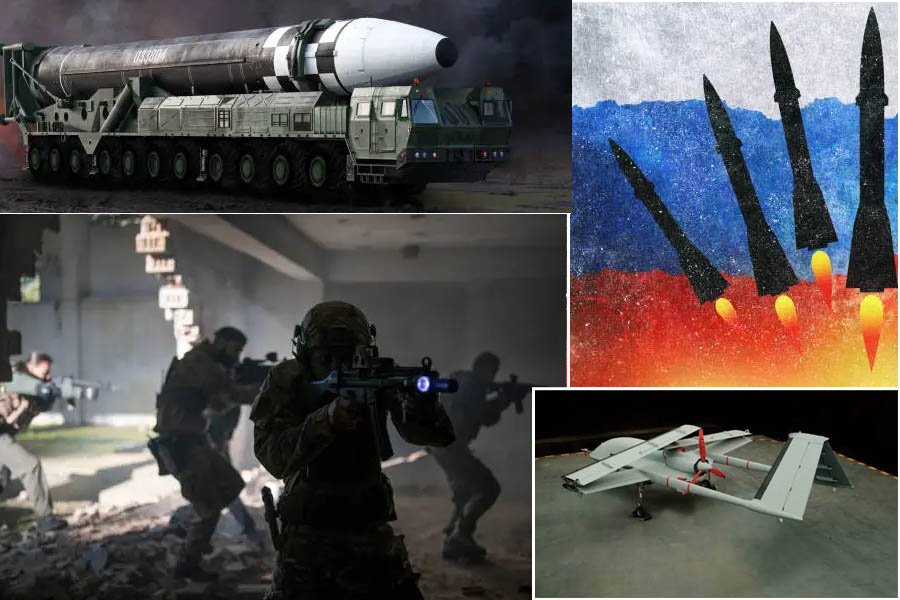
Against this backdrop of military posturing, Vladimir Putin's recent comments regarding nuclear warfare add a chilling dimension to the conflict. His declaration that an attack from a non-nuclear state, supported by nuclear powers, would be considered a joint assault, signals a dangerous escalation. The new doctrine, revealed in September 2024, lowers the threshold for Russia to use nuclear weapons in response to a conventional attack that "poses a critical threat to Russia's sovereignty." This could include a massive drone strike or a Ukrainian attack on Russian territory using Western weapons.
As tensions mount, Zelenskyy's request for long-range missiles could trigger a catastrophic chain reaction, inviting unprecedented consequences. The Kremlin's messaging is clear: the West should not assume that Russia's nuclear threshold is high. "We are not bluffing," Putin said in a televised address. "Russia reserves the right to use nuclear weapons in response to aggression that threatens the existence of our state."
The stakes are incomprehensibly high. The possibility of a nuclear confrontation looms, a specter haunting the dreams of leaders and citizens alike. In a world fraught with uncertainty, the very notion of a "nuclear deterrent" transforms into a potential catalyst for disaster. Western intelligence officials have noted that while Putin's nuclear saber-rattling is likely designed to deter deeper Western involvement, miscalculation remains the greatest risk.
🏛️ Zelenskyy's Washington Visit: A Recipe for Escalation?
As President Zelenskyy prepares for a pivotal meeting with President Biden, the potential for heightened conflict looms large. The discussions surrounding missile strike targets inside Russia could lead to unprecedented military escalation. Critics argue that this approach could be the catalyst for a broader conflict, reminiscent of Cold War tensions. With nuclear threats on the table, the world watches anxiously — will this meeting pave the way for peace or plunge the region into chaos?
Zelenskyy's "victory plan" includes four key elements: continued military aid, a path to NATO membership, economic reconstruction, and post-war security guarantees. However, U.S. officials are reportedly skeptical of the plan's feasibility, viewing it as an echo of previous requests that have already been partially granted. The Biden administration is also wary of escalating tensions with Russia before the November U.S. election, where foreign policy is a key issue.
Meanwhile, European allies are divided. Poland and the Baltic states support Ukraine's long-range strike requests, while Germany and France urge caution. The outcome of the Biden-Zelenskyy meeting could determine the trajectory of the war for the next six months.
📋 A Fractured Strategy: U.S. Unimpressed with Ukraine's Victory Plan
Ahead of the critical meeting, U.S. officials express skepticism about Ukraine's proposed victory strategy, viewing it as an echo of previous requests for military support. The focus on long-range missiles raises alarms about escalating the conflict further. As tensions mount, the complexities of U.S.-Ukrainian relations come into sharp focus, prompting critical discussions about the path forward. Will Ukraine's requests fall on deaf ears, or will they reignite a commitment to a robust military partnership?
Some U.S. officials have privately suggested that Ukraine needs a more realistic strategy that acknowledges Russia's battlefield advantages and the limits of Western support. "There is no silver bullet," a senior U.S. official told CNN. "We have given them billions in aid, but at some point, they need to articulate a political endgame, not just a military wish list."
For Ukraine, the stakes could not be higher. With winter approaching and Russian forces making incremental gains in the Donbas, the coming months will test the nation's resilience — and the West's commitment — as never before.
🕊️ The Urgency of Accountability in a World on Edge
As the world holds its breath, we are left to ponder the fate of Ukraine and the West's role in this unfolding saga. The narrative remains fluid, teetering between hope and despair, peace and war. What is certain is that the Ukraine-Russia conflict is not merely a regional dispute; it is a pivotal moment in history, a crucible that could reshape international relations for decades to come.
As the drama unfolds, the question remains: Can the collective will of the international community pave the way for a resolution, or will we descend into a cycle of violence that engulfs not only Ukraine but the very fabric of global stability? The answer lies not just in the hands of leaders but in the hearts of those who dare to dream of peace in a world marred by conflict.
Related Coverage: For more on the Russia-Ukraine war, visit Putin's Visit to China: Deepening Russia-China Ties and Russia-Ukraine War and U.S. Trade Policies.
Global Post Headline — independent coverage of the Russia-Ukraine war and global geopolitics. globalpostheadline.com | Follow updates: War News | Politics

Experience the Himalayas with expert Sherpa guides. Trekking, expeditions, and cultural tours in Nepal, Tibet & Bhutan.
Plan Your Nepal Trip →
Authentic Nepali crafts, pashmina, singing bowls — worldwide shipping.