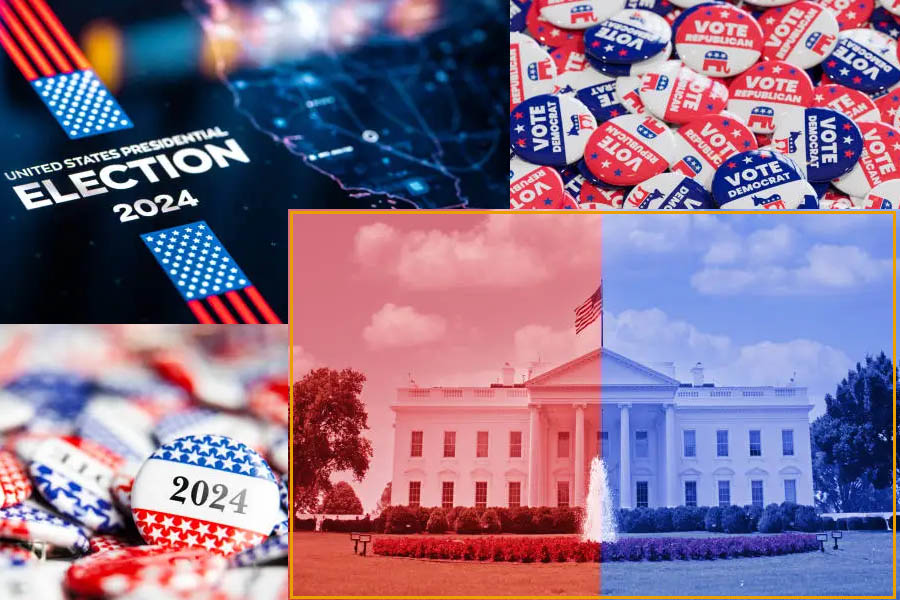
The 2024 U.S. Election: A Battle Between Two Global Visions — Israel or Ukraine? Trump vs Harris and the Future of World Order
The 2024 U.S. election is not just about America — it's about the fate of global politics, power struggles, and the alignment of world leaders. As the race between Donald Trump and Kamala Harris intensifies, the dynamics of foreign policy have come to the forefront, presenting two starkly different visions for American leadership on the world stage. The decisions made by American voters this November will reverberate far beyond US borders, directly impacting the Middle East, the Russia-Ukraine war, NATO's future, and the broader global order.
There's a growing narrative, especially in Asian and global political circles, that this election boils down to a choice between two opposing geopolitical alignments. On one hand, we have Donald Trump — the favored candidate for those who support a strong Israeli presence in the Middle East, closely aligned with Prime Minister Benjamin Netanyahu's vision of regional dominance. On the other hand, there's Kamala Harris, who represents continuity in American support for Ukraine's fight against Russian aggression and a more diplomatic, alliance-based approach to international relations.
For many observers, the 2024 election is less about domestic policies and more about the future of American global influence. It's about whether America should double down on its alliance with Israel's right-wing government or uphold its democratic commitment to Ukraine's sovereignty. Let's explore these two diverging views in depth.
🇺🇸 1. Donald Trump and Israel: A Reinforcement of Old Alliances
Trump's first term (2017-2021) solidified his close relationship with Netanyahu, most notably through his decision to move the U.S. embassy from Tel Aviv to Jerusalem — a move that recognized Jerusalem as Israel's capital and delighted the Israeli right while infuriating Palestinians and much of the international community. Trump also withdrew the United States from the Iran nuclear deal (JCPOA), reimposed crippling sanctions on Tehran, and brokered the Abraham Accords, normalizing relations between Israel and several Arab nations including the UAE, Bahrain, Morocco, and Sudan.
For many Israelis, particularly Netanyahu's governing coalition, Trump represents a reliable ally who is willing to take bold, controversial steps that favor Israeli security interests. His hardline approach against Iran and unwavering support for Israeli military actions in Gaza and the West Bank have made him a hero in the eyes of Israel's right-wing leadership. Netanyahu, who has reportedly delayed peace negotiations and settlement discussions, may be waiting for Trump's return to power to strengthen his hand against regional foes like Iran and Hezbollah.
For American voters who view Israel as a crucial strategic ally in a volatile Middle East, the decision is clear: a vote for Trump is a vote to keep Israel strong, to maintain maximum pressure on Iran, and to continue the shift of U.S. policy away from two-state solution diplomacy toward unilateral support for Israeli sovereignty. The implications extend beyond military might to a specific kind of American leadership — one that is unafraid of breaking with international consensus and taking unilateral action.
🌍 2. Kamala Harris and Ukraine: Defending Democracy on a Global Scale
On the other side of the coin, Vice President Kamala Harris represents the current administration's steadfast support for Ukraine and its fight against Russian expansionism. Since Russia's full-scale invasion began in February 2022, the Biden-Harris administration has poured over $175 billion into military aid, economic support, sanctions coordination, and diplomatic efforts to stop Vladimir Putin's aggression. Harris has personally met with Ukrainian President Volodymyr Zelenskyy multiple times and has been a vocal advocate for continued support.
While some Republicans, including Trump, have wavered in their support for Ukraine — with Trump suggesting he could end the war in 24 hours by pressuring Ukraine to concede territory — Harris has stood firm. She argues that the defense of democracy in Ukraine is crucial not only for European security but for the entire world order. In this view, allowing Russia to succeed in annexing Ukrainian territory would set a dangerous precedent, potentially emboldening other authoritarian regimes, including China, to make aggressive moves of their own against Taiwan or in the South China Sea.
Harris's vision of the world is one where democracy must be defended at all costs — where alliances like NATO are strengthened, where international law is upheld, and where American leadership is exercised through multilateral cooperation rather than unilateral action. For voters who believe that American global leadership is rooted in upholding democratic values and international institutions, Harris is the clear choice.
👀 The Leaders Eyeing the Election: Netanyahu and Putin
The importance of the U.S. election isn't lost on world leaders. Both Netanyahu and Putin have enormous stakes in who occupies the White House come January 2025. Netanyahu's preference for Trump is well-documented — the two leaders developed a close personal friendship during Trump's first term, and Netanyahu has been criticized for embracing Trump's election fraud claims. A Trump victory would likely mean continued U.S. support for Israeli settlement expansion, a harder line on Iran, and reduced pressure for a two-state solution.
Interestingly, Putin has expressed a degree of favor toward Kamala Harris, possibly seeing in her the potential for more predictable diplomatic engagement compared to the unpredictability of Trump. While Trump has praised Putin and questioned NATO's value, Harris has consistently condemned Russian aggression. However, some analysts suggest Putin might prefer Harris because a divided U.S. political establishment — with continued support for Ukraine but with constraints — could prolong the war in a way that drains American resources without resolving the conflict in Kyiv's favor.
As American voters prepare to head to the polls, they should recognize that their decision isn't just about domestic concerns like the economy, immigration, or abortion rights — it's about the future of the world order. Netanyahu's close relationship with Trump signals a Middle East policy focused on hard power and unilateral actions. In contrast, Harris's approach to Ukraine represents a commitment to multilateral diplomacy and the defense of democracy against authoritarian aggression.
🌏 Asian Eyes on America: The View from the East
Interestingly, this election is being closely watched by countries across Asia, who see it as a defining moment in global politics. Many Asian analysts view the 2024 election as the final match in a long-running contest of ideologies — a battle between an America that prioritizes its traditional Middle East alliances and an America that pivots to counter authoritarian threats in Europe and Asia.
For Japan, South Korea, and Australia — key U.S. allies in the Indo-Pacific — the outcome will determine whether Washington remains focused on countering China's military rise. A Trump victory could mean a more transactional approach to Asian alliances, with demands for increased defense spending and potential trade barriers. A Harris victory would likely mean continuity of the Biden administration's "Pacific Pivot" strategy, with strengthened alliances like AUKUS and expanded military cooperation with the Philippines and Taiwan.
For many Asian countries, the election is also a referendum on the kind of global leadership America will offer. Will it be the America that unapologetically backs its allies in controversial hardline policies, as seen with Trump and Israel? Or will it be the America that leads through democratic principles, international cooperation, and a rules-based order, as seen with Harris and Ukraine?
⚖️ A Global Responsibility: What's at Stake
As November 5 approaches, U.S. citizens face an immense responsibility. The future of global politics is, to a significant degree, in their hands. It's not just about who leads America — it's about the role America plays on the world stage for the next four years and beyond.
Will they choose a path aligned with Israel's Netanyahu, emphasizing military strength, unilateral action, and bold moves in the Middle East? Or will they side with Harris, defending democracy in Ukraine, strengthening NATO, and setting a new tone for global diplomacy that prioritizes alliances over unilateralism?
The choice carries profound implications for several active conflicts: Ukraine's survival as an independent nation depends on continued U.S. military aid; Israel's ability to manage its regional confrontations with Iran, Hezbollah, and Hamas depends on U.S. diplomatic and military support; the balance of power in the South China Sea depends on credible U.S. commitment to its Asian allies.
One thing is certain: this election will shape the future of international relations for years to come. The world is watching closely, with capitals from Tokyo to Berlin, from Kyiv to Riyadh, anxiously awaiting the outcome. Asia, Europe, and the Middle East all view November 2024 as the ultimate political showdown. The choice is yours, America. Let's see who the world's superpower sides with, come November.

Global Post Headline — independent analysis of U.S. politics and global affairs. globalpostheadline.com | Follow US election updates: US News | Politics Section

Authentic Nepali crafts, pashmina, singing bowls — worldwide shipping.