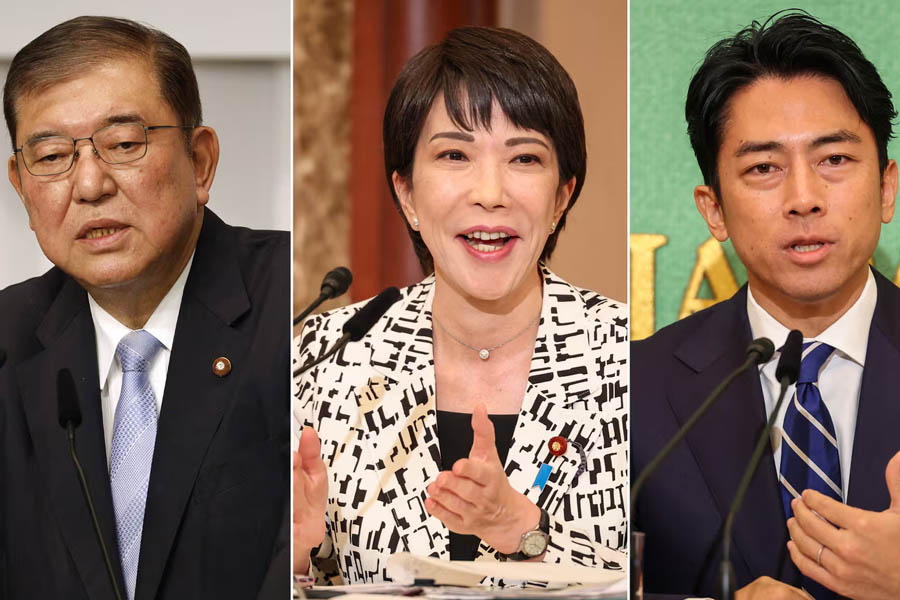
From left to right: Shigeru Ishiba, Sanae Takaichi and Shinjiro Koizumi — three prominent contenders in the race to become leader of the ruling LDP party, and Japan's next prime minister.
Japan's Next Prime Minister: A Race Between Policy Wonk, Ultra-Conservative, and Climate Activist — LDP Leadership Showdown
As Japan's ruling Liberal Democratic Party (LDP) prepares for its presidential election on September 27, 2024, the nation stands at a crossroads. Three distinct candidates have emerged as frontrunners — each offering a radically different vision for the world's third-largest economy. The winner will automatically become Prime Minister, given the LDP's majority in the lower house, and will face a snap election shortly thereafter.
Prime Minister Fumio Kishida's decision not to seek re-election after a series of scandals and record-low approval ratings has triggered a leadership contest that could reshape Japan's political and economic trajectory for years to come. Here's what you need to know about the three leading contenders.
Shigeru Ishiba: The Policy Wonk and Defense Expert
At 67, Shigeru Ishiba is making his fifth — and possibly final — bid for the LDP leadership. The former defense minister is widely regarded as the most knowledgeable party member on security issues, having authored multiple books on military strategy. Ishiba has long positioned himself as a maverick willing to challenge party orthodoxy, which has both endeared him to the public and alienated him from party elites.
On economic policy, Ishiba represents a potential break from the "Abenomics" era. He has consistently advocated for higher interest rates and a stronger yen — positions that have earned him the nickname "Ishiba shock" among market watchers. His victory could trigger a significant yen rally, impacting Japan's export-heavy economy. On social issues, Ishiba is relatively liberal, supporting married couples' right to separate surnames — a stance that has drawn criticism from conservative LDP factions.
Sanae Takaichi: The Ultra-Conservative Continuity Candidate
Sanae Takaichi, 63, is the current Minister for Economic Security and a protege of the late Shinzo Abe. If elected, she would become Japan's first female Prime Minister — a historic milestone for a country that ranks poorly on gender equality in politics. Takaichi is seen as the candidate who would most closely continue Abe's legacy, including his "Abenomics" policies of aggressive monetary easing and fiscal stimulus.
On foreign policy, Takaichi takes a hawkish stance toward China and North Korea, advocating for stronger military capabilities and constitutional revision to explicitly recognize the Self-Defense Forces. Her ultra-conservative social views — including opposition to same-sex marriage and separate surnames — could prove divisive among younger voters but resonate with the LDP's traditional base.
Shinjiro Koizumi: The Climate Activist and Reformist
At 43, Shinjiro Koizumi — the son of former Prime Minister Junichiro Koizumi — represents generational change. The former environment minister gained international attention for his energetic advocacy of climate action, famously attempting to make the climate fight "sexy." His youthful energy and reformist rhetoric have made him popular with the public, though his policy platform remains less developed than his rivals'.
Koizumi supports restarting Japan's nuclear reactors to achieve energy security and reduce carbon emissions — a pragmatic stance given Japan's limited natural resources. He has also called for party reform and a more open LDP, though critics question whether he has the experience to navigate Japan's complex political landscape. His political lineage — his father remains one of Japan's most popular postwar leaders — is both an asset and a liability.
What's at Stake: Policy Implications for Japan and the World
The outcome of the LDP leadership race will have profound implications for Japan's economy, foreign policy, and social direction:
Economic Policy: An Ishiba victory could signal the end of the BOJ's ultra-loose monetary policy, with potential interest rate hikes and a stronger yen. Takaichi would maintain the status quo, keeping borrowing costs low but the yen weak. Koizumi's economic platform remains the least defined, though he is seen as reformist on structural issues.
Security and Foreign Policy: All three candidates support strengthening Japan's defense capabilities, though Ishiba has proposed an "Asian NATO" — a more ambitious collective security framework. Takaichi is the most hawkish on China, while Koizumi emphasizes dialogue alongside deterrence.
Social Issues: The race represents a referendum on social liberalism in Japan. Ishiba and Koizumi support modernizing family laws, while Takaichi represents traditional conservative values. The outcome could signal whether Japan is ready to embrace greater diversity or will maintain its conservative social fabric.
Who Will Win?
LDP leadership elections are notoriously difficult to predict, as the vote is split between 376 LDP Diet members and 376 rank-and-file party members whose votes are weighted equally. While Ishiba consistently leads in public opinion polls among the general electorate, his support among LDP parliamentarians is weaker — many party elites view him as difficult to work with. Takaichi and Koizumi are both seen as having stronger internal party support.
A runoff between the top two candidates is likely if no one secures an outright majority in the first round. In that scenario, the 376 Diet member votes would determine the winner — a dynamic that favors the candidate with the strongest parliamentary support. The election will take place on September 27, with the winner set to face a snap general election on October 27, 2024.
Whoever emerges victorious will inherit a nation at a turning point — grappling with demographic decline, economic stagnation, and rising regional tensions. The next Prime Minister's ability to navigate these challenges will define Japan's trajectory for the next decade.
Related Coverage: For more on Japan's political transformation, explore Shigeru Ishiba: Japan's New Prime Minister and Japan's Leadership and Business Revolution.
Global Post Headline — independent coverage of Asian politics and global affairs. globalpostheadline.com | Follow Japan updates: Asian Daily News

Authentic Nepali crafts, pashmina, singing bowls — worldwide shipping.