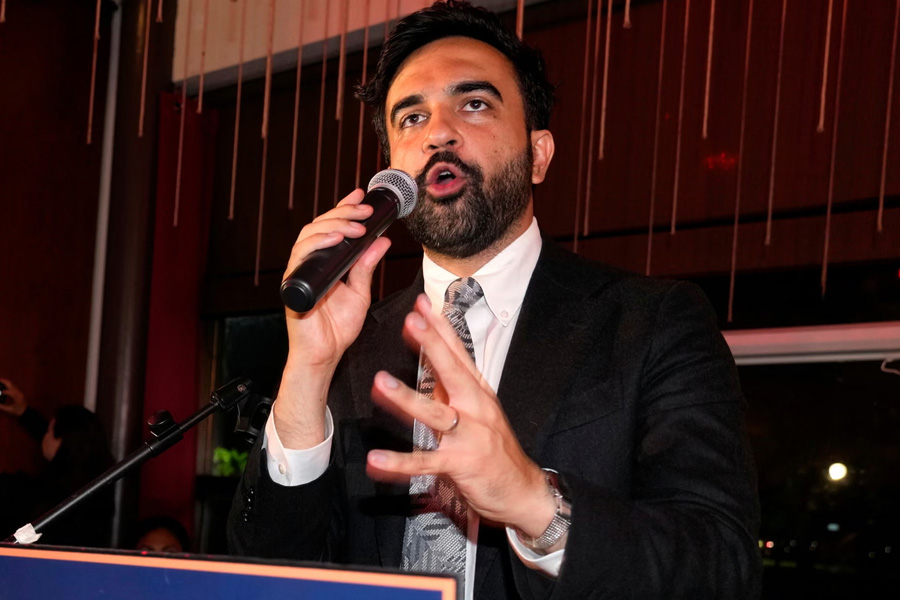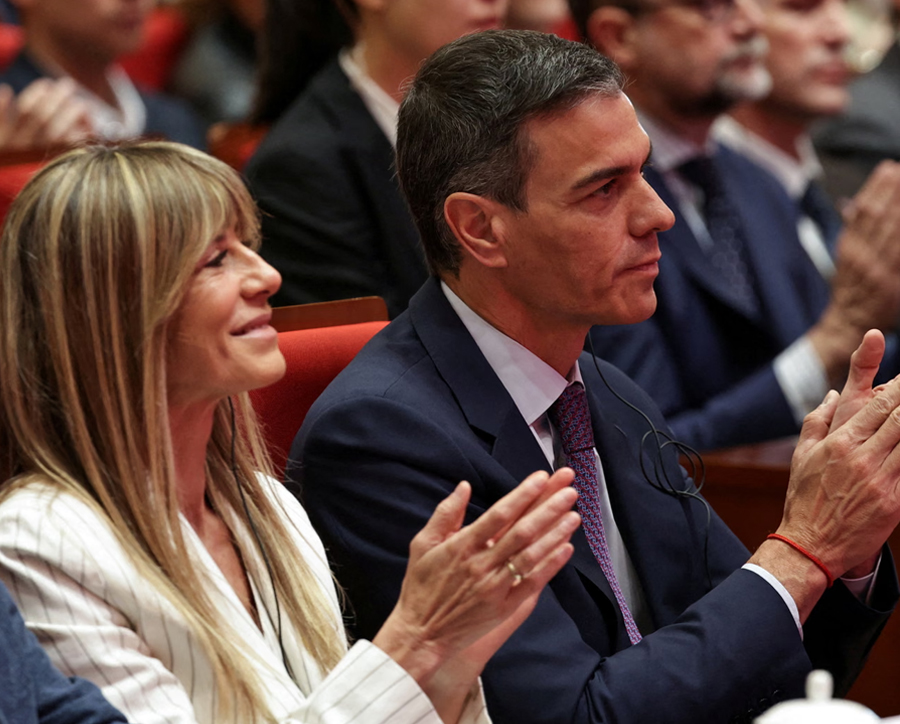
Begoña Gómez and Pedro Sánchez attend an event in Beijing in April. Sánchez's wife faces corruption charges and has been ordered to hand over her passport.
3 July 2026 | Madrid, Seville — Updated 16:30 GMT
The prospect of a national coalition between Spain's conservative People's party (PP) and its far-right Vox party has drawn closer still after the two groupings sealed another deal that will allow the PP to continue ruling the southern region of Andalucía.
The PP, which has governed the former socialist bastion for the past seven years, lost its absolute majority in May's regional election, forcing it to look to Vox to help it stay in power in Spain's most populous region.
The coalition agreement, signed on Thursday, explicitly guarantees "national priority in accessing public benefits" and rejects the immigration policies of Spain's socialist-led central government. It also says Andalucía will not accept any more unaccompanied migrant children.
Meanwhile, more than 1 million undocumented migrants and asylum seekers have applied to regularise their status in Spain under a government programme — double the expected number. Prime Minister Pedro Sánchez said: "Without immigration, Spain's GDP would be 19% lower in 2050."
In a damaging blow to Sánchez, Spain's supreme court has jailed the former transport minister José Luis Ábalos for 24 years for taking bribes on public contracts for sanitary equipment during the Covid pandemic.
Welcome to the latest from Spanish politics — where coalition deals, migration, and corruption scandals dominate the agenda.
🇪🇸 SPAIN POLITICS — THE NUMBERS: PP-Vox coalition in Andalucía • 53 PP seats, 15 Vox seats • 1 million+ migrants apply for regularisation • 500,000 expected applicants • €500m integration plan • Ábalos jailed 24 years • Koldo García jailed 19 years • 2.4 million applied for citizenship under memory law • 544,000 already approved.
PP and Vox Seal Andalucía Coalition Deal — 'National Priority' Policy Included
The prospect of a national coalition between Spain's conservative People's party (PP) and its far-right Vox party has drawn closer still after the two groupings sealed another deal that will allow the PP to continue ruling the southern region of Andalucía.
The PP, which has governed the former socialist bastion for the past seven years, lost its absolute majority in May's regional election, forcing it to look to Vox to help it stay in power in Spain's most populous region.
The incumbent PP regional president, Juan Manuel Moreno Bonilla, had hoped to govern alone in order to avoid depending on Vox, which has been seeking to drag the PP further to the right in regional coalitions by insisting Spaniards receive priority over foreign-born people for housing and public services.
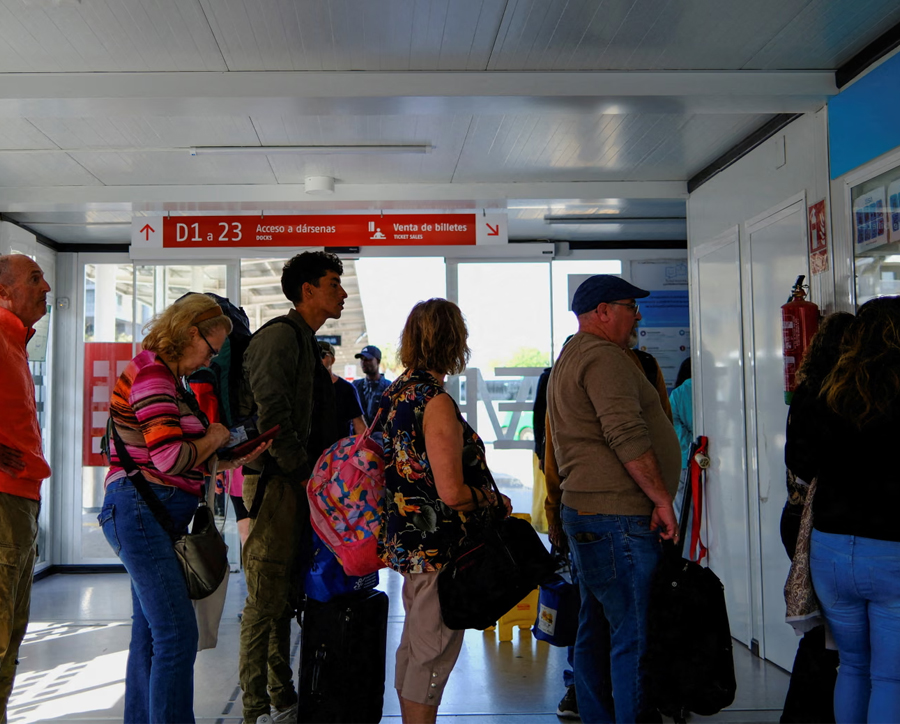
A young migrant (centre) queues in Almeria to buy a bus ticket to Valladolid, to obtain a vulnerability certificate to regularise migration status. More than 1 million migrants have applied for regularisation in Spain.
Although Moreno had rubbished Vox's so-called "national priority" policy as "a sensationalistic but empty slogan" during the campaign, the coalition agreement, signed on Thursday, explicitly guarantees "national priority in accessing public benefits". The agreement also rejects the immigration policies of Spain's socialist-led central government and says Andalucía will not accept any more unaccompanied migrant children.
Other priorities include opposing "the imposition of ideological agendas when it comes to caring for the environment", defending intensive livestock farming "in the face of criminalisation from the animal rights lobby and the climate policies developed in Brussels", and protecting and preserving bullfighting.
— Juan Manuel Moreno Bonilla, Andalucía's PP Regional President
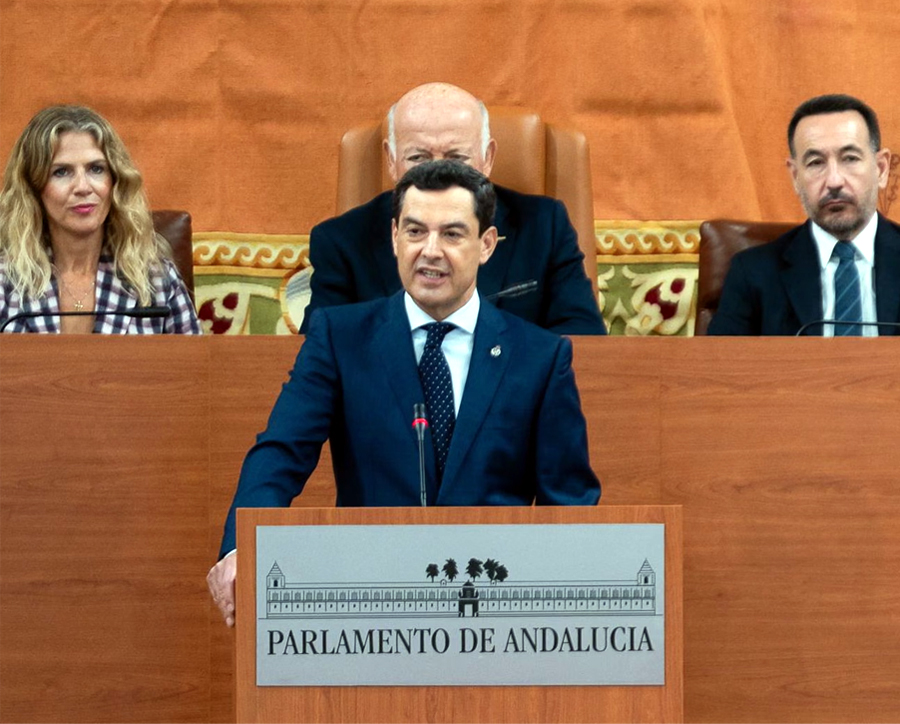
Andalucía's president, Juan Manuel Moreno Bonilla, speaking at the first session of his investiture debate in Seville last month. He hailed the coalition pact as a "sensible, fair and legal legislative agreement."
🇪🇸 ANDALUCÍA ELECTION RESULTS — MAY 2026
- PP: 53 seats (down from 58) — 1st place
- PSOE: 28 seats (down from 30) — worst ever result
- Vox: 15 seats (up 1) — coalition partner
- Adelante Andalucía: 8 seats (up from 2)
- Por Andalucía: 5 seats (held)
- Total seats: 109
- Coalition: PP + Vox = 68 seats (majority)
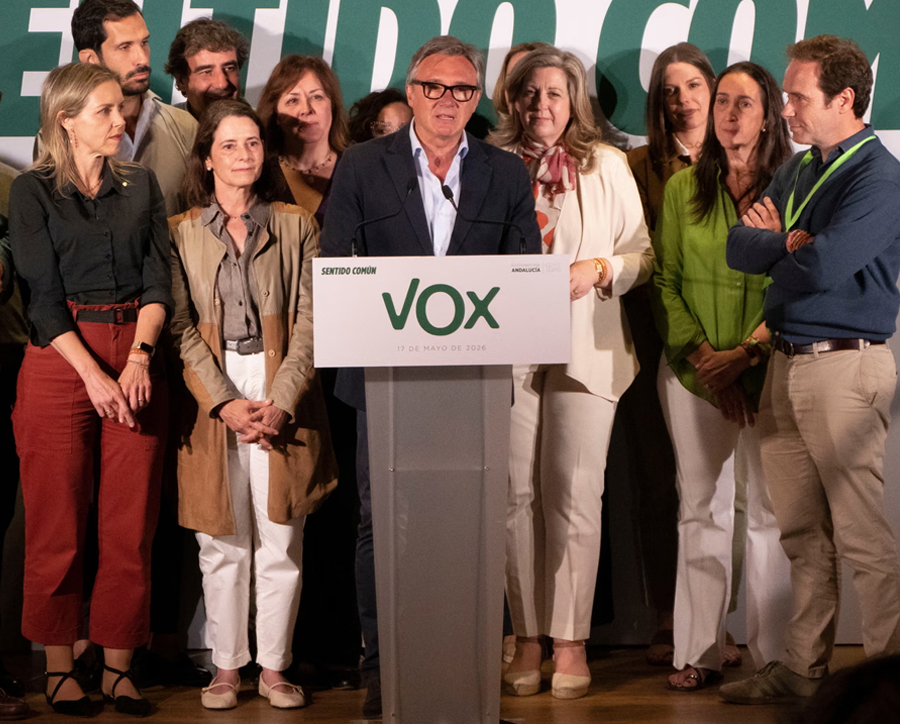
Vox's leader in Andalucía, Manuel Gavira, speaking at a press conference after the results of the regional elections in May. He will serve as a regional vice-president.
Vox's leader in Andalucía, Manuel Gavira – who will serve as a regional vice-president – said the deal would ensure a government "that defends common sense and improves the lives of the people of Andalucía".
May's regional election proved a disaster for the Spanish Socialist Worker's party (PSOE), which is led by the prime minister, Pedro Sánchez. It dropped from 30 seats to 28 in the 109-seat regional parliament – its worst ever result in Andalucía. The PP, despite finishing first, saw its seat count fall from 58 to 53, while Vox picked up another seat to finish with 15.
PP-Vox Coalition to Overturn Historical Memory Law
As in other regions where the PP and Vox govern in coalition – Extremadura, Aragón and Castilla y León – the new Andalucían government wants to overturn legislation that was introduced four years ago to bring "justice, reparation and dignity" to the victims of the civil war and the subsequent Franco dictatorship.
It intends to replace it with a so-called "harmony law", which the national government, historical memory associations and UN experts have all decried as a blatant attempt to whitewash, justify or eradicate the horrors of the Franco era.
Moreno hailed the coalition pact as a "sensible, fair and legal legislative agreement" that would bring four years of stability, while his boss, the national PP leader, Alberto Núñez Feijóo, paid tribute to the returning regional president's "commitment, capacity for dialogue, and vocation of service".
National Coalition Prospect Looms as Feijóo Refuses to Rule Out Vox Deal
The PP-Vox coalition in Andalucía comes as Sánchez's inner circle and his party are being battered by a series of corruption cases, and as Spain gears up for next year's general election. The polls suggest the PP will finish first but may struggle to secure an outright majority, leaving it dependent on Vox to govern nationally.
Feijóo has repeatedly refused to rule out a national coalition with Vox. In a recent TV interview, the PP leader – who was touted as the man who would bring the party back to the centre ground when he was appointed four years ago – said that while he hoped to govern alone, he had no intention of "demonising" Vox.
— Alberto Núñez Feijóo, PP National Leader
Feijóo's predecessor Pablo Casado was weakened by his inability to decide how to respond to growing competition from Vox. Despite relying on Vox to prop up three regional PP governments, he eventually turned on the far-right party in an incendiary speech to congress six years ago.
"You brag about being populists with your demagoguery that offers easy – and usually fake – solutions to complex problems," said Casado. "The People's party doesn't want to be another party of fear, of rage, of resentment and revenge, of insults and skirmishes, nor of manipulation, lies and backwards opposition."
One Million Migrants Apply to Regularise Status in Spain — Double Expected Number
More than 1 million undocumented migrants and asylum seekers have applied to regularise their status in Spain under a government programme to harness and defend the benefits of immigration at a time when most European countries are pulling up the drawbridge.
Although the massive regularisation initiative, announced by the socialist-led government in January, was originally intended to benefit about 500,000 people, it had attracted more than twice that number of applicants by the time the registration period ended on Tuesday.
The scheme offers a residence and work permit, initially valid for one year, to applicants who can prove that they do not have a criminal record and that they had lived in Spain for at least five months – or had sought international protection – before 31 December 2025.
— Pedro Sánchez, Prime Minister of Spain
Speaking in Madrid on Tuesday, Spain's prime minister, Pedro Sánchez, said the huge take-up of the programme revealed how sorely it was needed. "The fact that more than 1 million people submitted applications shows just how necessary this recognition of rights and responsibilities was," he said.
Sánchez said Spain needed immigration to grow economically, to tackle its demographic crisis and to finance its welfare state.
— Pedro Sánchez
He added that without immigration, Spain would be "poorer, emptier, weaker and without the resources to fund its welfare state."
🇪🇸 MIGRATION REGULARISATION — KEY NUMBERS
- Total applicants: 1 million+ (double the expected 500,000)
- Scheme announced: January 2026
- Registration deadline: 2 July 2026
- Residence permit: Initially valid for one year
- Requirements: No criminal record, lived in Spain for 5+ months before 31 Dec 2025
- Integration plan: €500m announced by Sánchez
- GDP impact (2050): 19% lower without immigration
Although similar extraordinary regularisation programmes have been introduced by previous socialist and conservative governments in Spain, the latest scheme has been fiercely criticised by the rightwing People's party (PP) and the far-right Vox party.
The PP has suggested the move will overwhelm Spain's public services, while Vox has claimed that Sánchez is trying to bring about "the demographic, social, labour and electoral transformation of Spain".
The PP regional governments of Valencia and Aragón have lodged appeals against the regularisation programme. On Tuesday, the court said it was considering asking the European court of justice whether aspects of the Spanish government's regularisation decree could be at odds with EU law.
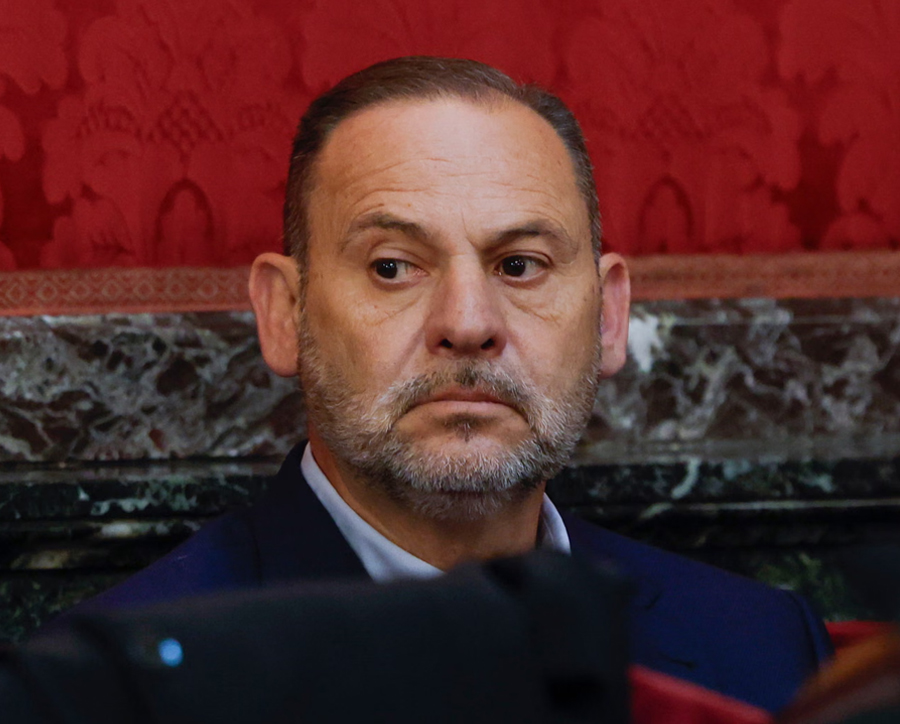
José Luis Ábalos attends a hearing in his supreme court trial in Madrid in April. The former transport minister has been jailed for 24 years for corruption.
Spanish PM's Former Right-Hand Man Jailed for 24 Years for Corruption
Spain's supreme court has jailed the former transport minister José Luis Ábalos for 24 years for taking bribes on public contracts for sanitary equipment such as face masks during the Covid pandemic.
Ábalos's aide, Koldo García, was jailed for 19 years in a trial that is one of several scandals to have enveloped the government of Pedro Sánchez over recent months.
The case is seen as particularly damaging for Sánchez because Ábalos was his trusted right-hand man for many years.
Ábalos and Koldo heard the sentencing via video-conference in the Madrid prison where they have both been held in preventive custody since November.
Presided over by seven judges, the court heard evidence from public officials, civil servants, expert witnesses and police, and found Ábalos and García guilty of being part of a criminal organisation, bribery, misuse of public funds, money laundering and influence peddling.
— Supreme Court ruling
Víctor de Aldama, a businessman linked to the scandal was also jailed for four and half years on Monday, but his sentence was suspended because he had cooperated with the court. Nor will he have to hand back the €3.7m (£3.2m) he received in commissions over the procurement of masks.
Ábalos is the fifth government minister to be jailed since Spain's transition to democracy in 1978.
⚖️ ÁBALOS CORRUPTION CASE — KEY DETAILS
- José Luis Ábalos: 24 years imprisonment (former transport minister)
- Koldo García: 19 years imprisonment (Ábalos's aide)
- Víctor de Aldama: 4.5 years (suspended, cooperated with court)
- Crimes: Criminal organisation, bribery, misuse of public funds, money laundering, influence peddling
- Context: Bribes on Covid-era public contracts for face masks and sanitary equipment
- Status: Fifth government minister jailed since 1978
- Commission: €3.7m received by Aldama (not returned)
Sánchez's Wife Ordered to Hand Over Passport as Corruption Cases Mount
The sentencing comes two days after a separate court ruled that Sánchez's wife, Begoña Gómez, who faces corruption and influence-peddling charges, is a flight risk and must hand over her passport.
Gómez is awaiting trial over accusations she used her influence as the prime minister's wife to secure sponsors for a university master's degree course she ran, and that she used state funds to pay her assistant for help with personal matters. The case was triggered by a complaint from the rightwing pressure group Manos Limpias, which translates as Clean Hands.
Gómez lives in the Moncloa palace, which is the seat of government and probably one of the most secure buildings in Spain, but the judge Juan Carlos Peinado said members of her security detail might help her to escape.
This in turn has led Spain's judicial watchdog, the General Council for Judicial Power, to take disciplinary action against Peinado for the "serious offence" of impugning the integrity of public servants, in this case, Gómez's personal protection agents.
Spain's national police also released a rare statement calling the judge's reasoning unjustified and stressing the force's political neutrality.
The government has denounced Peinado for what it described as his obsession with Gómez who, even if found guilty, would apparently have derived no personal benefit from the alleged influence peddling.
Sánchez has not been named in any of the cases, but his brother, David, is on trial over allegations that he was handed a bespoke job by the Socialist-led council of the south-western town of Badajoz in July 2017, when his brother was the national leader of the party but not yet prime minister.
Gómez and David Sánchez have denied any wrongdoing, and the prime minister has said his family have been the victims of a harassment and bullying operation.
🇪🇸 SPAIN POLITICS: THE NUMBERS THAT DEFINE THE MOMENT
📊 ANDALUCÍA ELECTION RESULTS (MAY 2026)
53 seats
Down from 58
28 seats
Down from 30
15 seats
Up 1
8 seats
Up from 2
5 seats
Held
📋 MIGRATION REGULARISATION
🗣️ KEY VOICES
Pedro Sánchez:
"Without immigration, Spain's GDP would be 19% lower in 2050."
Alberto Núñez Feijóo:
"If we need to make a deal for a coalition government, we'll sit down and we'll form a government coalition."
Juan Manuel Moreno Bonilla:
"A sensible, fair and legal legislative agreement that would bring four years of stability."
Supreme Court Ruling:
"The seriousness of the charges derives from the fact that they erode the fundamentals of a democratic state."
⚖️ CORRUPTION CASES
📜 HISTORICAL MEMORY LAW
🇪🇸 THE FINAL VERDICT: SPAIN AT A CROSSROADS
✅ WHAT'S HAPPENING:
- PP-Vox coalition sealed in Andalucía
- 1 million migrants apply for regularisation
- Sánchez defends immigration as economic necessity
- Ábalos jailed 24 years for corruption
- Feijóo refuses to rule out national Vox coalition
⚠️ THE CHALLENGES:
- National coalition prospect with far-right
- Historical memory law under threat
- Corruption scandals engulf Sánchez
- Gómez passport seized, awaiting trial
- PP-Vox reject migration policies
- General election looming next year
"If it turns out that we need to make a deal for a coalition government, we'll sit down and we'll form a government coalition," PP leader Feijóo said, as his party sealed a deal with Vox in Andalucía. The coalition agreement includes "national priority" in public benefits and rejects Spain's migration policies. Meanwhile, 1 million migrants applied for regularisation — double the expected number — as Sánchez warned Spain would be "poorer, emptier, weaker" without immigration. Former transport minister Ábalos was jailed for 24 years for Covid-era corruption, and Sánchez's wife had her passport seized. Spain stands at a crossroads — with the far-right ascendant, corruption scandals multiplying, and migration policy dividing the nation.
— Spain Politics Analysis
Stay updated with the latest Spanish politics, European news, and migration policy on our Europe Page.