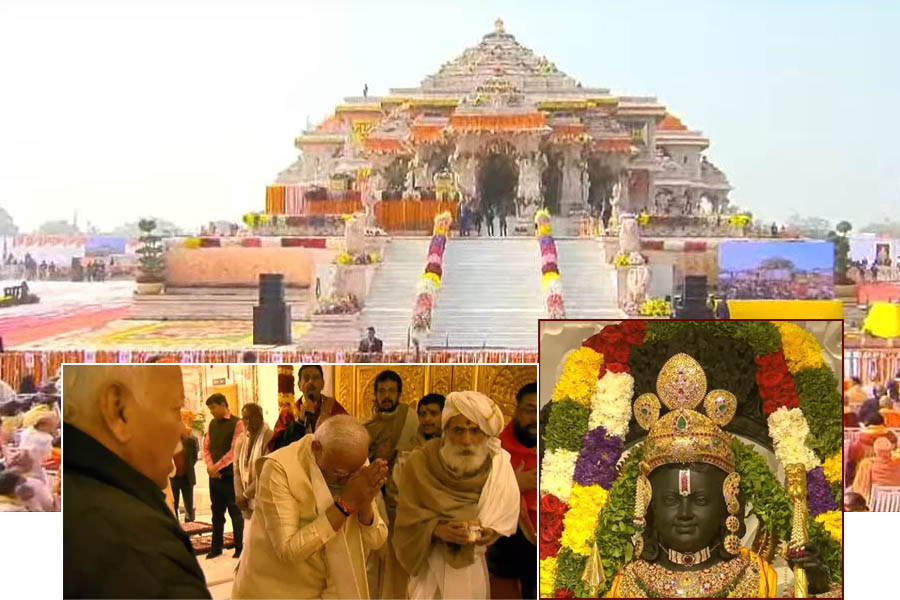
Prime Minister Narendra Modi at the Pran Pratishtha ceremony — A historic moment blending faith and statecraft
The Historic Consecration: Ending a 500-Year Wait
On January 22, 2024, the historic inauguration of the Ram Temple in Ayodhya marked a monumental moment in Indian history. Prime Minister Narendra Modi celebrated the consecration of the Ram Lalla idol, signaling the end of Lord Ram's tenure in a temporary shelter and the beginning of his residence in a splendid temple. However, beneath the grandeur of this event lies a complex blend of religious fervor, political strategy, and the challenges faced by the ruling Bharatiya Janata Party (BJP).
PM Modi's address during the consecration emphasized the fulfillment of a centuries-old wait and the collective patience and sacrifices that led to this momentous occasion. The city of Ayodhya, central to the story of Lord Ram, has been a focal point for the BJP's political aspirations since the late 1980s. The construction of the Ram Temple is not just a religious landmark but also a strategic move by the BJP to appeal to its electoral base.
Political Triumph and Electioneering: The 2024 Campaign Launchpad
Unofficially, the consecration serves as the launch of the BJP's campaign for the upcoming national election. PM Modi's call for all Indians to celebrate the temple's inauguration by lighting lamps echoes Hindu traditions, but it raises questions about the inclusivity of such celebrations in a diverse nation where not all citizens identify with Hinduism. The guest list, dominated by BJP leaders and affiliated Hindu nationalist groups, reflects the party's alignment with Hindutva, seeking to create a national identity based on Hindu-ness.
Electoral Strategy: Hindutva as Organizing Principle
The Ram Mandir is the most visible fruit of a three-decade-long mobilization around the Ram Janmabhoomi movement. For BJP, it serves as both an emotional climax and a powerful voter consolidation tool in the crucial Hindi heartland states — Uttar Pradesh, Madhya Pradesh, Rajasthan, and beyond — where over 40% of Lok Sabha seats are located.
Economic Transformation: Ayodhya's Development Boom
Ayodhya's transformation extends beyond religious symbolism. The BJP aims to boost the local economy with substantial investments in development schemes, including a new airport and railway station. Plans for the city include becoming a tourist hotspot with a Ram "experience center," a fountain park, hotels, and "patriotic" wedding venues. This blend of economic development and Hindu revivalism forms a potent narrative for the BJP, appealing to voters in Hindi-speaking northern and central India.
• Maharishi Valmiki International Airport — operational (₹1,400 crore investment)
• New Ayodhya Dham Junction railway station — revamped at ₹240 crore
• ₹32,000 crore tourism and infrastructure pipeline announced
• Expected to attract 5+ crore pilgrims annually within 5 years
Challenges & Opposition: The Secularism Debate
While the BJP frames the Ayodhya ceremony as the culmination of a 500-year struggle for Hindus, not everyone sees it as a victory. Business tycoons and Bollywood stars attend to flatter Modi, but opposition politicians, including some Hindu priests, are notably absent. Critics argue that Modi's intertwining of religion, government, and electioneering undermines India's secular constitution and campaign rules, raising concerns about authoritarian tendencies.
BJP's Strengths and Electoral Dominance
The BJP's success is attributed not only to its ideological appeal but also to PM Modi's popularity, organizational efficiency, and adept use of media and technology. However, concerns about eroding democratic institutions, communal tensions, and potential authoritarianism persist. Despite the BJP's electoral dominance, its vote share has not surpassed 40%, indicating a polarized political landscape.
Vote Share Reality (2019 Lok Sabha)
BJP: 37.4% | Congress: 19.5% | Others: 43.1% — A reminder that despite 303 seats, 60%+ voters chose non-BJP parties. The Ram Mandir factor aims to consolidate Hindu votes beyond this threshold.
Opposition Dynamics: Fragmented and Struggling
The opposition, primarily led by the Congress party, faces internal challenges, with an ageing leadership and a lack of unity. While the BJP's organizational edge and efficient use of media contribute to its success, the opposition struggles to present a cohesive message. Issues such as economic missteps, pandemic response, and cronyism could be potential electoral talking points, but the opposition needs strategic alignment and charismatic leadership to mount a formidable challenge.
From Gujarat to Ayodhya: Modi's Vision for a 'New India'
From Gujarat to Uttar Pradesh, Prime Minister Narendra Modi has successfully translated social influence and development promises into tangible reality. As India approaches the next national election, the Ayodhya Ram Mandir inauguration stands as both a symbol of religious significance and a strategic move by the BJP. The intersection of religion and politics poses challenges to the secular fabric of the nation, while economic development efforts in Ayodhya contribute to the BJP's narrative of building a prosperous, confident new India. The opposition's ability to address these challenges and present a compelling alternative will shape the political landscape in the coming years.
Global Post Headline — independent political and cultural analysis. globalpostheadline.com | Updated: June 2025