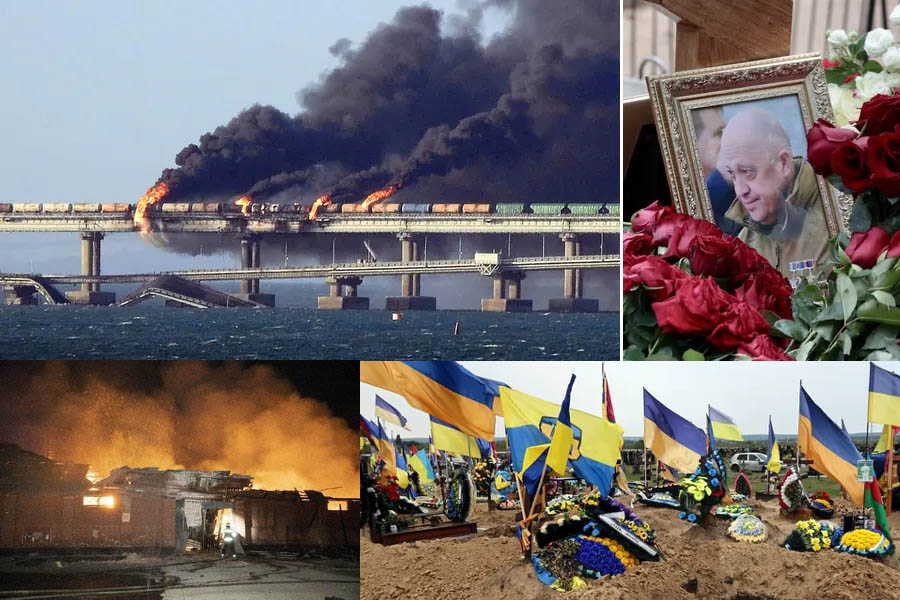
Russia-Ukraine War: Headline Stories from the Battlefield and the Global Stage — Counteroffensive Challenges, Diplomatic Maneuvers, and the Road Ahead
The Russia-Ukraine conflict continues to escalate, with both sides engaged in complex military maneuvers across a 1,000-kilometer front line. The international community faces growing pressure to support Ukraine's military efforts as the path to a negotiated settlement becomes increasingly uncertain. Ukraine's ability to overcome Russian defenses and achieve a breakthrough remains a pivotal factor in the conflict's outcome. As the war continues to unfold, recent developments on the battleground and diplomatic front have garnered international attention. In this comprehensive report, we delve into key stories that shed light on the evolving situation in Ukraine and its broader implications for global security.
🛡️ Ukraine's Struggle to Overcome Russian Defenses
Ukrainian forces are facing formidable Russian defensive structures as they attempt to make progress in the conflict. These defenses include trenches, anti-tank ditches, and concrete obstacles known as "dragon's teeth" — pyramid-shaped concrete barriers designed to channel armored vehicles into kill zones. While Ukrainian troops have made modest gains in the Zaporizhzhia region, advancing several kilometers through minefields and under constant artillery fire, significant obstacles lie ahead. The article highlights that advancing further into Russian-occupied territory is essential to cut off critical supply lines and achieve a breakthrough in the conflict.
The Russian defensive lines, built over months of preparation, consist of multiple layers stretching up to 30 kilometers deep. Ukrainian sappers have worked tirelessly to clear minefields, but progress has been slow. Western-supplied mine-clearing equipment has helped, but the sheer density of mines — in some areas, up to 5 per square meter — has made rapid advances impossible. Ukrainian commanders have acknowledged the difficulty of the task, comparing it to "eating a porcupine one quill at a time."
⚠️ Russia Takes Risks to Prevent Ukrainian Breakthrough, UK Ministry of Defence Warns
In a recent intelligence update, the UK Ministry of Defence has expressed concerns about Russia's strategy in southern Ukraine. Ukrainian forces continue to make offensive moves on the Orikhiv axis, reaching the first Russian main defensive line. The ministry pointed out that Russian forces are now divided, with a significant presence around Kupiansk in the north. This division could be a tactic to divert Ukrainian forces and prevent their counteroffensive. The situation remains tense as both sides maneuver in this critical region.
Russian forces have launched a significant offensive operation in the Kupiansk direction, attempting to recapture territory lost during Ukraine's 2022 Kharkiv counteroffensive. The Kremlin appears to be gambling that pressure in the north will force Ukraine to divert troops from the southern front, slowing the main counteroffensive. Ukrainian officials have acknowledged the intensity of the fighting around Kupiansk but claim to have held the line. The outcome of this northern push could determine whether Ukraine can maintain momentum in the south.
🤝 Russia's President Putin and Turkey's President Erdogan to Meet in Sochi
Russian Foreign Minister Sergei Lavrov has announced an upcoming meeting between President Vladimir Putin and his Turkish counterpart, Recep Tayyip Erdoğan. This meeting is set to take place in Sochi, Russia, on September 4th, with discussions primarily focused on Black Sea grain exports and the development of a "gas hub" in Turkey. The talks reflect Russia's efforts to secure its energy exports amid disruptions caused by the ongoing conflict and Western sanctions.
The Black Sea Grain Initiative, brokered by Turkey and the UN in July 2022, expired in July 2023 after Russia withdrew, complaining that its own grain and fertilizer exports remained受阻 by Western sanctions. Since then, global grain prices have risen, raising concerns about food security in developing nations. Turkey has been attempting to revive the deal, with Erdogan positioning himself as a mediator between Russia and the West. The Sochi meeting may determine whether a new grain agreement is possible — and whether Turkey can maintain its delicate balancing act between NATO obligations and economic ties with Russia.
Additionally, the proposed "gas hub" in Turkey would allow Russia to reroute natural gas exports that previously flowed through the Nord Stream pipelines, which were damaged by explosions in September 2022. If successful, Turkey could become a major energy hub for Europe, though the plan faces significant technical and political hurdles.
🗣️ Ukrainian Foreign Minister Rebukes Critics of Counteroffensive
Dmytro Kuleba, Ukraine's foreign minister, strongly responded to critics of Kyiv's counteroffensive strategy during a meeting of EU foreign ministers in Toledo, Spain. He emphasized the sacrifices of Ukrainian soldiers and urged critics to understand the challenges they face. "I would recommend all critics to shut up," Kuleba said bluntly. "Come to Ukraine and try to liberate one square meter yourselves."
Kuleba also highlighted the need for a united front and increased support from the international community to effectively counter Russia's invasion. He criticized those who suggest that Ukraine should accept territorial losses in exchange for peace, calling such proposals "appeasement" that would only encourage further Russian aggression. His remarks came as some Western officials have reportedly begun discussing the possibility of a frozen conflict and territorial concessions — ideas that Kyiv vehemently rejects.
"The only way to end this war is to defeat Russia on the battlefield," Kuleba said. "Any other outcome would be a victory for aggression and a defeat for international law."
🕊️ Pressure Mounts for Peace Talks Amid Ongoing Conflict
As the Ukraine-Russia conflict continues, pressure for peace talks is increasing, particularly as Ukraine's military faces challenges in making significant breakthroughs. However, the article emphasizes that the Kremlin demands nothing short of Kyiv's total capitulation — including recognition of Russian sovereignty over occupied territories and a commitment to neutrality — making a negotiated settlement seem increasingly unlikely. International leaders are urged to recognize this reality and focus on supporting Ukraine's military efforts rather than pushing for premature negotiations.
Some Western officials, including US Chairman of the Joint Chiefs General Mark Milley, have suggested that neither side can achieve a complete military victory and that the war may ultimately end at the negotiating table. But Ukrainian officials argue that negotiating from a position of weakness would only reward Russian aggression. "We will talk when Russia is ready to withdraw from all of our territory," Zelensky has repeatedly said. "Not before."
The path to peace remains blocked by fundamentally incompatible objectives: Ukraine demands the restoration of its 1991 borders; Russia demands recognition of its territorial gains. Until one side's position changes — or until the military situation shifts decisively — the war will continue. The question is not whether it will end, but at what cost in human lives.
📊 The Bigger Picture: A Conflict at a Crossroads
The Russia-Ukraine war continues to be a dynamic and complex conflict with far-reaching consequences. Recent developments on both the military and diplomatic fronts underscore the urgent need for international attention and concerted efforts to bring about a resolution. The path forward remains uncertain, but the determination of the Ukrainian people and the international community's response will play a crucial role in shaping the outcome.
As winter approaches — historically a period of reduced military activity — both sides are likely to use the coming months to regroup, resupply, and prepare for renewed offensives in the spring. The coming year will test Ukraine's ability to sustain its war effort, Russia's ability to replenish its depleted forces, and the West's willingness to continue providing military and financial support. The Ukraine war is not just a regional conflict; it is a defining struggle for the future of European security and the rules-based international order.
Related Coverage: For more on the Russia-Ukraine war, visit Russia-Ukraine War Hub and Russia-Ukraine War: Recent Escalations Analysis.
Global Post Headline — independent coverage of the Russia-Ukraine war and global geopolitics. globalpostheadline.com | Follow updates: War News | Politics

Experience the Himalayas with expert Sherpa guides. Trekking, expeditions, and cultural tours in Nepal, Tibet & Bhutan.
Plan Your Nepal Trip →
Authentic Nepali crafts, pashmina, singing bowls — worldwide shipping.