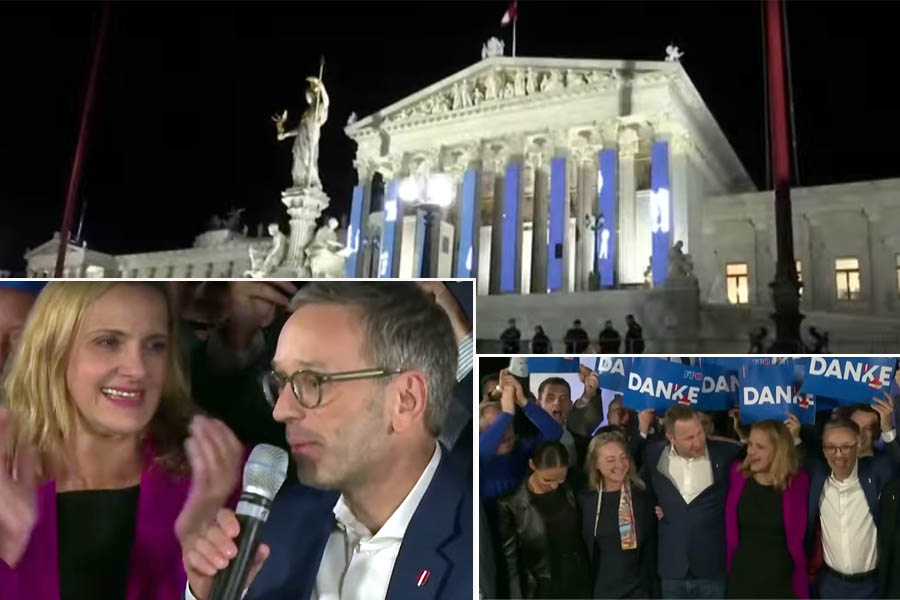
Austria's Far-Right Freedom Party Election Victory Shocks Europe — FPÖ Secures Historic Win as Populist Wave Continues
Vienna, Austria – On September 29, 2024, Austria's political landscape shifted dramatically, sending shockwaves across Europe. In a historic and widely anticipated outcome, the far-right Freedom Party of Austria (FPÖ), led by Herbert Kickl, claimed victory with 28.8% of the vote — its strongest result ever. This result not only eclipsed the centre-right People's Party (ÖVP), which garnered 26.3%, but also signaled a broader transformation in European politics. For the first time since World War II, a far-right party has won a national election in Austria, reflecting the growing disillusionment with mainstream politics across the continent.
The result represents a stunning comeback for a party that was mired in scandal and forced from government in 2019. The FPÖ's resurgence has been fueled by voter anger over inflation (which hit 7.5% in 2024), immigration concerns, and a general sense that traditional parties have failed to address everyday economic struggles.
📊 The Lead-Up: A Race Against Expectations
For weeks leading up to the election, pollsters and analysts predicted the FPÖ's strong performance, yet few anticipated the scale of its victory — or the collapse of the SPÖ. Austria's political arena was dominated by contentious issues like rising living costs, immigration, and national identity — all of which the FPÖ successfully exploited. With a hardline anti-immigrant, anti-Islam, and Eurosceptic platform, Kickl fashioned himself as Austria's version of Hungary's Viktor Orbán, pledging to implement policies that mirror those in Budapest, including the closure of mosques, suspension of asylum rights, and referendums on EU membership.
The FPÖ's campaign slogan — "Fortress Austria" — resonated with voters concerned about a perceived loss of national sovereignty. Kickl's promise to build border fences reminiscent of Hungary's, deport rejected asylum seekers, and reduce social benefits for migrants struck a chord in a country that has absorbed over 200,000 refugees since 2015.
Despite Austria's centrist and left-wing factions working to distance themselves from the FPÖ, they were no match for the nationalist and populist wave sweeping the country. The Social Democrats (SPÖ), Austria's oldest political party, fell to a humiliating 20% — its worst result in history. The collapse of the SPÖ, which once commanded 40% of the vote, reflects the erosion of traditional working-class loyalties in favor of identity-driven politics. Meanwhile, the liberal NEOS party and the Greens each managed 9%, securing enough to stay in parliament but with little influence on the looming power struggle.
🔄 The Aftershock: Coalition Chaos in Vienna
As Austria awoke to the FPÖ's first-place finish, all eyes turned to President Alexander Van der Bellen — a former Green Party leader and vocal critic of the far-right — who must now choose which party to task with forming a government. The road ahead is far from clear. While the FPÖ emerged victorious, its extreme positions, particularly on immigration, the European Union, and Russia, make it a controversial partner for any mainstream party.
The ÖVP, led by Chancellor Karl Nehammer, has categorically refused to form a coalition with the FPÖ under Kickl, recalling his tenure as Austria's interior minister from 2017 to 2019 — a period marred by scandal and international ostracism. In the "Ibiza affair," former FPÖ leader Heinz-Christian Strache was filmed offering government contracts to a purported Russian oligarch, leading to the collapse of the ÖVP-FPÖ coalition. Nehammer has called Kickl a "security risk" and a "conspiracy theorist."
However, Nehammer's position is precarious. Despite finishing second, he could still seek to form a coalition with the SPÖ and either the Greens or NEOS. Yet, such a three-party alliance would likely be fragile, especially given the ideological gaps between the SPÖ's center-left economics and Nehammer's economically conservative policies. The SPÖ has already signaled that it would demand significant policy concessions, including higher taxes on the wealthy and increased social spending.
Political scientist Peter Filzmaier suggests that Nehammer's chances of remaining chancellor are "slim but not impossible." The most likely scenarios are either a grand coalition of ÖVP and SPÖ (which would require both to swallow their pride) or a minority ÖVP government that relies on case-by-case support from the FPÖ — a precarious arrangement that would give Kickl veto power over legislation.
👤 The Herbert Kickl Factor: A Would-Be Autocrat?
Herbert Kickl's victory is more than a political win — it is an ideological triumph for Europe's far-right. Often described as a cerebral strategist, Kickl has long idolized Viktor Orbán's brand of illiberal democracy. His FPÖ platform, entitled "Fortress Austria," calls for the end of political asylum and a strict anti-immigration policy — proposals that blatantly defy European Union rules and would likely trigger legal challenges from Brussels.
Kickl's rhetoric is laced with historical and nationalist undertones. His use of the term "Volkskanzler" (people's chancellor) echoes Adolf Hitler's rise to power, a deliberate nod to Austria's Nazi past that resonates with his base while alarming democratic watchdogs. Although Kickl has tried to modernize the FPÖ's image, its roots as a party founded by former Nazis in the 1950s continue to stir controversy. Just before the election, a video surfaced of FPÖ members singing an SS anthem at a funeral, further amplifying concerns about the party's far-right extremism.
Yet, Kickl is playing the long game. Even if the FPÖ remains in opposition — a likely outcome if other parties freeze him out — Kickl is expected to leverage his position to polarize Austria's political landscape further. His supporters are fiercely loyal, and his strategy of stoking anti-elite sentiment mirrors populist movements across Europe. For him, this election is not the end but the beginning of a more profound political realignment in Austria.
🌍 European Implications: A Continent on Edge
The FPÖ's win is not an isolated incident but part of a broader right-wing resurgence across Europe. Countries like Hungary (Fidesz), Italy (Brothers of Italy), the Netherlands (PVV), Sweden (Sweden Democrats), and France (National Rally) are already witnessing the rise of populist parties, some of which are now in government. Austria's election confirms that far-right ideas are no longer on the fringe; they are becoming mainstream.
In 2000, when the FPÖ first entered a coalition with the ÖVP, the European Union attempted to diplomatically isolate Austria — a move that failed and now feels anachronistic. In today's Europe, where migration, economic instability, and national sovereignty dominate the agenda, many voters see populist leaders as the only ones willing to address their concerns. Brussels has learned that isolation only strengthens the far-right by allowing them to claim victimhood.
The FPÖ's rise will also complicate Austria's relations with its European neighbors. Kickl's pro-Kremlin stance and opposition to sanctions against Russia — he has called EU sanctions "useless" and met with Russian diplomats — along with his skepticism of the European Union, are likely to strain Austria's role within the EU. Moreover, Austria's participation in the German-led European Sky Shield initiative, which Kickl vehemently opposes, raises questions about the future of Austria's defense policies and its role in Europe's security framework.
EU leaders are watching closely. French President Emmanuel Macron called the result "concerning," while German Chancellor Olaf Scholz urged Austrian democrats to "stand firm." However, the success of far-right parties in recent European Parliament elections — where ID group made significant gains — suggests that Austria is not an outlier but a trend.
🔮 What's Next for Austria? Three Scenarios
Scenario 1: ÖVP-SPÖ Grand Coalition — The traditional center-left/center-right alliance that governed Austria for decades. Requires both parties to overcome mutual distrust. Unlikely but possible if President Van der Bellen exerts pressure. Would be deeply unpopular with voters who rejected both parties.
Scenario 2: ÖVP-FPÖ Coalition under Kickl — Currently ruled out by Nehammer, but a change in party leadership could change the calculus. If Nehammer falls, his successor might be more willing. This would be the most radical outcome, likely triggering EU sanctions concerns.
Scenario 3: FPÖ Minority Government — If Van der Bellen invites Kickl to form a government, he could attempt a minority administration. Would require case-by-case support from the ÖVP or SPÖ. Highly unstable, likely leading to new elections within two years.
For now, Austria is in a holding pattern. President Van der Bellen has signaled he will take time to consult with all parties before making a decision. The most likely interim outcome is a caretaker ÖVP government continuing to run the country while coalition negotiations drag on for weeks or even months — a repeat of the 2017-2019 deadlock that preceded the last FPÖ coalition.
📝 Conclusion: A Moment to Remember
Austria's 2024 election is not just a national event; it's a bellwether for Europe's future. The rise of the FPÖ signals that the far-right is no longer a fringe movement but a formidable force in shaping modern politics — capable of winning elections, setting agendas, and forcing mainstream parties to adopt their language on migration and sovereignty.
As Austria navigates this political earthquake, the rest of Europe watches with bated breath, wondering if this is a sign of things to come or a temporary detour from the liberal democratic order. What is certain is that the days of centrist consensus in European politics are over. Populism is here to stay — and Austria has just become its latest laboratory.
This election will be remembered as a turning point — a moment when Austria, and perhaps Europe, stood on the precipice of a new political era. The decisions made in Vienna over the coming weeks will echo across the continent.
Related Coverage: For more on European political shifts, visit Friedrich Merz's Leadership Prospects in Germany and UK-Europe News Hub.
Global Post Headline — independent coverage of European politics and global affairs. globalpostheadline.com | Follow updates: Europe News | Politics Section

Experience the Himalayas with expert Sherpa guides. Trekking, expeditions, and cultural tours in Nepal, Tibet & Bhutan.
Plan Your Nepal Trip →
Authentic Nepali crafts, pashmina, singing bowls — worldwide shipping.