Bashar al-Assad: Syria's Political Shift and Global Alliances — Fall of Damascus Reshapes Middle East Power Dynamics
Damascus, Syria – The fall of Damascus marks a seismic shift in the Middle East, igniting waves of uncertainty, opportunity, and risk. The collapse of Bashar al-Assad's regime after nearly 14 years of civil war has not only redrawn Syria's political landscape but also reshaped regional and global alliances, presenting a series of cascading consequences that will reverberate from Tehran to Moscow to Tel Aviv.
The lightning offensive by Hayat Tahrir al-Sham (HTS) forces, which swept through Aleppo, Hama, Homs, and finally Damascus in just 11 days, caught virtually every intelligence agency by surprise. Assad, who had been propped up for years by Russian airpower and Iranian ground forces, found his defenses crumbling as his allies were distracted by other conflicts: Russia by its war in Ukraine, and Hezbollah by its devastating confrontation with Israel.
🇷🇺 Assad's Denial and Russia's Moves: A Strategic Withdrawal
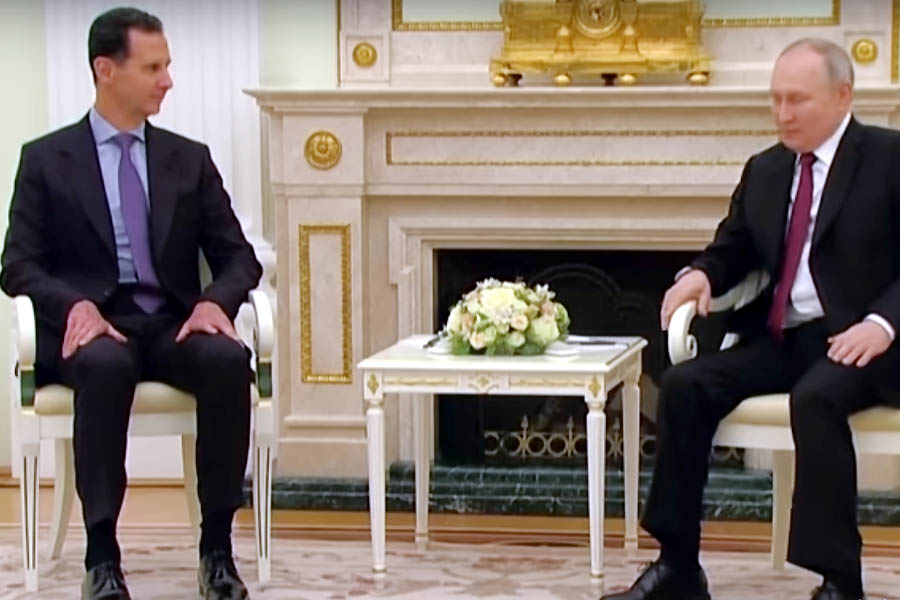
Eight days after Damascus fell to Hayat Tahrir al-Sham (HTS) forces, Bashar al-Assad broke his silence, issuing a statement from Moscow denying that he fled Syria, claiming instead that he was directing operations from Russia's Hmeimim airbase until the final hours. Yet, satellite images of Russian forces dismantling their military installations in Syria — including the removal of S-400 air defense systems and the evacuation of naval assets from Tartus — tell a very different story. The swift evacuation of critical assets suggests Moscow is recalibrating its Middle Eastern strategy amid Assad's political demise.
Russia's potential withdrawal from its Syrian bases — its only Mediterranean naval facility and a key air hub for Africa operations — would represent a major strategic loss for President Vladimir Putin. However, reports indicate that Moscow is negotiating with Syria's new transitional government to retain access to its bases, offering reconstruction aid and diplomatic recognition in exchange. The outcome of these talks will determine whether Russia remains a major player in the Levant or suffers a historic humiliation.
The implications of Russia's diminished presence are profound: Moscow's reduced footprint may embolden Islamist factions, destabilize neighboring states (including Lebanon and Jordan), and disrupt Iran's regional supply lines to Hezbollah. For the United States, a weakened Russia in the Middle East presents both opportunities and risks — less Russian influence, but potentially greater chaos.
🇮🇷 Iran on the Defensive: The Loss of a Key Ally
The loss of Assad — Tehran's staunchest Arab ally — represents a staggering blow to Iran's regional influence. Syria was a critical conduit for Iranian arms to Hezbollah in Lebanon, a frontline in Iran's struggle against Israel, and a key node in Tehran's "Axis of Resistance." The collapse of Assad's regime threatens to isolate Iran further, especially as it faces mounting domestic and international pressures, including a struggling economy and protests over mandatory hijab laws.
Iran's Supreme Leader, Ayatollah Ali Khamenei, framed the fall of Assad as a joint U.S.-Israeli conspiracy, vowing that the "resistance front" would persevere despite this setback. "The enemies should know that the axis of resistance will not break," Khamenei said in a televised address. However, with Israel ramping up covert operations against Iranian assets in Syria and Gulf states solidifying ties with the West, Iran's options appear increasingly constrained.
Observers speculate that Tehran may accelerate its nuclear program in a bid to reclaim strategic leverage — a move that would trigger a renewed crisis with the West and Israel. The International Atomic Energy Agency (IAEA) reported this month that Iran has already tripled its production of near-weapons-grade uranium. Western powers have warned that Tehran is "playing with fire."
🇮🇱 Israel's Strategic Calculus: Doubling Down in the Golan
Israel, quick to capitalize on the situation, announced plans to double its settlements in the Golan Heights while establishing a "sterile defensive zone" in southern Syria. Prime Minister Benjamin Netanyahu's rhetoric underscores a broader strategy to reshape Israel's regional standing and preempt any future threats from a potentially hostile Syrian government.
"The Golan Heights will remain an inseparable part of Israel for eternity," declared Netanyahu, who framed the developments as an opportunity to strengthen Israel's security and economic foothold. "We will never allow a hostile force to establish itself on our border." The move has drawn sharp criticism from the United Nations and Arab states, which consider the Golan occupied territory under international law.
However, critics warn that these moves risk inflaming tensions with Syria's transitional government, led by interim Prime Minister Mohammed al-Bashir. The new Syrian leadership has condemned Israeli incursions and vowed to "liberate every inch of Syrian territory." While Israel maintains military superiority, a prolonged guerrilla conflict on its northern border — similar to what it has faced in Lebanon — would be a costly outcome.
🏛️ A Fragile Transitional Government: Can HTS Govern?
HTS's formation of a transitional government under Mohammed al-Bashir — a relatively unknown figure with a background in engineering and local governance — has sparked cautious optimism and deep skepticism. The group's Islamist roots and UN designation as a terrorist organization complicate international recognition. The United States, European Union, and United Nations have all listed HTS as a terrorist entity due to its former affiliation with Al-Qaeda.
Yet, countries like Qatar have reopened diplomatic channels, signaling a potential shift in how the global community engages with Syria's new leadership. Turkey, which has supported some opposition factions, has hinted at supporting reconstruction efforts. Still, questions about HTS's ability to govern a fractured nation — and its commitment to democratic norms, minority rights, and non-sectarianism — loom large.
The group has attempted to rebrand as a nationalist Syrian movement, distancing itself from its global jihadist past. Its leadership has promised amnesty to former regime soldiers, protection for Christians and other minorities, and a transitional justice process. However, early reports of targeted killings of former intelligence officers and restrictions on women's education have raised alarms among human rights organizations.
Syria's humanitarian crisis remains staggering. Over 12 million Syrians have been displaced — more than half the pre-war population — with Turkey hosting over 3.6 million refugees, Lebanon 1.5 million, Germany 1 million, and Jordan 650,000. As Western sanctions impede economic recovery and reconstruction, calls to lift restrictions have intensified, but Western powers remain wary of legitimizing an HTS-led government.
🌍 A Turning Point for the Region: What Comes Next?
The fall of Assad signals more than the end of a 24-year reign; it heralds a fundamental transformation of Middle Eastern geopolitics. As Israel asserts dominance on its northern front, Iran grapples with strategic isolation, Russia reconsiders its commitments, and Turkey emerges as a potential kingmaker, the regional order is in flux.
Britain, France, and Germany have strongly condemned Iran's nuclear escalation, urging it to halt uranium enrichment activities to prevent further regional tensions. Meanwhile, the United States has conducted airstrikes against remaining ISIS cells in eastern Syria, warning that the chaos of transition could allow the terrorist group to resurge.
The fall of Bashar al-Assad's regime in Syria poses a critical challenge to Iran's influence in the region, potentially weakening its power projection and alliances — but also creating a vacuum that could be filled by Sunni extremist groups, Turkish-backed factions, or renewed ISIS activity. For the Syrian people, who have endured the world's worst humanitarian crisis since World War II, the fall of Assad represents a moment of hope mixed with deep anxiety about what comes next.
Only time will reveal whether this pivotal moment leads to a new dawn for Syria — with inclusive governance, reconstruction, and refugee return — or a deeper descent into chaos, fragmentation, and proxy war. The international community faces a test: engage with the new reality in Damascus, or isolate the HTS-led government and risk an even worse outcome.
Related Coverage: For more on Middle East geopolitics, visit Israel-Hezbollah Ceasefire Analysis and Middle East Breaking News Hub.
Global Post Headline — independent coverage of Middle East politics and global affairs. globalpostheadline.com | Follow updates: Middle East News | Israel-Gaza War

Experience the Himalayas with expert Sherpa guides. Trekking, expeditions, and cultural tours in Nepal, Tibet & Bhutan.
Book Your Adventure →
Authentic Nepali crafts, pashmina, singing bowls — worldwide shipping.