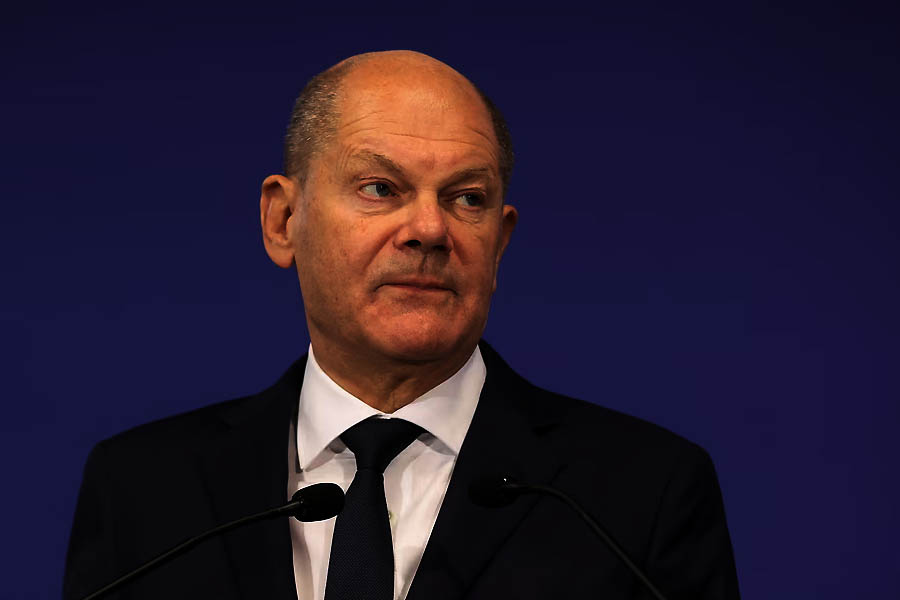
Olaf Scholz Loses Vote of Confidence: Early Elections in Germany — Coalition Collapse Triggers February 23 Vote
Berlin, Germany – German Chancellor Olaf Scholz has entered the history books, losing a pivotal vote of confidence in the Bundestag on Monday. This calculated political move signals the end of his fractious three-party "traffic light" coalition government and sets the stage for early national elections scheduled for February 23, 2025. Scholz, who remains as interim chancellor until a new government is formed, described the decision as a necessary step to restore political stability amid Germany's deepening economic and political turmoil.
The final tally: only 207 members of parliament voted in favor of Scholz, while 394 voted against, with 116 abstentions. The result was widely expected after Scholz deliberately engineered the loss by instructing his SPD and Green coalition partners to abstain, allowing the opposition CDU/CSU to deliver the decisive no votes. Following the outcome, Scholz immediately traveled to Bellevue Palace to ask President Frank-Walter Steinmeier to dissolve the Bundestag, triggering the 60-day countdown to new elections.
📉 The Fall of the Traffic Light Coalition
Scholz's "traffic light" coalition — comprising the center-left Social Democrats (SPD), the environmentalist Greens, and the pro-business Free Democrats (FDP) — collapsed last month following escalating disagreements over economic policy. The tipping point came on November 6 when Scholz dismissed Finance Minister Christian Lindner of the FDP, a move that fractured the coalition irreparably and left the government without a parliamentary majority.
The FDP's resistance to easing Germany's strict constitutional debt limits — the "debt brake" — to fund infrastructure, defense, and climate projects was at odds with Scholz's vision for modernizing the country. Lindner's insistence on fiscal austerity, even as Germany's economy contracted and the war in Ukraine strained defense budgets, created an unbridgeable gap. The FDP subsequently left the coalition, reducing the government to a minority administration.
"The coalition was no longer able to find consensus on the critical issues facing our nation," Scholz said in a statement after the confidence vote. "This path — asking the German people for a new mandate — is the right one for our democracy."
🗣️ A Defiant Address: 'Germany's Best Days Lie Ahead'
"This is about trust in our country. Germany's best days lie ahead, but we need unity and purpose to get there." — Chancellor Olaf Scholz
In a defiant address to the Bundestag before the vote, Scholz defended his record and laid out his vision for Germany's future, despite the imminent collapse of his government. He highlighted achievements including navigating the energy crisis following Russia's invasion of Ukraine, increasing military spending to 2% of GDP, and implementing the country's largest-ever climate investment package.
Scholz also criticized the FDP for prioritizing fiscal conservatism over coalition cohesion and national needs. "Politics is not a game," Scholz remarked, referring to Lindner's refusal to compromise on the debt brake. "It is about the future of 84 million people. When one partner refuses to negotiate in good faith, the coalition cannot continue."
The Chancellor acknowledged the deep challenges facing Germany: a second consecutive year of economic contraction, a migrant housing crisis, and uncertainty surrounding the war in Ukraine and potential shifts in U.S. policy under a second Trump presidency. "These are not normal times," Scholz said. "They demand clarity, not drift."
🏛️ Friedrich Merz and the Conservative Momentum
As the SPD struggles in the polls — currently trailing the opposition by 10-12 points — CDU/CSU leader Friedrich Merz emerges as the clear frontrunner to succeed Scholz as Chancellor. Merz, a 69-year-old corporate lawyer and former rival to Angela Merkel, has promised sweeping economic reforms, including delayed retirement incentives, corporate tax cuts to stimulate growth, and a freeze on new immigration regulations.
His campaign highlights Germany's rising cost of living, industrial decline, and migration policy as top issues. Merz has also called for a tougher stance on China and a more assertive German role within NATO and the EU. However, critics note that Merz has never held a cabinet position and lacks government experience, a vulnerability Scholz's SPD is likely to exploit.
"Germany needs a fresh start — less ideology, more pragmatism," Merz told supporters at a campaign rally in Munich. "We will revive our economy, secure our borders, and restore confidence in German leadership in Europe."
🔴 The Political Landscape: Fragmentation and Extremism
Germany's political system is grappling with unprecedented fragmentation. The rise of radical parties complicates coalition-building, with the far-right Alternative for Germany (AfD) now polling near 20% — double its 2021 result. However, the AfD will likely remain isolated, as no mainstream party — including the CDU — is willing to collaborate with it at the federal level, a policy known as the "firewall" (Brandmauer).
Adding to the uncertainty is the emergence of the far-left Sahra Wagenknecht Alliance (BSW), which split from Die Linke in late 2023. BSW, which combines left-wing economic policies with conservative stances on migration, is polling around 6-8% and could enter the Bundestag for the first time. This would further fragment an already crowded parliament, making stable coalition majorities harder to achieve.
A recent INSA poll shows: CDU/CSU (32%), AfD (19%), SPD (16%), Greens (14%), FDP (4%), BSW (7%), Left (3%). If these numbers hold, a "grand coalition" between CDU and SPD would be mathematically possible — but politically uncertain given the parties' bitter rivalry. A CDU-Greens coalition is also possible, though policy differences on climate and migration would be significant.
💰 Economic and Policy Paralysis
The prolonged political uncertainty has stalled critical economic initiatives, from inflation relief measures to industrial growth incentives. Germany's economy — Europe's largest — is expected to contract for the second consecutive year in 2024, with manufacturing particularly hard-hit by high energy costs and weak global demand. The automotive sector faces existential challenges from Chinese EV competition, while chemical giants like BASF have announced plant closures and layoffs.
Key policies awaiting cross-party agreement include: a €50 billion corporate tax relief package, reforms to the pension system, a new immigration law to address labor shortages in tech and healthcare, and a long-delayed overhaul of the electricity grid. However, such compromises remain elusive in a fractured Bundestag where the government no longer holds a majority.
"Every day without a functioning government is a day lost for German competitiveness," warned Siegfried Russwurm, president of the BDI industry federation. "Companies are postponing investment decisions. We need clarity — and soon."
⚖️ A Test for German Stability
"We must act swiftly to maintain Germany's tradition of stability and effective governance. The constitutional process is working, but we need a new government as quickly as possible." — President Frank-Walter Steinmeier
While the vote of confidence and subsequent early elections are constitutional mechanisms, the crisis evokes uncomfortable memories of the unstable Weimar Republic, which saw frequent government collapses in the 1920s and early 1930s. Modern Germany has prided itself on stability — only five chancellors since 1949 — making the current upheaval particularly unsettling for voters.
President Steinmeier, a former SPD politician, has signaled he will dissolve the Bundestag promptly, as requested by Scholz. However, he also reminded politicians of their responsibility: "The trust of citizens in democratic institutions is not guaranteed. It must be earned through responsible, transparent, and effective governance."
🔮 What Lies Ahead: A Crossroads for Europe's Largest Economy
As Germany braces for seven weeks of campaigning over the Christmas and New Year period — an unusual timing that has drawn criticism — the road ahead is fraught with challenges. The outcome will shape the nation's economic recovery, migration policies, climate transition, and European leadership. With global crises looming — including a potential trade war with a Trump-led United States, ongoing Russian aggression in Ukraine, and China's economic slowdown — the stakes have never been higher.
The February elections could usher in a new era of German politics — or deepen the fractures already threatening its stability. For the first time since World War II, a far-right party could become the second-largest in parliament. For the first time since reunification, a far-left party could also enter the Bundestag. Coalitions may require three or even four parties, a recipe for continued instability.
One thing is certain: the post-Scholz era will redefine Germany's path in the face of mounting internal and external pressures. And with a new American president taking office in January, Germany's next leader will be tested from day one.
Related Coverage: For more on European political developments, visit UK-Europe News Hub and German Politics Section.
Global Post Headline — independent coverage of European politics and global affairs. globalpostheadline.com | Follow updates: Europe News | Politics

Experience the Himalayas with expert Sherpa guides. Trekking, expeditions, and cultural tours in Nepal, Tibet & Bhutan.
Book Your Adventure →
Authentic Nepali crafts, pashmina, singing bowls — worldwide shipping.