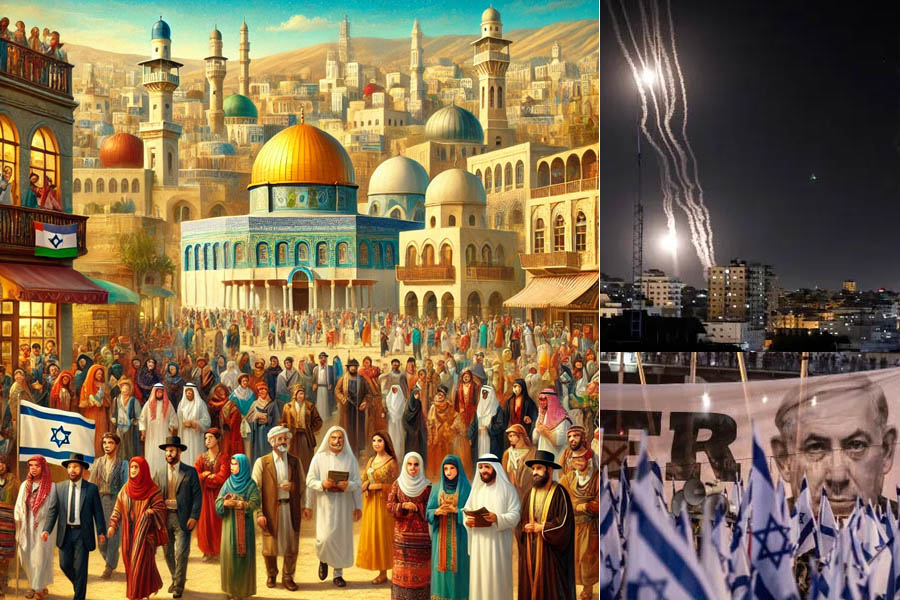
Israel and Middle East Unseen Future: Strategic Shifts and Regional Tensions — Golan Heights, Syria, and the New Power Dynamics
The Middle East is witnessing a dramatic shift in power dynamics, particularly in Israel's strategic positioning and its interactions with neighboring countries. Israel's presence along Syria's southern border is evolving, and the country's influence in the region continues to expand, despite facing growing challenges. As Israel strengthens its foothold in the Golan Heights, it is not just securing a military advantage but is also playing a crucial role in shaping the geopolitical future of the region. The collapse of Bashar al-Assad's regime in Syria — triggered by a stunning rebel offensive in December 2024 — has set the stage for a new era of strategic alliances, military posturing, and regional conflicts.
Israel's Expanding Presence on the Syrian Border: A Calculated Military Strategy
Israel's military presence in southern Syria, particularly its occupation of Mount Hermon (Jabal al-Shaykh), marks a significant shift. The region, which was once under Syrian control, is now seeing Israeli troops, infrastructure, and surveillance operations that have raised alarms internationally. The move is being presented by Israeli officials as a necessary step to protect national security, with concerns about the vacuum of power created by Assad's fall. The mountain peak provides Israel with a clear line of sight to strategic locations, including Damascus, and serves as a buffer against both Hezbollah and Syrian rebel forces. Israeli forces have established observation posts and electronic surveillance systems on the mountain, potentially providing intelligence advantages over multiple adversaries.
Local reactions have been mixed, with some residents fleeing the area due to fears of Israeli military operations. Despite these concerns, Israel has defended its actions as a temporary and defensive measure, positioning itself against the growing threat of Islamist militias, including those with ties to ISIS and al-Qaeda. As Israeli troops expand beyond the established buffer zone, tensions are rising both in Syria and internationally, with the UN and regional powers condemning the partial annexation of the Golan Heights — a territory Israel captured from Syria in 1967 and unilaterally annexed in 1981, a move not recognized internationally.
The Turkey-Israel Rivalry: A Complex Dance of Interests
While Israel's actions along the Syrian border are a direct response to local instability, they also have broader implications for regional power dynamics. Turkey, which has been actively involved in Syria, sees Israel's growing influence as a challenge to its own ambitions. President Recep Tayyip Erdoğan's vision for a Turkish-led sphere of influence in the region places Turkey in direct competition with Israel, particularly as both countries aim to limit Iranian power in Syria. However, despite their rivalry, both nations share an interest in preventing Iranian expansion in the region. This mutual concern could lead to a shift in alliances as Turkey and Israel navigate their diverging interests. While an outright military confrontation remains unlikely, the strategic and ideological differences between the two nations will continue to shape the region's future.
The Broader Impact on Syria's Fragile State and Israel's Position
Syria's fragmentation following Assad's collapse has created an unstable environment where multiple factions are vying for control. The rise of Islamist militias, many of which have ties to terrorist organizations, is a significant concern for Israel, especially as these groups could spill over into neighboring countries. Hezbollah's presence in Lebanon also adds another layer of complexity, as it continues to pose a direct threat to Israeli security. Israel's growing presence in the Golan Heights, its strategic partnerships with Kurdish forces, and its surveillance capabilities are all part of a broader strategy to mitigate these risks. The country is focused on fortifying its borders against potential attacks from multiple fronts, particularly as the Syrian conflict continues to evolve.
Gaza, Yemen, and Beyond: Israel's Regional Role in Flux
While Israel's military activities in Syria remain at the forefront, its involvement in other regional conflicts is equally significant. The ongoing violence in Gaza, where Israel's airstrikes continue to target Hamas, has escalated to tragic levels with over 45,000 Palestinian deaths since October 2023. The situation has become a humanitarian crisis, with human rights organizations accusing Israel of war crimes. At the same time, Israel is extending its reach to Yemen, where it has conducted airstrikes against Houthi targets in response to missile launches aimed at Israeli territory — part of the Houthis' solidarity campaign with Gaza. This escalation underscores the growing regional implications of Israel's military actions. The Houthis, backed by Iran, have pledged their solidarity with Palestinians, further complicating Israel's position as it faces increasing threats on multiple fronts — Gaza, Lebanon, Syria, Yemen, and the West Bank.
A Changing Middle East: Israel's Path Forward
The future of the Middle East is uncertain, and Israel's role in shaping that future is becoming ever more crucial. As it navigates a volatile region, Israel's decisions will not only affect its national security but also influence the balance of power in the wider Middle East. The complex interactions with Syria, Iran, Turkey, and other regional players are setting the stage for a new geopolitical reality. Israel's strategy of preemptive military actions, territorial expansion, and regional alliances may offer short-term security benefits, but it also risks exacerbating existing tensions and creating new conflicts. The coming years will likely see Israel at the center of regional debates, with its military actions in Syria and Gaza serving as critical flashpoints. In this rapidly evolving landscape, one thing is clear: the Middle East's future is being shaped by a delicate and often dangerous balance of power.
Related Coverage: For ongoing updates on the Middle East crisis, visit our Middle East Breaking News page and Israel-Gaza War Hub.
Global Post Headline — independent Middle East geopolitical coverage. globalpostheadline.com | Follow live: middle-east-breaking.php